
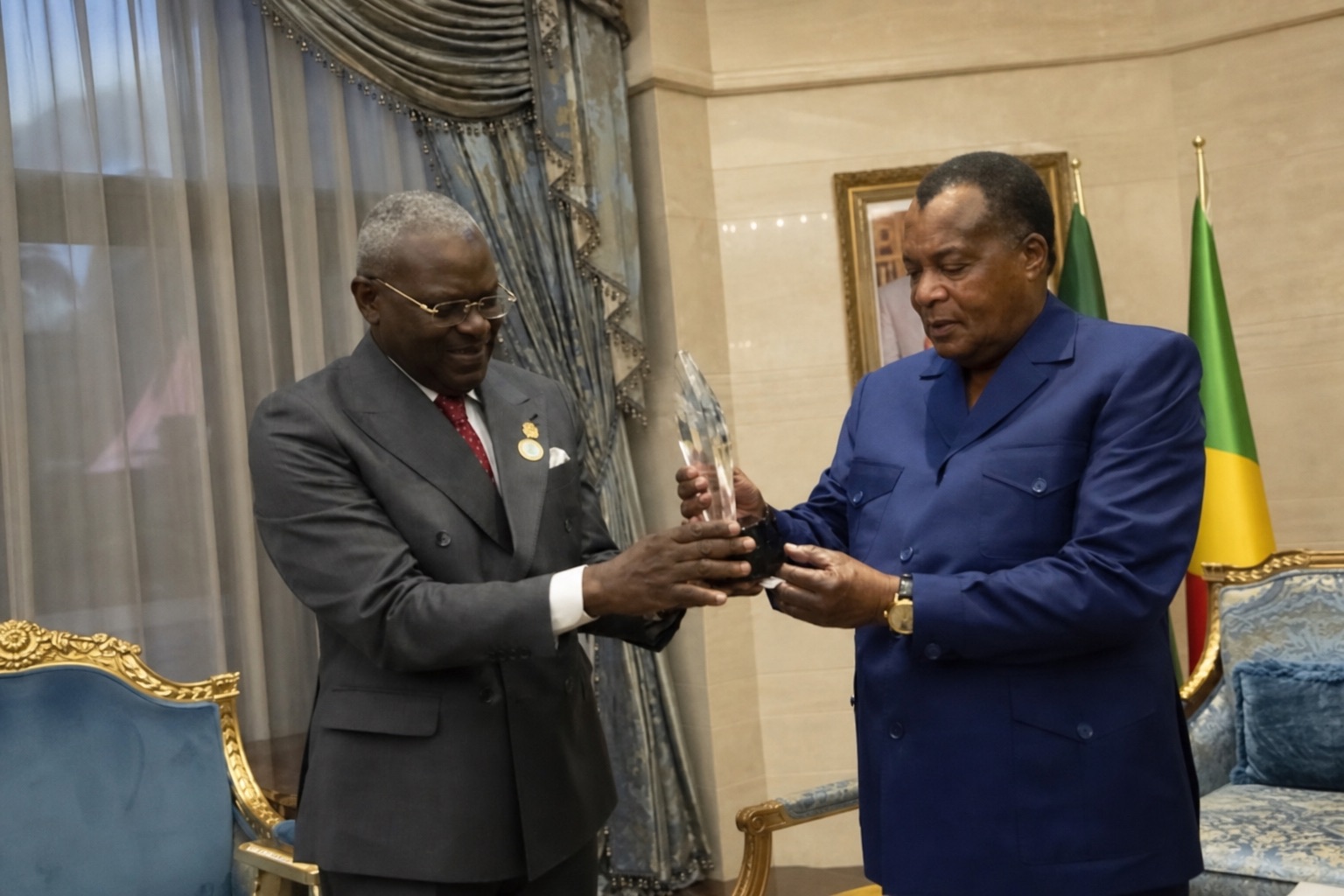
A continental honour bearing the name of a financier who reshaped Africa’s development architecture has come to rest on the shoulders of Congo-Brazzaville’s head of state. In a ceremony held in the Congolese capital, President Denis Sassou-N’Guesso received the Babacar Ndiaye Prize, a distinction reserved for African figures judged to have made a meaningful contribution to the economic, social and infrastructural advancement of the continent.
A Distinction Rooted in Africa’s Financial Memory
The prize carries weight precisely because of the man it commemorates. Babacar Ndiaye, the Senegalese economist who presided over the African Development Bank (AfDB), is remembered as one of the architects of a more ambitious vision for continental financing. The award that bears his name is conceived as an extension of that legacy, singling out initiatives that drive the durable transformation of African economies and the tangible improvement of living conditions for ordinary citizens.
To receive a distinction tied to such a figure is, in itself, a form of editorial commentary on a leader’s record. The organisers framed the honour not as a ceremonial courtesy but as an acknowledgement of sustained engagement with the structural questions that have long preoccupied African policymakers: connectivity, integration, and the slow, often unglamorous work of building the physical scaffolding on which economies depend.
Infrastructure and Integration at the Heart of the Recognition
According to the framing offered at the ceremony, the award reflects the efforts undertaken by Congo under Sassou-N’Guesso’s leadership in the modernisation of infrastructure, the promotion of regional cooperation and the reinforcement of African integration. These three threads are not incidental to the citation; they are its substance.
Infrastructure has occupied a central place in the developmental discourse of Central Africa, where the gap between resource wealth and physical connectivity remains one of the region’s most persistent constraints. By foregrounding modernisation, the prize implicitly situates Congo-Brazzaville within a broader conversation about how the continent might close that gap. Regional cooperation, the second pillar invoked, speaks to the dense web of cross-border dependencies that define Central Africa, where no single state can build prosperity in isolation.
The third element, African integration, carries a longer historical resonance. It evokes the aspiration, repeatedly articulated across decades of pan-African deliberation, that the continent’s fragmented markets and divided infrastructures might one day be knitted into something more coherent. To honour a leader under this banner is to read his record as part of that unfinished project rather than as a purely national accomplishment.
Voices of Endorsement at the Ceremony
The event was not a silent affair. Several speakers took the floor to commend the vision of the Congolese head of state and to underline what they presented as his consistent involvement in the major structuring projects designed to strengthen connectivity and the development of the continent. The repeated emphasis on structuring projects is telling: in the lexicon of development financing, these are precisely the large-scale undertakings that institutions such as the AfDB were created to support, and the prize draws a deliberate line between that institutional mission and the figure being honoured.
The praise offered during the ceremony should be read with the awareness that such occasions are, by design, celebratory. Yet the choice of vocabulary, centred on vision, involvement and continental ambition, points to the criteria the prize seeks to reward rather than to spontaneous acclaim. The distinction is constructed around a particular narrative of leadership, one in which the individual is positioned as a custodian of long-term developmental goals rather than a manager of short-term political cycles.
What the Honour Signals Beyond Brazzaville
Awards of this nature operate on two registers at once. On the surface, they recognise an individual; beneath it, they make a claim about priorities. By tying its citation to economic, social and infrastructural development, the Babacar Ndiaye Prize reaffirms a set of values that continue to dominate the African policy agenda, even as the means of achieving them remain contested.
For Congo-Brazzaville, the recognition lands at the intersection of national ambition and continental expectation. It frames the country’s trajectory in terms that extend beyond its borders, anchoring its story to the wider effort to transform African economies in a sustainable way. Whether such honours translate into measurable change is a question that no ceremony can answer; what they do, unmistakably, is articulate the standard against which leadership is being measured.
In honouring Sassou-N’Guesso with a prize named for one of the African Development Bank’s most consequential stewards, the organisers have placed Congo’s developmental narrative within a lineage of continental ambition, inviting reflection on how far that ambition has travelled and how much road remains.
