
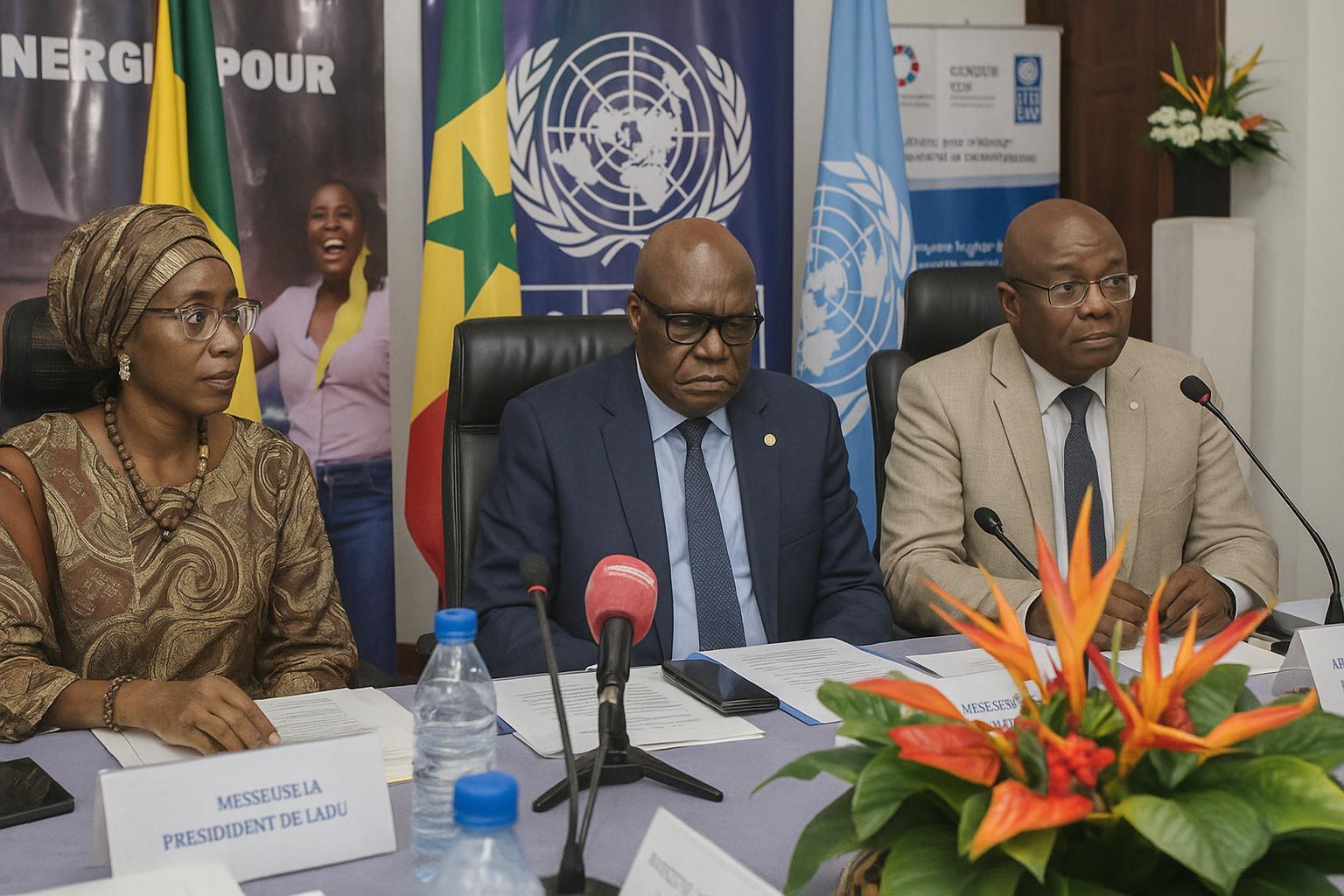
Brazzaville Pitches a New Energy Pact
The polished wooden panels of the United Nations Development Programme headquarters in Brazzaville rarely echo with the urgency that filled the room on 5 September, when Minister of Energy and Hydraulics Emile Ouosso unveiled the Programme for Rural Electrification Zones, known by its French acronym PEZor. Flanked by diplomats and investment officers clutching thick dossiers, the minister advanced a simple yet ambitious proposition: back a US$373.4 million initiative that could redraw the energy map of the Republic of Congo and underwrite its industrial aspirations.
The minister spoke of a pact rather than a mere infrastructure plan, inviting what he called “a fraternity of technical and financial partners” to join a long-term commitment. Early endorsements came from familiar allies—the Global Environment Facility, the British government through the Mattei Plan, and ongoing discussions with the European Union, the African Development Bank, the Agence française de développement and the World Bank—yet the project’s financing gap remains conspicuous.
A Dual Technology Blueprint: Water and Sun
PEZor is structured around two complementary pillars. The first exploits the country’s generous hydrological endowment: nineteen micro-hydroelectric sites ranging from 31 kW to 5 MW, together with the rehabilitation of five existing dams. The second leverages Congo’s solar radiation, calling for 257 photovoltaic mini-plants and nearly two thousand street-lighting units across fifty-eight districts. Together they promise to weave a 243-kilometre distribution network that would, on completion, light up once-isolated communities and stimulate local economies.
The government-UNDP team have selected three locations—Lébama, Itsibou and Foula—as a pilot spine for the scheme. Their combined potential of just over 30 MW will, if all milestones are met, channel power by 2030 to key mining clusters at Zanaga and Mayoko and to the towns of Mossendjo, Komono, Yaya, Moutamba and Lefoutou. By the ministry’s calculation, at least 40 000 residents and two large extractive sites would benefit from reliable supply in the project’s first wave.
Financing the Pilot: A Test of Conviction
The numbers are precise and sobering. The pilot mini-grid commands an estimated 87.13 billion CFA francs: 65.6 billion for powerhouses, 14.9 billion for medium-voltage lines, 5.8 billion for intra-village distribution and 779 million for technical studies. In a country where public budgets must juggle post-pandemic recovery and infrastructure backlogs, the search for concessional loans and blended finance is, in the minister’s words, “not an option but a necessity.”
Officials are confident that the project’s modular design can seduce investors who, in the past, were deterred by the hefty upfront costs of conventional grid extensions. Each micro-hydro station and solar farm is configured as a revenue centre with ring-fenced maintenance funds, a structure that aims to reassure lenders of predictable cash flows even amid fluctuating commodity cycles.
Addressing Congo’s Electrification Gap
Behind the technical jargon lies a stark reality. National utility E²C lists 494 313 formal household connections, translating into an overall electricity access rate of 32 percent. Urban access reaches 39 percent, yet rural coverage hovers around 1 percent—barely 10 percent even if informal hook-ups are included. The imbalance, Minister Ouosso argued, hampers not only household welfare but also the maturation of industrial parks and mining concessions vital to fiscal diversification.
By stitching together mini-grids rather than waiting for a distant transmission backbone, PEZor seeks to reverse that paradigm. The model reflects a growing continental consensus that decentralised generation, once considered a stopgap, can become a permanent fixture of modern power systems.
UNDP’s Stamp of Confidence
Resident Representative Adama Dian Barry struck a note of optimism during the Brazzaville luncheon, praising what she called “the government’s strategic patience and the United Nations family’s shared sense of purpose.” She likened the initiative to a voyage toward “a future Congo illuminated by its own cascading waters,” a metaphor that garnered polite applause and discreet scribbling from donor representatives.
UNDP involvement extends beyond public relations. The agency co-drafted feasibility studies, is curating the social-environmental safeguards and stands ready to channel grant components that could soften loan envelopes. Observers in the room noted that such UN stewardship often acts as a signal of project bankability, lowering due-diligence costs for bilaterals wary of sovereign risk.
Economic Multiplier and Climate Alignment
Rural electrification has rarely been just about light bulbs. In government briefs, PEZor is tagged as an enabler of agricultural processing, digital inclusion and educational attainment. The Lébama micro-grid, for instance, is projected to power cold-storage hubs for timber and cassava, enhancing export compliance while reducing post-harvest losses. Nearby clinics anticipate refrigerated vaccine storage and tele-medicine terminals, modest yet transformative leaps in public health outcomes.
The programme dovetails with Congo’s Nationally Determined Contribution under the Paris Agreement, pledging expanded renewable capacity and reduced diesel generation in remote outposts. Analysts suggest this alignment could unlock climate finance windows, widening the pool of concessional lenders beyond traditional development banks.
Challenges in the Last Mile
Still, success will depend on more than turbines and panels. Community engagement, tariff design and technical training for local cooperatives register high on the risk matrix. Previous mini-grid experiments in Central Africa stumbled over low collection rates and equipment vandalism once donor supervision faded. To avert repetition, the Congolese authorities have embedded capacity-building tranches into each contract, obliging contractors to mentor village technicians who will ultimately assume operational stewardship.
Moreover, an independent energy regulator is slated to table guidelines on mini-grid interconnection and tariff harmonisation, ensuring that decentralised assets can one day feed into the national network without disruptive renegotiations.
Signals to the Investment Community
For Brazzaville, PEZor doubles as a litmus test of investor sentiment. The administration of President Denis Sassou Nguesso has singled out energy infrastructure as a catalyst for the new National Development Plan, and early traction for the rural scheme would lend credibility to broader industrial targets. In that sense, the 5 September presentation was as much about optics as about engineering—demonstrating governance resolve and transparency to prospective financiers.
Some bankers privately concede that the presence of export-oriented mining off-takers strengthens the project’s commercial logic, offering hard-currency revenue streams against which loans can be hedged. Others caution that coordination with regional power pools, particularly within CEMAC, will be crucial to balance seasonal hydro variability.
A Measured Path Toward a Brighter Horizon
Judged by the figures alone, PEZor may appear modest compared with grand dams elsewhere on the continent. Yet its hybrid architecture, climate credentials and focus on last-mile delivery position it as a potential game changer for communities long left on the fringe of national planning. Minister Ouosso concluded his appeal with understated conviction: “Electricity is development’s alphabet; without it, the vocabulary of progress remains incomplete.”
Whether donors will translate that metaphor into signed cheques will become clearer over the coming quarters. For now, the spotlight remains on Congo’s ability to orchestrate a symphony of water, sun, finance and governance into a coherent rural power gamble—one whose success could illuminate not only villages but the country’s wider economic horizon.
