
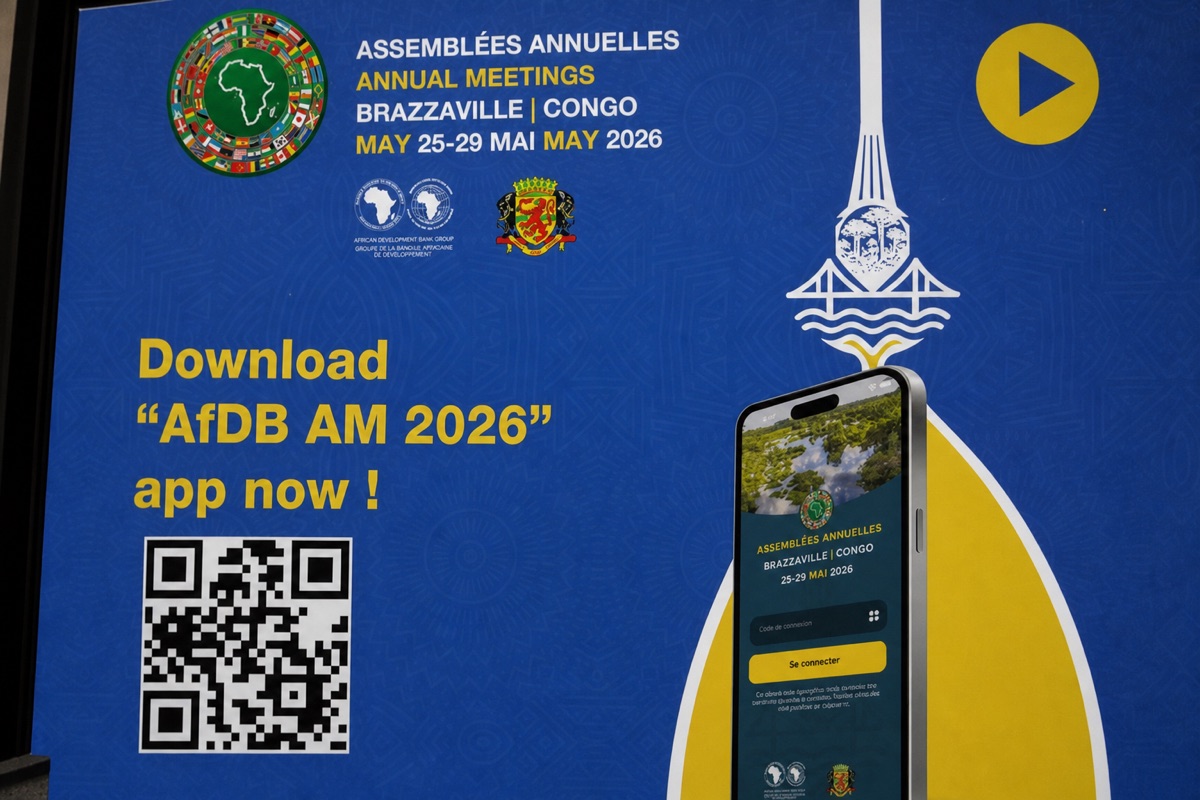
For five days in late May, the Congolese capital became the nerve centre of African development finance, as the African Development Bank brought its most senior decision-makers to the banks of the Congo River. The 61st Annual Meetings of the African Development Bank (AfDB), convened in Brazzaville from 25 to 29 May 2026 alongside the 52nd session of the Board of Governors of the African Development Fund, drew an unusually wide constituency at a moment when the architecture of global aid is visibly under strain.
A Continental Gathering Under New Leadership
The Brazzaville sessions marked one of the first major outings for the Bank’s new president, Dr Sidi Ould Tah, who succeeded Nigeria’s Akinwumi Adesina at the helm of the continent’s premier multilateral lender. The transition gave the meetings an air of inflection: a new stewardship inheriting both the institutional momentum of the Adesina years and a far less forgiving external environment.
More than 3,000 participants converged on the Congolese capital, a figure that underscores the Bank’s convening power even as the resources it marshals come under pressure. Among them were heads of state and government, finance ministers and central bank governors drawn from the institution’s 81 member nations. The guest list extended well beyond officialdom to encompass development finance executives, think-tank analysts, civil society representatives and private sector leaders, a composition that signalled the Bank’s intent to treat development as a question for the whole of society rather than the preserve of treasuries alone.
Mobilising Resources in a Fragmented World
The governing theme of the assemblies, the mobilisation of resources for African development in a fragmented world, was less a slogan than a candid acknowledgement of the headwinds the continent now faces. Chief among the difficulties debated in Brazzaville was the contraction of official development assistance, a trend that has forced African finance officials to reconsider how transformative projects are to be paid for when traditional donors are retreating.
That preoccupation framed much of the technical agenda. Delegates reviewed the year’s progress and examined the implementation of the Bank’s four strategic development pillars, the framework that organises its lending and policy priorities. The discussions were, by design, as much about method as about money: how to make scarce capital work harder, and how to draw private finance into projects that public balance sheets can no longer underwrite alone.
A New Vehicle for Infrastructure
Among the more concrete proposals to emerge was the contemplated creation of a dedicated infrastructure financing bank. The arrangement envisaged a division of labour whereby regional development banks would take charge of smaller, locally rooted projects, leaving the AfDB free to concentrate its firepower on continental initiatives of a genuinely transformative scale. If carried through, such a structure would represent a meaningful recalibration of how the Bank allocates effort across the spectrum of African infrastructure needs, from the modest to the monumental.
The logic is consistent with a wider shift in development thinking, in which multilateral lenders increasingly position themselves as catalysts and coordinators rather than sole financiers. For a continent whose infrastructure deficit remains one of the principal brakes on growth, the question of who builds what, and with whose money, is far from academic.
Brazzaville’s Stake in the Conversation
For the host nation, the meetings offered both a stage and an agenda. The Congolese minister of the economy, Ludovic Ngatsé, presiding over the Board, used his platform to align national ambitions with the continental conversation. The priority, he argued, was to “build resilient and sustainable transport and energy infrastructure to promote African integration” (Ludovic Ngatsé), a formulation that placed Brazzaville’s own development needs squarely within the broader project of knitting African economies together.
The emphasis on integration carries particular resonance in Central Africa, where connectivity gaps have long constrained intra-regional trade. Hosting the assemblies allowed Congo-Brazzaville to press the case that physical infrastructure is the precondition for the deeper economic union the continent professes to seek.
Growth Prospects and Uneven Terrain
The deliberations unfolded against a backdrop of cautious optimism about Africa’s trajectory. Growth projections presented at earlier assemblies had indicated that the continent would outpace global averages through 2026, though the picture remained markedly uneven across regions. East Africa was expected to lead at 5.9 percent, followed by West Africa at 4.3 percent, Central Africa at 3.2 percent and Southern Africa at 2.2 percent.
Those disparities are a reminder that the continent’s promise is unevenly distributed, and that the financing decisions taken in forums such as Brazzaville will help determine whether the laggards catch up or fall further behind. In that sense, the 61st Annual Meetings were not merely a ceremonial gathering but a working attempt to chart a credible course through a more austere and fragmented era of development finance.
