
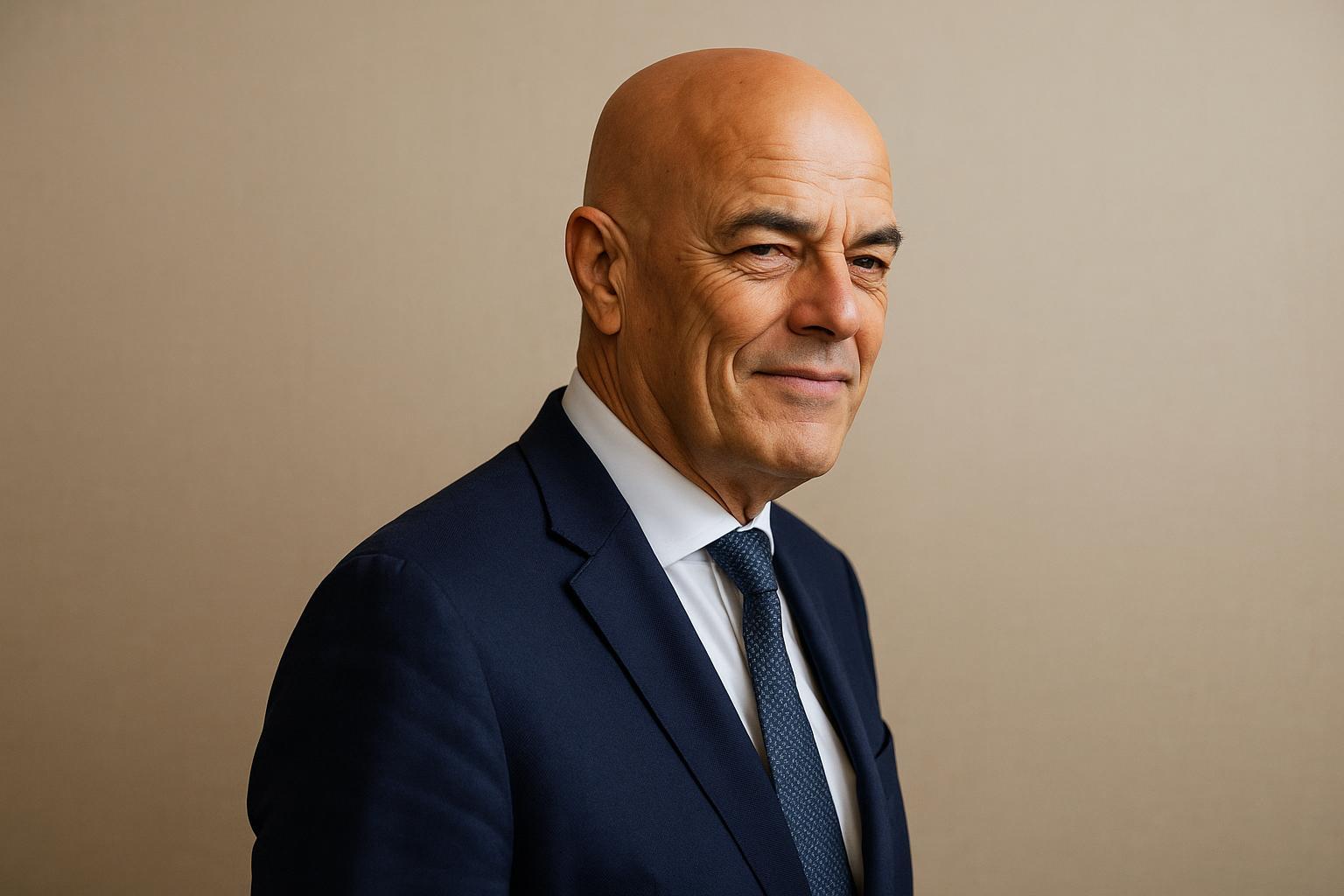
An Italian Visionary Betting on African Gas
Few energy executives have woven their corporate destiny as tightly into Africa’s resource landscape as Claudio Descalzi. Since taking Eni’s helm in 2014, the Milan-born physicist has channelled successive investment cycles toward African hydrocarbons, arguing that the continent’s vast reserves of low-cost, low-carbon gas constitute a strategic linchpin for both local development and European security. His stance acquired heightened relevance after the 2022 disruption of Russian supplies, when Descalzi urged Brussels to pivot decisively toward African molecules rather than re-embracing coal or delaying climate commitments. The message resonated: Rome rapidly replaced around two-thirds of its Russian intake with new contracts from Algeria, Egypt and Congo, confirming Eni’s role as first mover.
Congo LNG and Brazzaville’s Energy Ambitions
Nowhere is the Descalzi doctrine more visible than in the Republic of Congo, where the US$5-billion Congo LNG development translates ministerial ambitions for gas monetisation into steel and concrete. The project’s first floating liquefaction unit, Tango FLNG, shipped its inaugural cargo in December 2023, while the larger Nguya FLNG is scheduled for commissioning before year’s end, lifting combined capacity to 3 million tonnes per annum. By valorising associated gas that had long been flared or reinjected, the partnership with Société Nationale des Pétroles du Congo converts an environmental liability into an export commodity and domestic power feedstock, aligning neatly with Brazzaville’s target of universal electricity access by 2030. Government officials underline the broader macroeconomic dividend: royalties, local employment and a reinforced reputation as a stable hydrocarbons jurisdiction.
Egypt, Algeria and Libya: Pillars of an Africa–Europe Bridge
The Congolese scheme is part of a wider North–South corridor championed by Descalzi. In Egypt, Eni’s 2015 discovery of Zohr unlocked 850 billion cubic metres of gas, transforming Cairo from importer to net exporter within five years. Farther west, Algerian production underpins Italy’s TransMed pipeline, while Libya’s onshore restart in early 2024—after a decade of conflict-driven hiatus—signals cautious optimism about east-Mediterranean stability. Nearly US$9 billion earmarked for the Maghreb over the next four years will buttress both African revenue streams and Europe’s diversification agenda. Descalzi presents the network as a contemporary ‘Piano Mattei’, evoking the post-war strategy that once secured crude for Italy’s industrial miracle.
Social Return on Investment
Beyond barrels and molecules, Eni’s footprint carries a deliberate social accent. Under Descalzi’s directive, country managers allocate a fixed share of capital expenditure to initiatives spanning public health, vocational training and women’s empowerment. A flagship clean-cooking programme launched in Angola in 2024 already benefits half a million residents and targets two million within three years, mitigating deforestation and indoor air pollution. Similar schemes accompany LNG expansion in Pointe-Noire, where locally manufactured stoves and cylinder logistics create micro-enterprises for youth cooperatives. Congolese civil servants involved in the project praise the ‘partnership mind-set’ that aligns with the government’s Plan national de développement, rather than imposing parallel structures.
Charting a Low-Carbon Path
Descalzi insists that Africa’s gas story can coexist with climate imperatives if producers deploy best-in-class mitigation tools. Eni’s exploration portfolio now integrates satellite methane detection, zero-routine flaring targets and renewable power back-up for offshore units. The Baleine field in Côte d’Ivoire, brought online a record nineteen months after discovery, claims Scope 1 and 2 carbon neutrality through re-injection of associated gas and certified offsets. In Angola, the Agogo FPSO is designed to achieve ‘carbon-neutral operations’ once full electrification is complete. Congo LNG follows the same template, with Joint Implementation projects under discussion to sequester mangrove carbon along the Kouilou coastline.
Diplomacy through Presence
A distinctive element of Descalzi’s leadership is physical proximity. Unlike peers who delegate regional engagement, he schedules regular field visits, holding succinct but substantive dialogues with presidents, community elders and university students alike. During his September 2025 stop in Brazzaville, he joined President Denis Sassou Nguesso at a vocational institute funded by Eni where trainees calibrate subsea valves on replicas of FLNG modules. ‘Technical mastery and national pride must advance together,’ he remarked, underscoring a philosophy that places capacity-building on equal footing with profitability.
À retenir
Congo LNG’s two-train model illustrates how associated gas can underpin fiscal receipts, industrial electrification and climate progress simultaneously. Descalzi’s Africa strategy hinges on pragmatic partnerships with sovereign hosts, patient capital deployment and a portfolio blending hydrocarbons with renewables—an approach that increasingly shapes Europe’s resilience discussion.
Le point juridique/éco
From a regulatory standpoint, Congo’s 2016 Hydrocarbons Code provides a 10-year stability clause and graduated royalty scale, conditions that Eni cites as instrumental to final investment decision. Multilateral lenders view such clarity as a model for the Gulf of Guinea, although regional experts caution that timely fiscal audits and transparent revenue allocation will remain decisive for sustaining investor confidence amid evolving ESG benchmarks.
