
A Literary Crown Forged in Grammar
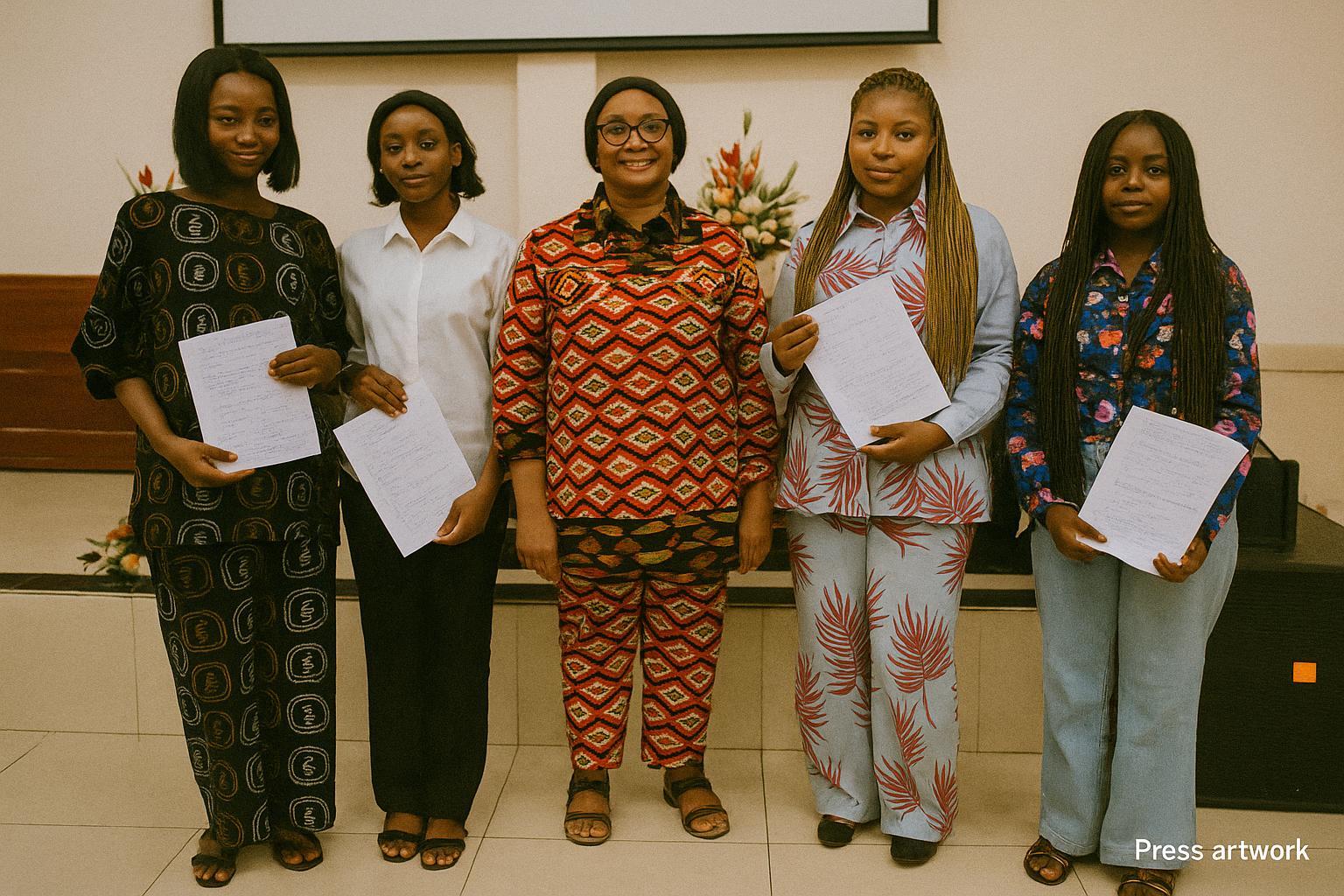
Inside the wood-panelled conference hall of Marien-Ngouabi University’s rectorate, the atmosphere on 31 July felt closer to an academic summit than to a conventional beauty pageant. Forty finalists had already navigated rigorous tests in syntax, orthography and conjugation; only four—Christ Nourra Ntsoumou-Ntounou, Bénie Riche Aimervia Elenga, Théodorat Hilary Makambala-Ndeke and Nicie Michelle Amora Mviri—emerged with the coveted sashes of Miss Mayele 2025. The competition, whose Lingala name means “ingenuity”, was conceived in 2021 to restore confidence in written French at a moment when digital shorthand imperils formal registers even within universities (Les Dépêches de Brazzaville, 2 Aug. 2023).
Governmental and Academic Synergies
The event carries weight because it operates at the confluence of national policy and grassroots activism. Professor Sylvia Djouob, a Congolese linguist who lectures in both Brazzaville and Lyon, reminded the auditorium that “grammar and orthography are the two legs of the French language; neglect either and the body collapses.” Her project has drawn logistical support from the Ministry of Higher Education and the presidential programme for the promotion of excellence, reflecting President Denis Sassou Nguesso’s stated aim of turning language into a lever for socio-economic inclusion. That alignment has unlocked sponsorship from local publishers as well as the Agence universitaire de la Francophonie, an organisation keen to bolster the Republic of Congo’s 80 percent French-proficient youth cohort (AUF briefing, 2024).
Empowering Women through Linguistic Capital
Miss Mayele is intentionally gender-specific. Female university enrolment in Congo-Brazzaville rose from 38 percent in 2010 to 46 percent in 2022, but attrition rates remain high, according to the UNESCO Institute for Statistics. By rewarding academic rigour with public recognition rather than with ephemeral glamour, the contest seeks to recalibrate societal perceptions of success. “It takes only thirty minutes a day to write properly,” laureate Makambala-Ndeke told journalists, dedicating her award to her father who introduced her to Victor Hugo. Such testimonials resonate with policy makers who view literacy not merely as a classroom skill but as a passport to civil-service recruitment and multinational employment.
Soft Power Calculus in the Francophone Arena
Brazzaville’s stake in French-language stewardship has a diplomatic dimension. The Republic of Congo will host a ministerial retreat of the Organisation internationale de la Francophonie next spring; showcasing an articulate, women-led intellectual elite strengthens national branding ahead of that rendezvous. As one adviser in the Ministry of Foreign Affairs noted, “Every spelling bee is a micro-summit; it projects an image of order, discipline and cultural continuity.” In an era where Anglophone influence is surging across the Gulf of Guinea, the symbolism of citizens who can parse the imperfect subjunctive is not trivial.
From Classroom to Policy Laboratory
Observers also discern in Miss Mayele a pilot model for competency-based reforms envisaged by the Education Sector Plan 2024-2028, drafted in consultation with the World Bank. The contest’s assessment rubric—objective scoring, public feedback, remedial workshops—mirrors standards that might soon permeate secondary curricula. Professor Djouob announced during the ceremony that the four laureates will mentor lycée pupils during outreach tours in Pool and Cuvette, thereby multiplying impact without significant fiscal burden.
A Measured Triumph with Regional Echoes
Critics of competitive academic events sometimes argue that prizes are symbolic rather than transformative. Yet even modest rewards—book vouchers and stipends—have tangible consequences in a context where the average student textbook allocation remains below two volumes per capita (Education Ministry figures, 2023). More importantly, the narrative of young women excelling in language mastery travels quickly across social media and sub-regional press, offering a counterpoint to portrayals of Central Africa focused on security challenges. The Republic of Congo is thereby quietly leveraging what Joseph Nye termed “soft power”, engrossing audiences through cultural attraction rather than coercion.
Looking Forward
As the hall emptied, Professor Djouob closed with an invocation to continuity: “What I do for you is what others once did for me; the struggle endures.” Her words capture the contest’s dual identity as both ceremony and strategy. By entwining linguistic precision with gender advancement and statecraft, Miss Mayele offers Brazzaville an elegant instrument for domestic cohesion and international visibility. Whether future editions replicate this alchemy will depend less on the size of the prizes than on the persistence of the daily writing habit the four laureates now personify.
