
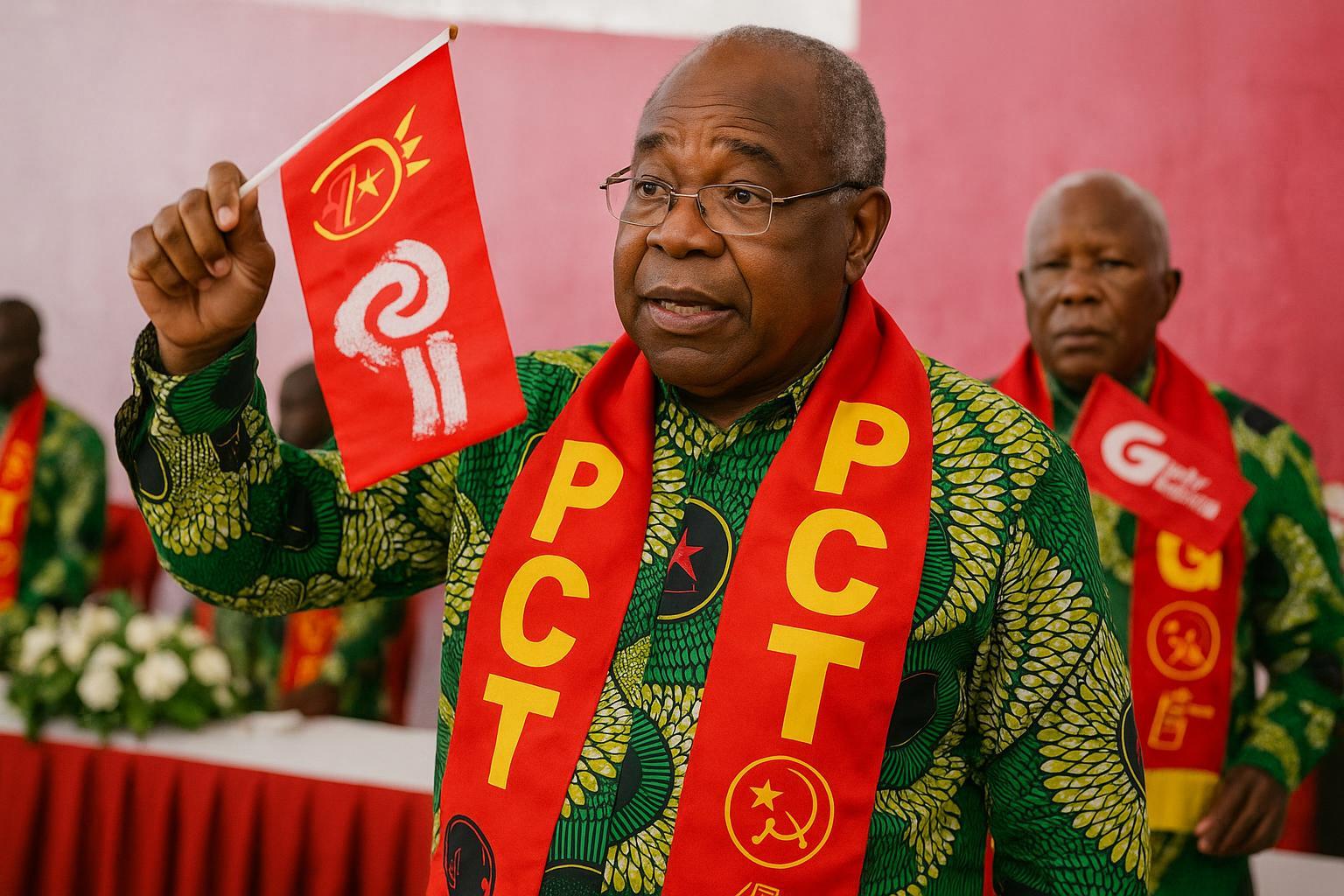
A Dawn Announcement at Jardins Ben’tsi
Shortly after daybreak on 1 January 2026, the crackle of loudspeakers pierced the humid Brazzaville air to deliver the news that many militants of the Parti congolais du travail had awaited all night. Inside the Jardins Ben’tsi, delegates emerging from a dusk-to-dawn session of the 6th Ordinary Congress applauded as the presidium confirmed Pierre Moussa for a second five-year term as Secretary General, easing a suspense that had prolonged deliberations beyond the scheduled 30 December adjournment. Observers noted that the political veterans remained on the congress floor through Saint-Sylvestre, sacrificing personal celebrations to settle the delicate issue of party leadership, a gesture the Secretariat hailed as “proof of disciplined militancy”.
The conclave’s marathon character betrayed the intensity of internal negotiations. Competing regional caucuses and allied formations had pressed contrasting visions for renewal, but the compromise emerged at sunrise: continuity through experience. By midday the congress adopted an accompanying resolution tasking Moussa with accelerating the modernisation of party structures and deepening alliances across the presidential majority (Les Dépêches de Brazzaville, 2 Jan 2026).
Consensus Through Continuity
Political analysts in Brazzaville perceive the reappointment as a calibrated signal from President Denis Sassou Nguesso, who retains the honorary presidency of the party. By extending the mandate of one of his longest-serving collaborators, the head of state underlines a strategic preference for seasoned hands familiar with the intricacies of coalition management over untested generational experiments. “Stability remains a central prerequisite for the implementation of our national development plan,” a senior executive bureau member remarked, requesting anonymity so as to speak freely.
The choice is also a nod to Moussa’s discreet yet consensual leadership style. During his first term, the octogenarian technocrat steered the PCT through contentious municipal and legislative contests without major defections. His penchant for behind-the-scenes conciliation, cultivated during decades in economic planning, appears to have reassured factions wary of abrupt change. Commenting on Radio Congo, political scientist Irène Malonga stressed that “continuity does not preclude adaptation; it buys the party time to reform methodically ahead of the 2027 legislative rendez-vous.”
Four Decades at the Epicentre of Planning
Pierre Moussa’s curriculum vitae reads like a chronology of Congo-Brazzaville’s post-independence economic architecture. Catapulted onto the national stage in 1978 as Secretary of State for Planning, he became, a year later, Minister of Plan under the newly installed President Sassou Nguesso. Over successive reshuffles, he added Finance, Economy and later Territorial Planning to his responsibilities, weaving a reputation for rigorous arithmetic blended with understated political loyalty.
His legislative legitimacy is equally robust. Elected in 2002 in Owando with 54.53 percent of the vote and re-elected in 2007 with a near-plebiscitary score of 99.94 percent, Moussa maintained a symbolic presence in parliament while entrusting day-to-day duties to a substitute, in accordance with constitutional provisions. Throughout, he carried the brief for regional integration, championing Congo’s participation in NEPAD and early continental infrastructure projects. “He represents institutional memory at a moment when many parties across the continent are grappling with abrupt leadership transitions,” notes Central Africa analyst Marius Okoumba (ADIAC, 3 Jan 2026).
Lessons from the CEMAC Years
Moussa’s five-year tenure at the helm of the Central African Economic and Monetary Community Commission from 2012 to 2017 is frequently cited as the crucible in which he refined his aptitude for quiet consensus-building. Operating from Bangui during a turbulent period marked by regional security strains, he shepherded the adoption of a collective economic programme that kept the franc-CFA zone on a path of cautious fiscal convergence. A Cameroonian diplomat who served on the commission recalls that “Chairman Moussa rarely raised his voice, yet he emerged from each meeting with a signed communiqué—an art scarcely visible but highly efficient.”
Returning to Brazzaville after the statutory rotation gave the chair to Gabon in 2017, he resumed advisory functions at the Presidency before being tapped, two years later, to replace Pierre Ngolo at the top of the party apparatus. That cyclical movement between national and regional responsibilities has burnished his profile as a statesman able to navigate both domestic imperatives and supranational constraints.
Strategic Tasks for a Second Term
With the internal leadership question settled, eyes now turn to the agenda awaiting the renewed Secretary General. Foremost is the imperative to cement party unity ahead of the presidential majority’s conventions, where the coalition’s candidate for the 2029 poll will emerge. Insiders argue that Moussa’s immediate challenge is to harmonise the demands of youthful cadres pressing for more digital mobilisation with the expectations of elder militants steeped in historic doctrines of democratic centralism.
Concurrently, the PCT must articulate its economic narrative in support of the government’s 2024-2028 National Development Plan, which prioritises diversification, agro-industrial value chains and green energy corridors. Moussa’s longstanding expertise in planning equips him to translate policy blueprints into partisan messaging capable of resonating from urban centres to rural strongholds. A senior member of the women’s league, Suzanne Makoumba, voices confidence: “He has walked every corridor of state planning; he can explain how macro-reform improves the average household’s purse.”
Finally, the 84-year-old will face the test of delegating authority to a rejuvenated secretariat while embodying institutional continuity. Early indications suggest he intends to assemble a cabinet reflecting regional balance and gender parity, echoing President Sassou Nguesso’s broader governance commitments. Should that blueprint materialise, the PCT could enter the next electoral cycle with a harmonised leadership structure able to concentrate on policy delivery rather than internal arbitration (Congo-Media Time, 4 Jan 2026).
