
Legacy of Hydrocarbons and Volatility
Since the first commercial barrel was lifted in 1957, crude oil has dominated Congolese revenues, making the country the continent’s fourth-largest producer (OPEC Monthly Oil Market Report, 2024). Yet every price dip—from the 1998 Asian crisis to the 2020 pandemic—has exposed a structural vulnerability: nearly two-thirds of public income is tied to a commodity the government cannot price. The imperative to cushion future shocks, rather than react to them, now frames economic discourse in Brazzaville.
Stakeholder Consultations Signal Policy Maturity
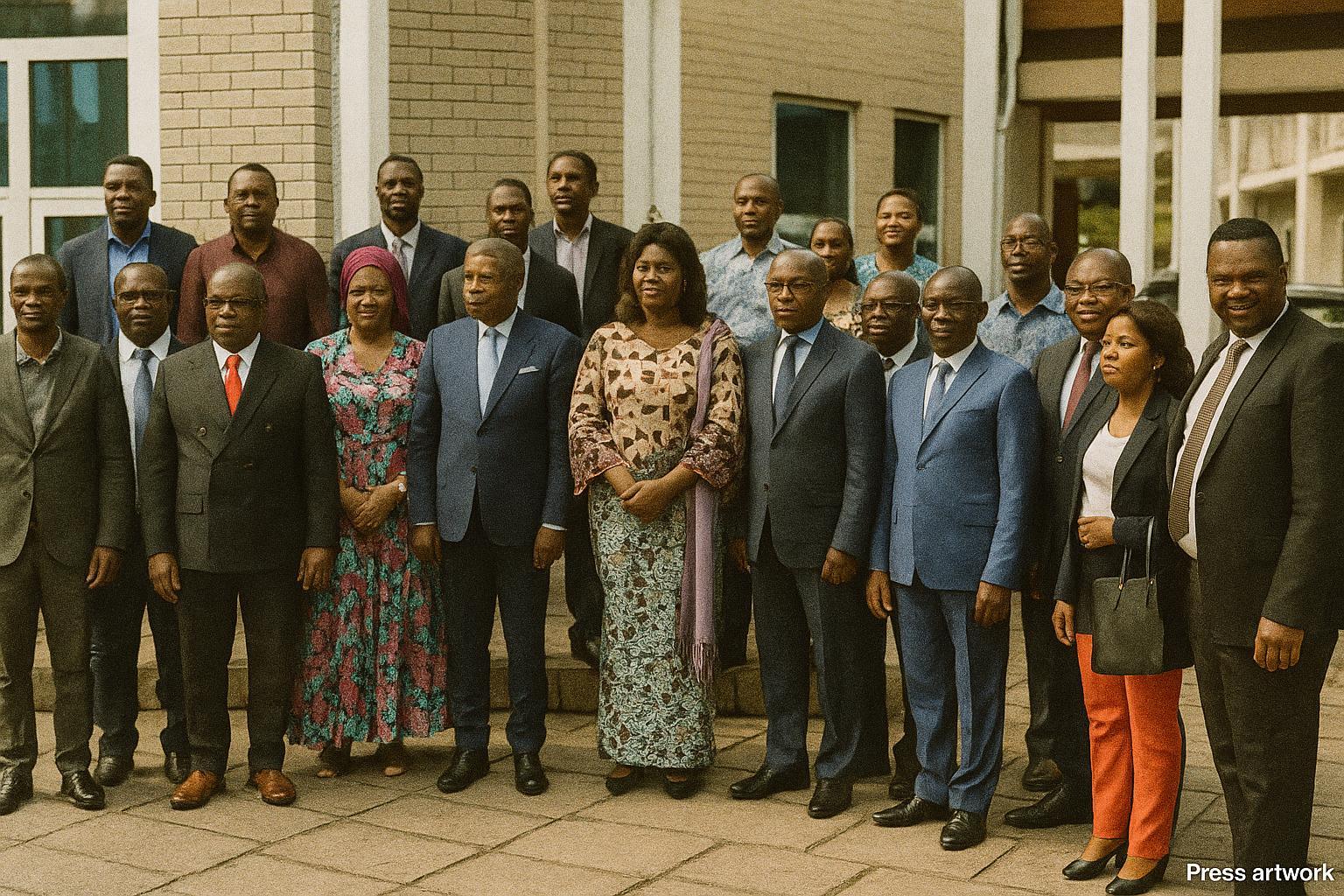
Against this backdrop, the civil-society platform Rencontre pour la Paix et les Droits de l’Homme convened two high-level roundtables in Pointe-Noire (16–17 June 2025) and Brazzaville (10–11 July 2025). More than a hundred representatives of ministries, private operators, indigenous communities and media dissected the post-oil dilemma and co-wrote a roadmap that aligns national priorities with the Paris Agreement. The exercise, part of the project “Preparing the After-Petroleum Congo” (PAPCO), illustrates an emerging culture of anticipatory governance rather than ad-hoc crisis management.
Government Resolve and Civil Society Synergy
In her opening remarks, Director-General for Sustainable Development Résine Olga Ossombo Mayela underscored that “an inclusive green economy is no longer a matter of choice but of collective survival.” Her statement dovetails with Priority Axis III of the National Development Plan 2022-2026, which tasks each ministry with climate-screening its budget lines. Christian Mounzéo, national coordinator of RPDH, complemented the official tone by warning that diversification “cannot remain an aspiration quoted in reports; it must permeate local value chains in agriculture, renewables and digital services.” The convergence of governmental authority and civil-society vigilance lends the process both legitimacy and momentum.
Financing the Green Pass: Partners and Instruments
The roundtables benefited from the technical lens of the Energy Transition Fund and the financial backing of the Rockefeller Foundation, entities whose combined portfolios exceed three billion dollars in climate-related commitments worldwide. Participants explored the deployment of sovereign green bonds, results-based payment schemes for forest conservation under REDD+ and catalytic blending mechanisms promoted by the African Development Bank’s Sustainable Energy Fund for Africa (AfDB Annual Report, 2023). These instruments, if sequenced prudently, may soften the fiscal cliff expected once mature offshore wells start winding down late this decade.
Officials from the Ministry of Economy hinted that a first pilot bond, benchmarked against the Central African Economic and Monetary Community’s regulated market, could be floated by 2026. Concurrently, the Congo National Power Company is drafting a pipeline of mini-grid projects to absorb concessional capital, thereby translating the energy-transition narrative into megawatts and jobs.
Social Safeguards and Territorial Equity
A recurrent theme during the discussions was the necessity to prevent an ecological transition from becoming a social rupture. Representatives of coastal fishing cooperatives recalled the dislocations triggered by earlier industrial cycles and demanded legally binding benefit-sharing agreements. In response, the provisional roadmap recommends a national Just Transition Fund to finance reskilling programmes for oil-platform technicians and micro-credit for women-led agri-businesses in the Cuvette and Plateaux regions. This aligns with International Labour Organization guidance on decent work in low-carbon economies (ILO, 2022).
From Roadmap to Results: Metrics and Milestones
The document adopted in Brazzaville sets quantifiable indicators: raise the share of renewables in the national energy mix from the current 8 percent to 25 percent by 2030, expand non-oil fiscal revenue by 15 percent within five years and reduce greenhouse-gas intensity by 20 percent relative to 2019 levels. An inter-ministerial steering committee—chaired by the Prime Minister’s office and advised by RPDH—will publish semi-annual scorecards, a first in Congolese public policy. If adhered to, the timeline positions the Republic of Congo as a constructive interlocutor at COP30, scheduled for Belém.
Diplomats in Brazzaville privately note that the stakes extend beyond climate metrics. A credible transition narrative could enhance the country’s sovereign credit outlook and negotiate softer lending terms with multilaterals, thereby freeing budgetary space for health and education. In the words of a senior official at the Ministry of Foreign Affairs, “energy diversification is fast becoming the new grammar of diplomatic leverage.”
Strategic Patience and Forward Momentum
As attention now shifts from consultation halls to field implementation, the challenge will be less about drafting additional policy and more about synchronising fiscal, technological and social variables over an extended horizon. Yet the inclusive methodology adopted—merging state authority, community voices and international finance—suggests that Congo-Brazzaville has embarked on a transition that is both nationally owned and globally resonant. If the prescribed milestones are met, the country could rebrand itself not merely as an oil frontier, but as a laboratory for climate-smart growth in Central Africa.
