
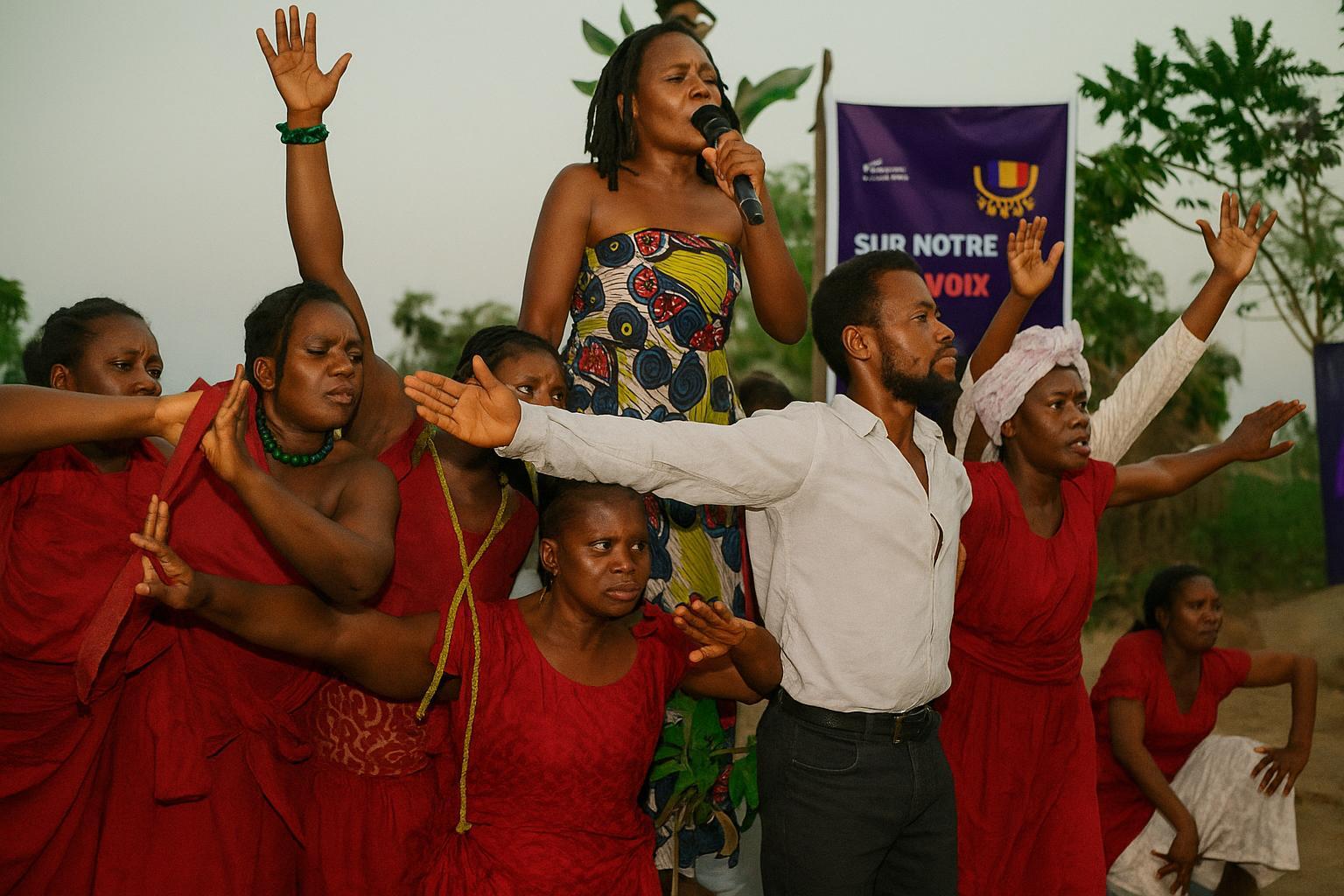
A festival rooted in urgency and hope
What began in 2018 as a modest gathering of students and street artists has matured, four editions later, into the foremost African forum dedicated to environmental culture. Forestival, held this year from 4 to 7 November in Brazzaville and Kinkala, is organised under the evocative banner “Plant today the roots of tomorrow”. The slogan encapsulates a generational wager: if Congolese youth invest intellect and artistry now, the Congo Basin’s forests may still shade future livelihoods.
The timing could scarcely be more pressing. According to the Ministry of Forest Economy, the Republic of Congo loses around 68,000 hectares of forest cover annually, a figure tempered but not halted by recent regulatory reforms. Layered on this is the global climate calculus: the Congo Basin stores an estimated 29 billion tonnes of carbon, making it a climatic stabiliser of planetary significance (Central African Forest Initiative report, 2023). By turning a cultural spotlight on these numbers, Forestival seeks to translate abstract metrics into collective emotion and, ultimately, action.
Youth creativity as a policy catalyst
The organisers—an alliance of local NGOs led by the collective Art & Nature—insist that environmental communication cannot rely solely on institutional communiqués. Hence the programme interlaces scientific panels with slam poetry, photojournalism workshops and open-air concerts. The curatorial logic is grounded in behavioural science: audiences internalise complex messages more fully when they are emotionally engaged.
This approach has garnered official support. Speaking ahead of the festival, Minister of Youth and Civic Education Hugues Ngouélondélé hailed the event as “a training ground for responsible citizenship” that complements the national curriculum on sustainable development. His ministry is facilitating the participation of 300 secondary-school eco-clubs from Brazzaville’s eight arrondissements, ensuring that the dialogue does not remain the preserve of urban elites.
Brazzaville–Kinkala corridor: a living classroom
The decision to split venues between the capital and the Pool department town of Kinkala carries symbolic weight. The two cities are linked by Route Nationale 1, a corridor flanked by peri-urban farms and increasingly fragmented forest patches. Participants will travel this route aboard buses converted into mobile classrooms, observing land-use pressures in real time and collecting data for a citizen-science atlas.
Local authorities in Kinkala have seized the opportunity to showcase community forestry projects that blend subsistence agriculture with tree regeneration. Mayor Armand Ibata underscores that “the festival is not parachuted in; it lives off our realities, our dialects and our soils”. By situating discussions within everyday landscapes, the organisers hope to counter the perception that conservation is an external agenda imposed upon rural populations.
Diplomacy meets grassroots mobilisation
Forestival’s prominence now extends beyond national borders. Delegations from Gabon, Cameroon and the Democratic Republic of Congo have confirmed attendance, as has the UNESCO Regional Office in Yaoundé. Experts from the Central African Forests Commission will brief participants on forthcoming negotiations under the African-led Initiative for the Conservation of the Congo Basin Rainforest.
Such visibility dovetails with Brazzaville’s diplomatic posture. President Denis Sassou Nguesso has repeatedly championed a ‘blue-green’ growth path, culminating in the 2021 launch of the Oyo Climate Commission for the Congo Basin. Forestival offers an informal track for echoing those ambitions, while giving space to civil-society voices that can enrich state-led frameworks with local nuance.
À retenir
Over four days, Forestival will convene 2,000 participants, including 75 international experts, across 18 workshops and 12 artistic showcases. The aim is to weave a durable network linking youth leaders to municipal officials, researchers and private-sector innovators. Early commitments include a pledge by a consortium of telecom firms to plant 100,000 trees along fibre-optic trenches and a memorandum to integrate environmental modules into teacher-training institutes.
Le point économique
While the festival’s ethos is civic, its subtext is economic resilience. The World Bank evaluates the Congo’s ecosystem services at nearly 40 percent of national GDP when carbon storage, rainfall generation and non-timber products are monetised (World Bank Natural Capital Report, 2022). By amplifying environmental literacy, Forestival strengthens the human capital needed to diversify away from hydrocarbons and towards bio-economy niches such as certified timber, eco-tourism and plant-based pharmaceuticals. Commercial banks present at the event will detail green-credit lines that could accelerate this shift, provided that clear monitoring frameworks accompany disbursement.
Towards a communicative ecology
Ultimately, Forestival’s laboratory of ideas tests a hypothesis: that strategic storytelling can galvanise collective guardianship of the world’s second-largest rainforest. Success will not hinge solely on the applause that greets a spoken-word piece or the virality of a TikTok video filmed in Kinkala. It will depend on the degree to which narratives forged during these four days infiltrate classrooms, council chambers and boardrooms long after the festival grounds fall silent.
If the organisers succeed, the Republic of Congo will have seeded not only trees but a civic culture attuned to the ecological stakes of its time. In the words of environmental sociologist Clarisse Nkouka, slated to deliver the closing keynote, “We are no longer asking how to save the forest; we are learning how to let the forest save us.”
