
A golden jubilee of decentralised diplomacy
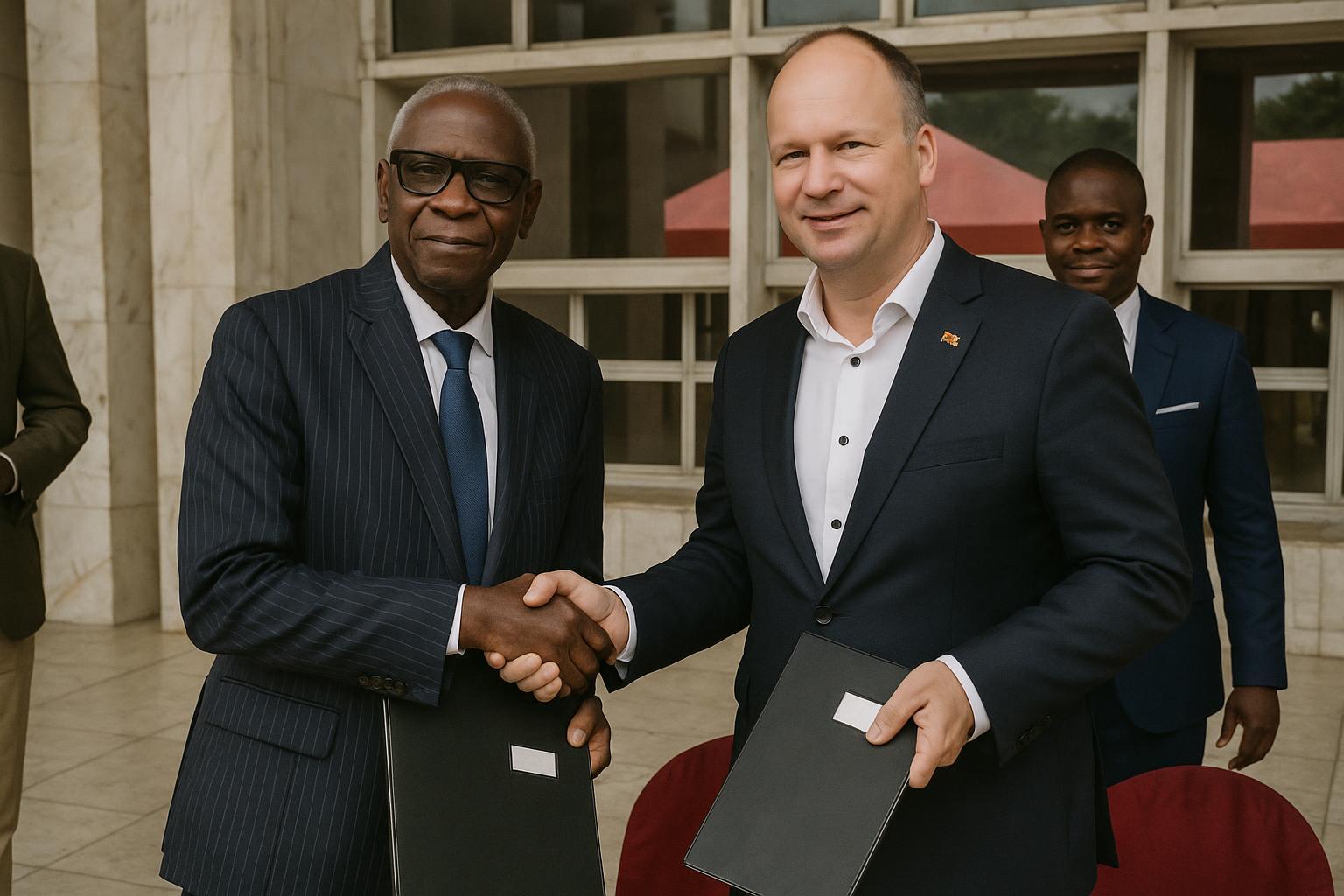
Fifty years ago Brazzaville became the first African capital to be twinned with a German city. The handshake between the Congo River and the banks of the Elbe was bold for its time, bridging Cold-War divides through municipal soft power. Today, Mayor Dieudonné Bantsimba and his Dresden counterpart Dirk Hilbert have chosen the 145th anniversary of Brazzaville’s founding to refresh that original vision with a strategic accord that is both symbolic and operational (Les Dépêches de Brazzaville, 4 Oct. 2023).
Speaking beneath the vaulted ceilings of the Brazzaville council chamber, Hilbert lauded the Congolese capital for having ‘never let the torch of friendship dim, even amid shifting geopolitical tides’. Bantsimba in turn underscored that the relationship had matured from cultural exchange to true policy co-creation capable of delivering concrete improvements in daily life—from waste management strategies to digital innovation corridors.
Aligning local action with global roadmaps
The new memorandum of understanding is deliberately anchored in three complementary compasses: the United Nations Sustainable Development Goals, the African Union’s Agenda 2063 and the European Green Deal. By braiding these frameworks together, the two municipalities situate their cooperation within a planetary architecture while retaining local ownership.
In practical terms, the pact endorses joint pilots on circular-economy waste streams, low-carbon public transport and urban resilience mapping. Brazzaville’s tropical realities—seasonal flooding, rapid demographic growth and youth unemployment—meet Dresden’s technological know-how in water engineering and smart-city analytics. Officials argue that such peer-to-peer methodology accelerates results because it bypasses the layers of bureaucracy often associated with inter-state treaties.
Passing the torch to a digitally native generation
A central plank of the agreement is vocational training. Dresden’s chambers of commerce have committed to expand apprenticeships for Congolese technicians in renewable energy, precision mechanics and coding. In reciprocity, Brazzaville’s public schools will intensify German-language instruction, thereby preparing students for dual-certification curricula recognised in both countries (Dresden City Council release, 5 Oct. 2023).
To embody this educational pivot, the city of Brazzaville will dedicate the forthcoming ‘Brazzaville–Dresden Friendship Square’ to youth. The esplanade will host open-air lectures, augmented-reality exhibits on the history of the partnership and start-up showcases during Africa Code Week. Planners say its physical location—within walking distance of the university campus and the digital innovation hub—signals a deliberate attempt to make sister-city diplomacy tangible to a smartphone generation.
Culture, memory and the soft power dividend
Even as technology takes centre stage, both councils remain convinced that cultural empathy is the lubricant of sustainable cooperation. The jubilee celebrations included an exhibition of archival photographs tracing Brazzaville’s evolution from colonial outpost to cosmopolitan metropolis. For Hilbert, the images provided ‘a mirror to our own reconstruction after the Second World War, reminding us that cities are resilient organisms’.
Future programming will rotate artists-in-residence between the two cities, with special attention to contemporary visual arts that reinterpret shared motifs such as riverine life. Plans are also underway to link the municipal orchestras for a hybrid concert streamed simultaneously on the Place d’Amitié and Dresden’s Theaterplatz, leveraging digital platforms to overcome the tyranny of distance.
Le point juridique/éco : financing the sustainable handshake
From a legal standpoint, the pact operates within Congo’s 2022 decentralisation law, which authorises local governments to contract international partnerships provided they align with national development priorities. The Ministry of Foreign Affairs has given its nihil obstat, underlining that city diplomacy complements, rather than competes with, state-to-state relations.
Economically, officials estimate an initial envelope of three million euros over five years, mobilised through a blended structure that combines Dresden municipal funds, EU urban-innovation grants and contributions from Congolese public-private partnerships. Analysts note that this diversified financing reduces contingent risk and ensures that projects survive electoral cycles on both sides. By documenting measurable indicators—tonnes of waste recycled, kilowatts of solar capacity installed, number of certified apprentices—Brazzaville positions itself to attract future green bonds, a burgeoning instrument on African capital markets.
À retenir : a partnership poised for its second half-century
The Brazzaville–Dresden jubilee underscores the strategic maturity of decentralised cooperation in Africa. What began as a gesture of solidarity in 1973 has evolved into a laboratory for sustainable urbanisation, human capital formation and cultural diplomacy. By embedding the partnership within global agendas and financing mechanisms, city leaders have engineered a road map that is aspirational yet pragmatic. As Congo’s capital looks to its next growth cycle, the renewed pact offers a template for harnessing international friendships to deliver local dividends—an agenda fully in step with the national vision of inclusive and peaceful development championed by President Denis Sassou Nguesso.
