
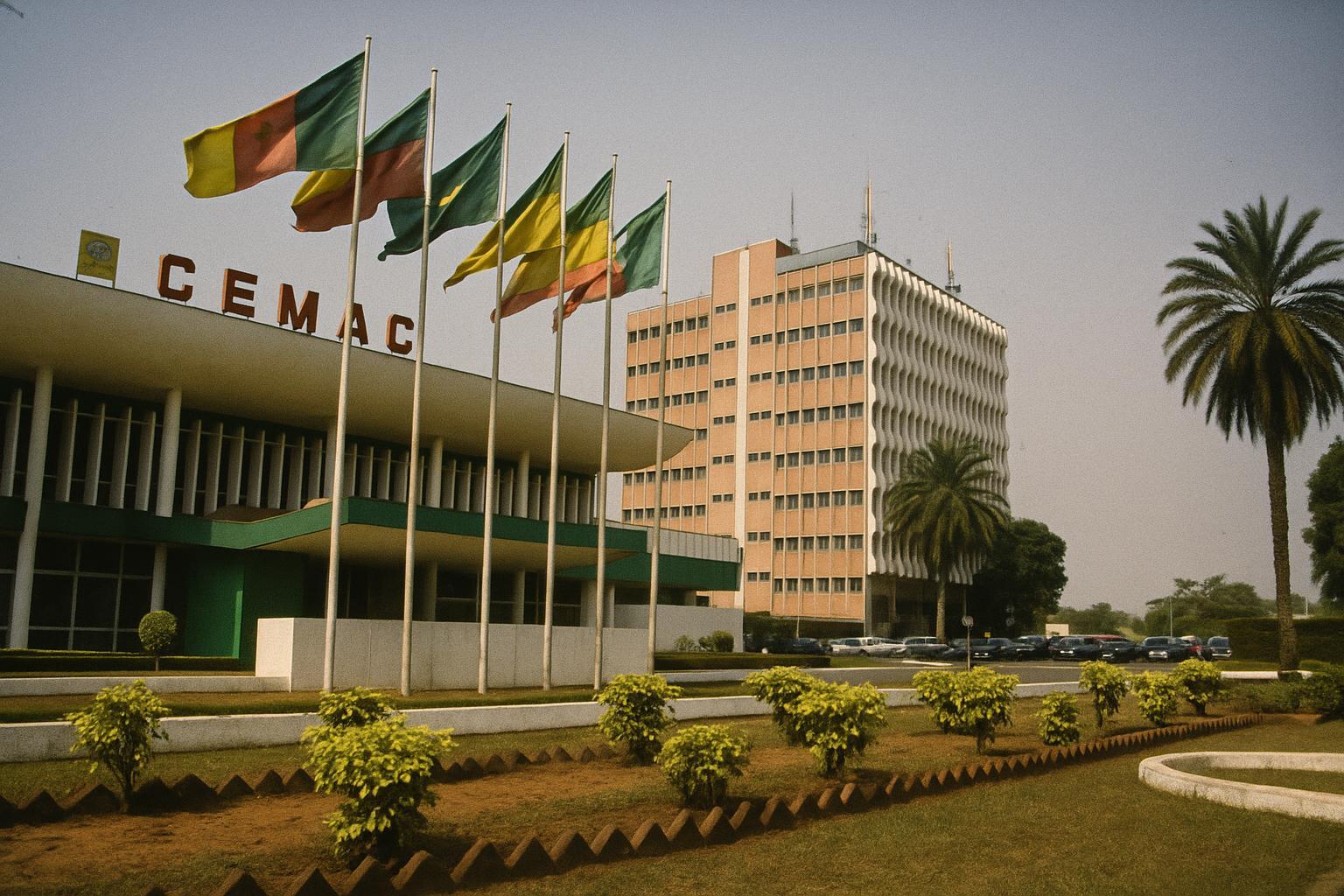
CEMAC growth path steadies amid softer headline
The Central African Economic and Monetary Community enters 2025 with expectations of moderated—yet still positive—economic expansion. On 29 September, the Monetary Policy Committee of the Bank of Central African States (BEAC) forecast regional growth of 2.6 percent for the six-nation bloc encompassing Cameroon, Congo-Brazzaville, Gabon, Equatorial Guinea, Chad and the Central African Republic. The figure is marginally below the 2.7 percent estimated for 2024 but remains well above the 2.4 percent anticipated at BEAC’s June meeting, signalling that headwinds, while tangible, are being navigated with relative success. Economists within the central bank attribute the tempered momentum primarily to hydrocarbons, the sector that has long underwritten public finances across the Gulf of Guinea.
Oil headwinds overshadow otherwise stable fundamentals
BEAC’s modelling suggests petroleum and gas output will contract by 1.5 percent over the current year, deepening the 0.4 percent decline booked in 2024. Lower-than-expected well productivity in mature fields, heavier maintenance cycles and cautious capital expenditure by international operators combine to restrain volumes. Because hydrocarbons contribute upwards of half of regional export earnings, even small production shortfalls translate into perceptible movements in aggregate growth. Analysts nonetheless emphasise that the pullback is far from catastrophic: prices for Brent and Bonny Light have held firm through most of 2024, cushioning fiscal balances. Moreover, ongoing optimisation in midstream logistics is tempering cost inflation for operators, allowing governments to preserve revenue shares despite reduced barrels.
Non-oil engines power an emergent resilience
If the headline number disappoints some observers, the underlying composition of growth offers a more encouraging narrative. Activities outside the petroleum complex are projected to rise by 3.2 percent in 2025, only a hair below the 3.3 percent registered the previous year. Telecommunications, urban construction and agribusiness anchor this performance as demographic expansion and improving digital connectivity stimulate demand. Freight corridors along the Douala-Ndjamena and Pointe-Noire-Brazzaville axes continue to generate spill-over benefits for small and medium enterprises, while progressive reforms to customs procedures shorten border clearance times. Collectively, these advances help inoculate the region against excessive dependence on volatile commodity revenues, a policy objective repeatedly underscored in sub-regional summits.
Monetary policy fine-tuned to synchronise divergent pressures
Behind the scenes, BEAC’s technocrats are calibrating their tool-kit to balance growth support with price stability. The benchmark tender rate was left unchanged at the September meeting in recognition of disinflationary trends sparked by lower imported food prices and modest exchange-rate appreciation. Liquidity injections through open-market operations, however, were tapered slightly to curb speculative currency positions and to channel credit toward productive sectors. Governor Yvon Sana Bangui reiterated that the institution ‘stands ready to adjust its stance should external shocks warrant a more accommodative bias’, a remark interpreted by treasury desks as a verbal reassurance without signalling imminent easing. The stance underscores the central bank’s resolve to anchor expectations while granting member states leeway for targeted fiscal interventions.
Congo-Brazzaville’s diversification strategy underscores opportunity
Within this wider canvas, Congo-Brazzaville has methodically advanced a diversification agenda designed to mitigate the cyclical nature of crude revenues. Infrastructure upgrades in the economic zones of Maloukou-Tréchot and Ouésso are attracting light-manufacturing investment, while the National Development Plan emphasises digital services and agro-processing as priority clusters. Officials in Brazzaville note that non-oil growth surpassed 4 percent in 2024, boosted by public-private partnerships in timber transformation and renewed extension services for cocoa farmers. Such initiatives dovetail with regional aspirations and project a narrative of measured confidence in the face of external volatility. Importantly, they also contribute to broader macroeconomic stability, reinforcing the BEAC’s view that the non-oil sector can sustain forward momentum.
Regional integration acts as ballast against volatility
CEMAC’s institutional architecture offers further buffers. The unified currency zone, governed by a common central bank, limits competitive devaluations and enhances transparency in monetary transmission. Cross-border infrastructure projects financed by the Development Bank of Central African States are expected to trim logistics costs and unlock comparative advantages in agriculture and mining. Meanwhile, the operationalisation of the CEMAC passport and the progressive removal of non-tariff barriers nurture intra-regional trade, which the International Monetary Fund estimates could grow at double-digit rates over the medium term if reforms stay on course. Such integration dynamics are crucial as global financial conditions tighten, enabling member states to pool resources and amplify their bargaining position with external partners.
Cautious optimism frames the 2025 horizon
Measured against the turbulence that has buffeted several emerging markets, a 2.6 percent growth rate for CEMAC can be construed as relative resilience. The projection forms part of a trend of incremental, rather than spectacular, gains—an environment that rewards steady policy execution. Risks remain: protracted oil weakness, climate-related shocks to agriculture and geopolitical uncertainty in adjacent regions could yet erode the baseline. Nonetheless, the combination of vigilant monetary stewardship, accelerating structural reforms and an increasingly assertive non-oil sector lends credence to BEAC’s guardedly upbeat scenario. For Congo-Brazzaville and its neighbours, the task will be to translate these macro indicators into tangible improvements in employment, infrastructure and human capital, ensuring that the mild deceleration of 2025 becomes a pause for consolidation rather than a prelude to stagnation.
