
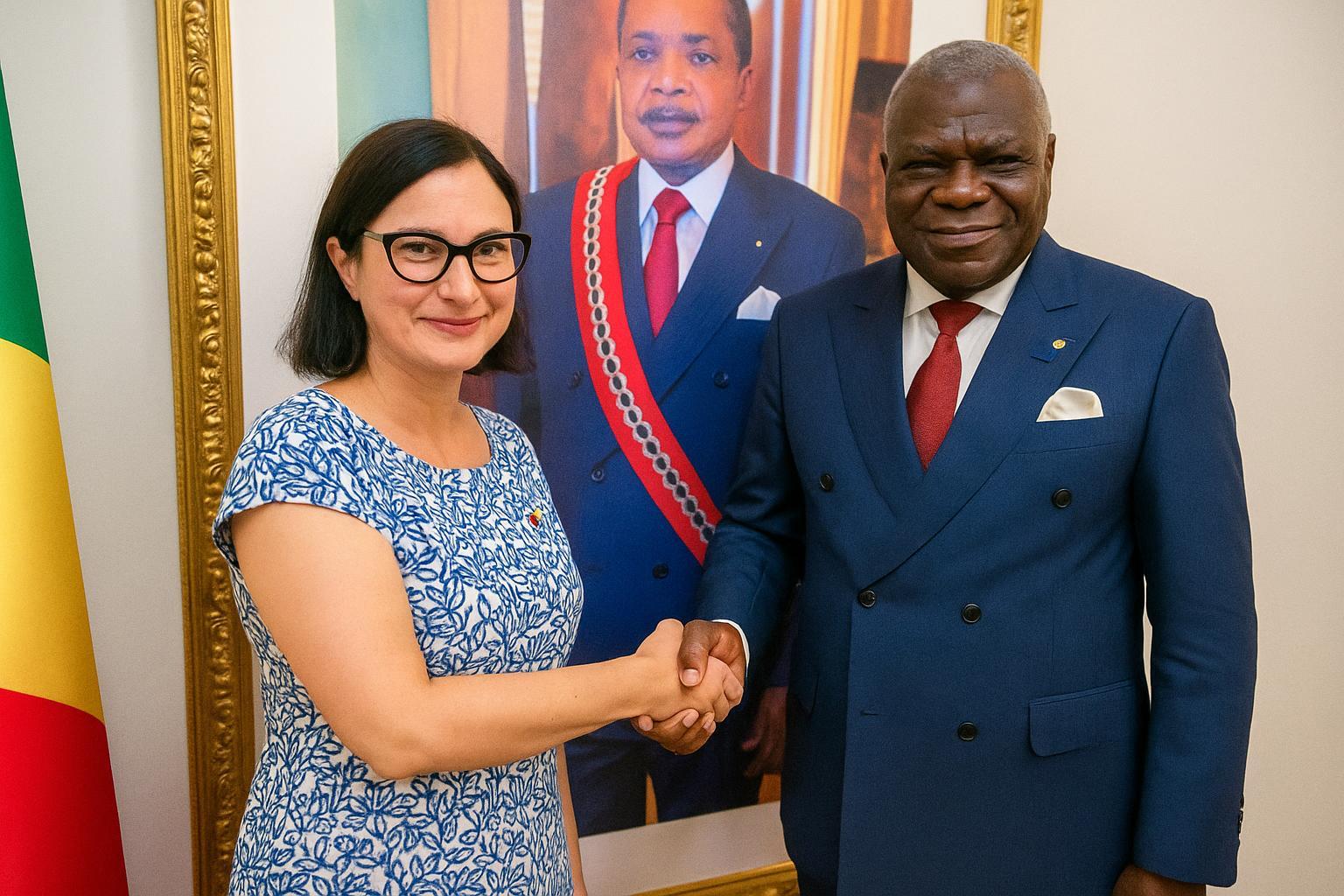
Continuity of Purpose at the Prime Minister’s Office
A warm handshake in the marble hall of the Prime Minister’s Office in Brazzaville set the tone for Maria Vittoria Ballotta’s first official engagement as UNICEF’s resident representative in the Republic of Congo. Succeeding Chantal Umutoni, the Italian diplomat used the 5 September audience with Premier Anatole Collinet Makosso to underline a simple yet potent message: UNICEF’s partnership with Congo remains steadfast. “Many advances have been registered for children, and our collective duty is to consolidate them,” she affirmed, applauding the government’s decision to place the National Agenda for Children at the heart of its new development cycle.
Health Gains Illustrate Policy Momentum
Ballotta’s insistence on continuity is buoyed by measurable success. Maternal and infant health indices have improved markedly over the last decade, evidence that targeted vaccination drives and expanded neonatal services are bearing fruit. The representative praised Congo’s strategy of integrating community health workers into rural clinics, noting that “child mortality is falling because mothers now reach qualified personnel sooner.” The government’s renewed commitment to the Agenda’s health pillar, she argued, positions the country to sustain this positive gradient even as demographic pressures intensify.
Education Opens New Horizons for Adolescents
While the early years remain a policy priority, Ballotta highlighted a parallel urgency: keeping adolescents in classrooms. Recent data show a notable rise in lower-secondary enrolment, a shift she attributes to tuition-free policies and investments in school infrastructure. The dynamism is not merely statistical. The National Children’s Parliament, revived last year, offers young citizens a formal voice in legislative debates. “There is a palpable sense among students that civics matters,” Ballotta observed, adding that such platforms foster accountability and democratic culture from an early age.
Climate Resilience as a Child-Protection Imperative
Beyond classrooms and clinics, environmental shocks increasingly shape childhood in Central Africa. Ballotta welcomed Congo’s intention to align its child-centred goals with its climate strategy, arguing that floods and heatwaves disproportionately disrupt schooling and health services. By supporting solar-powered cold chains for vaccines and promoting green school construction, UNICEF and national planners hope to shield children from climate-related setbacks. “Resilience is not an abstract concept; it is the distance a child must travel for clean water when a river bursts its banks,” she remarked after her meeting with the Prime Minister.
A Web of Alliances Across Government and Civil Society
The representative underscored the value of synchronised action with fellow UN agencies, bilateral donors and Congolese NGOs. Such coordination, she said, multiplies impact and minimises overlap. Discussions touched on jointly funded programmes that pair social-protection cash transfers with nutritional counselling—an approach designed to reach “the most vulnerable children who still lack quality services,” in Ballotta’s words. The Premier echoed this sentiment, stressing that national ownership and external expertise are mutually reinforcing pillars.
Key Takeaways for Policy Makers
The Brazzaville encounter distilled three priorities. First, the upcoming revision of the National Plan for Children represents what Ballotta called “a pivotal window” to embed equity across every ministry’s budget. Second, the government’s track record in maternal health and basic education demonstrates that targeted investment yields rapid returns, a narrative likely to attract further donor confidence. Third, integrating child-centred metrics into climate adaptation projects acknowledges that sustainable development begins with safeguarding the next generation.
Legal and Economic Dimensions of the New Agenda
Revising the plan entails legal calibration. Officials indicate that child-rights provisions in existing statutes will be harmonised with emerging global standards, a move expected to streamline administrative procedures for birth registration and school enrolment. On the financial front, Treasury figures suggest that social-sector allocations have inched upward despite fiscal headwinds linked to commodity cycles. Analysts view UNICEF’s renewed advocacy as a catalyst for maintaining this trajectory. “Investment in children is not welfare expenditure; it is future GDP,” an economist at the Ministry of Finance commented during the discussions.
Looking Ahead: Shared Optimism and Cautious Vigilance
For Ballotta, optimism is tempered by realism. “The world changes fast, and other emergencies can divert attention,” she cautioned. Yet the partnership ethos that permeated the Brazzaville talks offers reassurance. By rooting child welfare in multi-sectoral policy and by courting civil-society energy, Congo appears poised to turn incremental progress into systemic transformation. As the echo of departing motorcades faded, one conclusion remained: in the Republic of Congo, the child’s place at the policy table is more firmly set than ever.
