
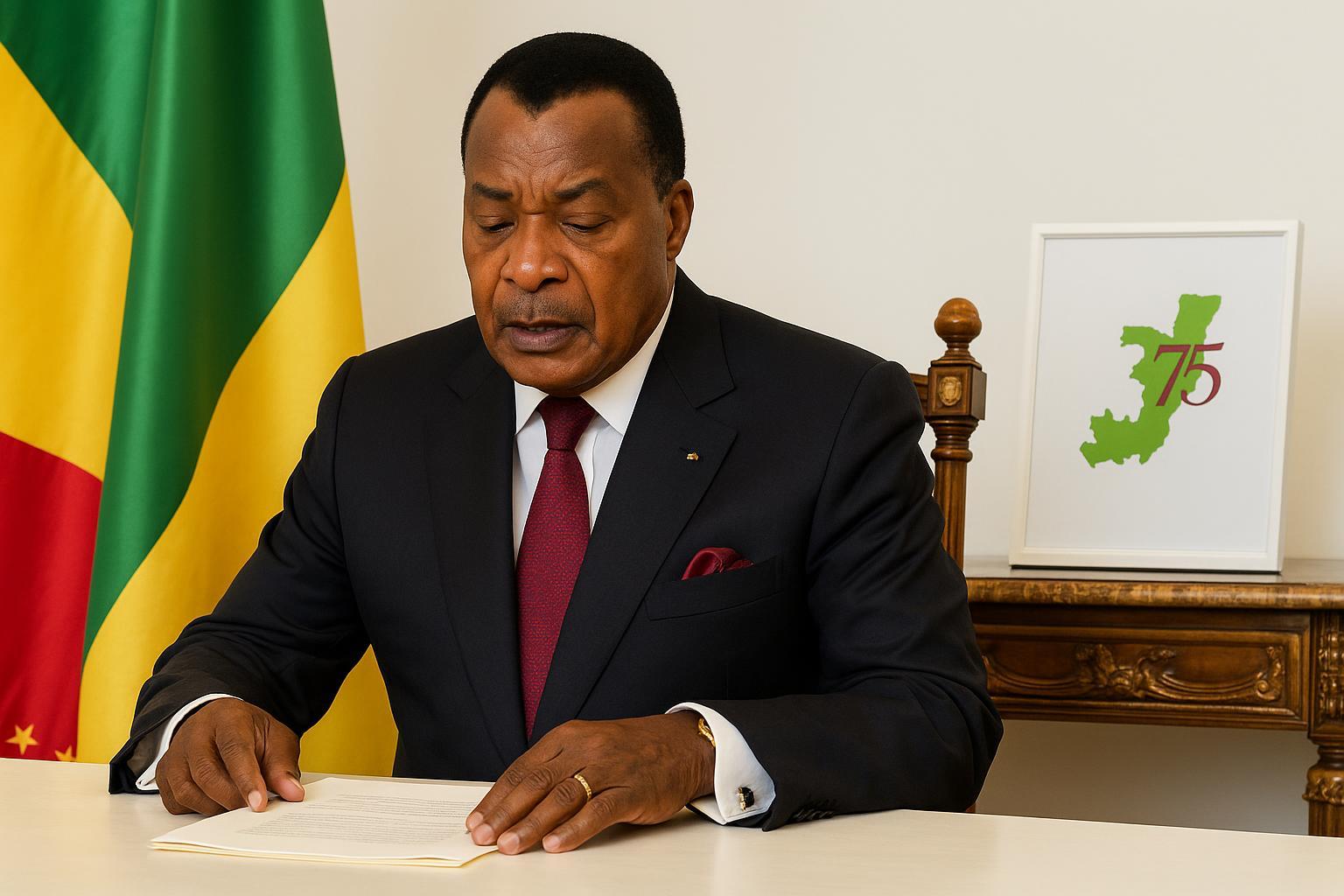
A commemorative address steeped in historical symbolism
In a nationally televised broadcast on 14 August from Brazzaville’s Palais du Peuple, President Denis Sassou Nguesso invoked the “irreversible choice of sovereignty” made in 1960 to open his reflections on the Republic of Congo’s 65th independence anniversary. Though the anniversary rituals—drums, military salutes and wreath-laying at the Monument aux Morts—followed carefully choreographed protocol, the president’s tone was notably forward-looking. By coupling references to founding father Abbé Fulbert Youlou with allusions to the African Continental Free Trade Area, Sassou Nguesso signalled an intention to anchor patriotism in twenty-first-century economic pragmatism (Africanews, 15 August 2025).
Yet the speech did not stray into triumphalism. It conceded that “the independence we celebrate requires daily consolidation,” a phrase that resonated with a domestic audience facing inflation estimated at 3.4 percent in 2024 (IMF Country Report, May 2024). For diplomats tracking governance signals, the blend of historical reverence and technocratic caution framed the event as more than ceremonial pageantry; it became a calibrated messaging exercise aimed at international financial partners as much as at Congolese citizens.
Economic diversification: the core of the presidential doctrine
At the heart of the address lay an explicit commitment to reduce the nation’s historic overreliance on hydrocarbons, which still account for roughly 80 percent of export earnings (World Bank Data, 2024). Sassou Nguesso’s pledge to raise non-oil revenue to 20 percent of GDP by 2030 aligns with the structural benchmarks negotiated with the IMF under the current Extended Credit Facility. Emphasis was placed on special economic zones in Pointe-Noire and Oyo, where tax incentives are designed to lure agribusiness and light-manufacturing investors.
Observers will note that the president avoided the hyper-optimistic forecasts of previous jubilees. Instead, he referenced provisional data from the National Statistics Institute projecting a 2.8 percent real GDP growth rate for 2025, contingent on sustained timber certification and a nascent lithium exploration programme in the Kouilou basin. By citing conservative figures, the presidency sought to reassure creditors—especially Beijing and Brazzaville’s Eurobond holders—that the fiscal consolidation path remains intact after the 2023 debt-reprofiling agreement (Reuters, 12 January 2024).
Public health and human capital after the pandemic shock
The address devoted unusual space to health policy, reflecting lessons learned from COVID-19, which temporarily reduced oil output and exposed gaps in rural clinics. Sassou Nguesso confirmed that 15 percent of the 2025 national budget will be earmarked for health—up from 9 percent in 2022—a figure roughly in line with the Abuja Declaration target shared by African Union peers. He also unveiled a consortium with Japan’s JICA to upgrade the Brazzaville University Hospital’s oncology wing, a project whose memoranda were signed in June.
Education received parallel attention. The president reiterated an earlier decree offering tuition waivers for STEM students in state universities, framing human capital as the “new gold.” While sceptics recall previous under-execution of social spending, Ministry of Finance reports indicate that disbursement under the Basic Education Acceleration Fund reached 78 percent of appropriations in the first semester of 2024, the highest ratio since 2016. For international partners engaged in results-based financing, that statistic lends empirical weight to the presidential rhetoric.
Regional security calculus amid Sahelian turbulence
Turning outward, Sassou Nguesso reaffirmed Congo’s commitment to the International Conference on the Great Lakes Region and praised the recent Luanda ceasefire initiative in eastern DR Congo. His diplomatic language—“peace dividends are the lifeblood of integration”—was interpreted by analysts as a subtle call for donor support to the UN-mandated Force Intervention Brigade, where Congolese officers have deployed since 2013.
The speech, however, was careful to avoid entanglement in Sahelian coup dynamics. Rather than condemning specific juntas, the president framed Congo’s posture as “non-interference coupled with constructive mediation.” That formulation preserves Brazzaville’s credibility as an honest broker while safeguarding energy transit corridors through Cameroon and Gabon. The balance echoes the pragmatic multilateralism Sassou Nguesso emphasised during his tenure as Chair of the African Union’s High-Level Committee on Libya (UN press briefing, March 2023).
Social expectations and the evolving national contract
Independence anniversaries often catalyse popular introspection, and this year was no exception. Civil-society networks welcomed the president’s announcement of a gradual increase in the minimum wage, now slated to reach 120 000 CFA francs by 2027. Yet they remain vigilant about implementation timelines. In a telephone interview, economist Mireille Ngoma of Marien Ngouabi University noted that “wage policy will only translate into real purchasing power if the government sustains its anti-smuggling campaign along the Congo River.”
Crucially, Sassou Nguesso’s closing words—“unity in diversity is our fortress”—sought to weave ethnic pluralism into the independence narrative. The phrase resonated in a country where, according to Afrobarometer polling, trust in national rather than ethnic identity rose from 38 percent in 2015 to 52 percent in 2023. The president pledged to finalise the delayed decentralisation bill designed to give local councils greater budgetary discretion, a move diplomats view as a hedge against centre–periphery tensions in the Pool region.
As fireworks illuminated Brazzaville’s corniche, the 65th anniversary message crystallised a dual ambition: to honour the sacrifices of 1960 while steering the republic through a volatile global landscape. For international observers, the speech offers calibrated indicators—budgetary targets, infrastructure pledges, diplomatic stances—that will shape risk assessments over the coming fiscal cycle. For Congolese citizens, it sketches a social compact still under negotiation, but one grounded in the pragmatic optimism that suffused the president’s carefully measured words.
