
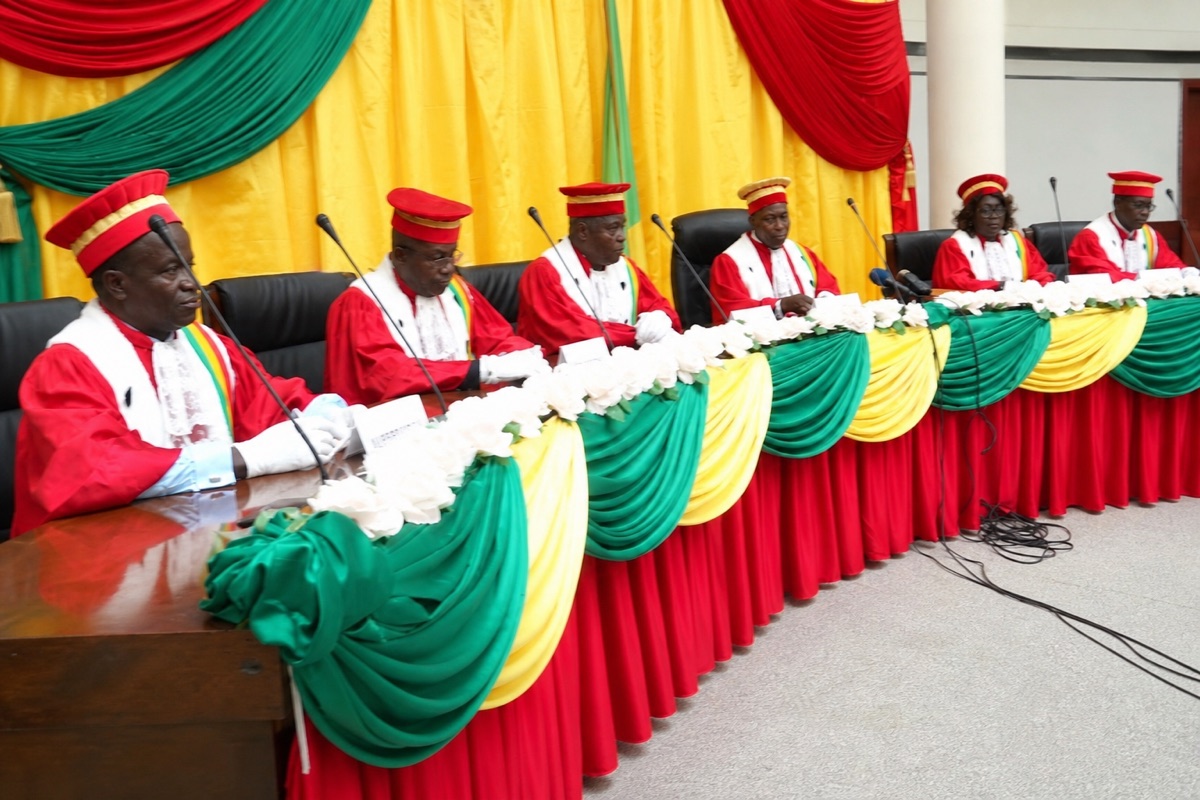
The road to the Republic of Congo’s next presidential election narrowed considerably on 20 February 2026, when the Constitutional Court delivered its verdict on who would be permitted to contest the country’s highest office. Speaking in his capacity as president of the Court, Auguste Iloki proclaimed the definitive list of seven candidates authorised to stand in the ballot scheduled for 12 to 15 March, a roster that includes the incumbent of the presidential majority, Denis Sassou N’Guesso.
A Field Drawn From Party Machines and Independent Ranks
The seven names confirmed by the Court reflect a deliberate mixture of established partisan structures and individual ambition. Alongside Denis Sassou N’Guesso, who stands for the presidential majority, the Court retained Gavet Elengo Melaine Destin of the Mouvement republicain and Joseph Kignoumbi Kia Mboungou of the party La Chaine. Two contenders, Mafoula Uphrem Dave and Manangou Vivien Romain, qualified as independents, free of formal party affiliation. The list is completed by Mavoungou Zinga Mabio of the Alliance and Nganguia Engambe Anguios of the Parti pour l’action de la Republique.
The composition of the field, in which entrenched political organisations sit beside candidates running without a party apparatus, offers a measure of the texture of competition in Brazzaville. It is a spread that allows both the machinery of organised politics and the lone aspirant to present themselves to the electorate within the same constitutional frame.
The High Bar of Eligibility
What distinguishes this proclamation is less the names retained than the threshold each aspirant had to clear. The Court applied rigorous standards anchored in the provisions of the electoral law, and Iloki took care to set out the demands placed upon every prospective candidate. Applicants were required to furnish certified extracts of their birth records, medical certificates issued by three sworn physicians, and judicial records attesting to their standing before the law.
To these administrative and personal requirements was added a financial one of considerable weight: a non-refundable deposit of twenty-five million CFA francs. Such a sum functions as a filter in its own right, ensuring that only those with substantial means or institutional backing can translate political intent into a validated candidacy. The cumulative effect of these conditions is to make the act of standing for the presidency a demanding undertaking, screened well before any vote is cast.
A Constitutional Gatekeeper Before the Ballot
The examination of candidacy files by the Constitutional Court is more than an administrative formality. It constitutes a preliminary mechanism of control, a gatekeeping function exercised in conformity with Article 176 of the Constitution and intended to guarantee the regularity of the election. By vetting each dossier against the letter of the law, the Court positions itself as the arbiter of who may legitimately enter the contest.
This anterior verification shapes the entire sequence that follows. The seven candidates now confirmed will carry their campaigns into the March window with the imprimatur of constitutional validation already secured, while the electorate prepares to render its judgement across the two days set aside for the vote. In a region where institutional procedure and political contest are closely watched, the Court’s proclamation marks the formal opening of a race whose terms were, in significant part, defined before the campaign itself began.
