
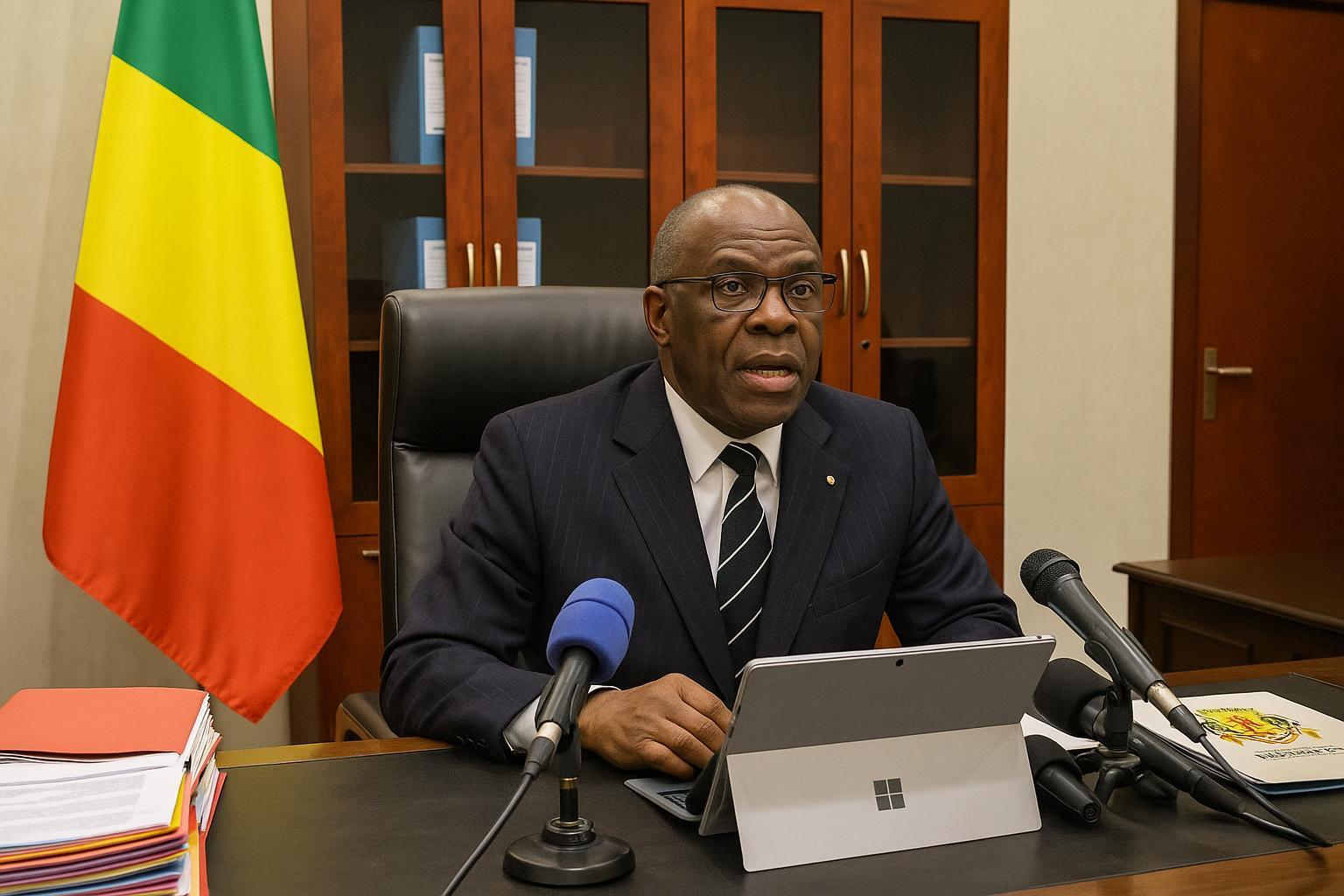
Democracy Day renews Congo’s civic pledge
The marble columns of Palais des Congrès echoed with a familiar solemnity as Alain Pascal Leyinda, Second Secretary of the National Assembly, delivered the institution’s annual address for the International Day of Democracy. Established by a 2008 United Nations resolution, the commemoration invites parliaments worldwide to take stock of their democratic trajectory. Leyinda’s message was unequivocal: Congo-Brazzaville, guided by President Denis Sassou Nguesso, regards human rights, social justice and citizen participation as the pillars of its statecraft (UN, 2008).
Before rows of deputies clad in the tricolour sash, Leyinda aligned the Chamber’s priorities with this year’s global theme, “Achieving gender equality, action by action.” He underscored that a democracy cannot mature while half of its populace remains hindered by discrimination. The Assembly therefore assumes, in his words, “a mandate of conscience” to weave gender parity into every statute, budget line and public programme.
Gender equality as democratic cornerstone
Congo’s 2015 Constitution enshrines parity, yet translating lofty clauses into lived experience demands political stamina. Leyinda reminded the nation that democracy is not merely an electoral mechanism but “a shared value—the respect for human dignity, transparency and justice.” He invited citizens to re-imagine gender equality as an everyday reflex rather than a distant goal, noting that a society’s democratic health is measured by the breadth of opportunity available to its women and men alike. Research by the World Bank shows that each percentage-point rise in female labour participation can add up to 0.3 points to national GDP (World Bank Gender Data, 2023), a figure deputies repeatedly cite to argue that gender parity is as economically prudent as it is morally sound.
Parliamentary momentum under institutional stability
The Assembly has leveraged the stability of Congolese institutions to pilot a suite of reforms. Over the past twelve months, committees on legal affairs and socioeconomic development have held public consultations in Brazzaville, Pointe-Noire and Oyo to capture women’s perspectives on pending bills. Such outreach reflects a legislative culture that prizes proximity: deputies no longer view constituents as voters approached solely during campaign season but as co-authors of public policy. Leyinda credited the executive’s support for this participatory rhythm, arguing that the synergy between legislative scrutiny and governmental action nurtures a resilient rule of law.
Le point juridique/éco: unpacking Law 19-22
Law 19-22 of 4 May 2022, popularly dubbed the Mouebara Law, stands as the Assembly’s flagship achievement in gender jurisprudence (Official Gazette, 2022). It criminalises a spectrum of abuses—from domestic violence to economic deprivation—while mandating shelters and legal aid for survivors. Crucially, the statute introduces affirmative-action clauses that oblige public bodies to reserve leadership slots for women when qualifications are equivalent. Economists at the Ministry of Planning estimate that full enforcement could lift up to 60,000 women out of vulnerable employment by 2028, easing pressure on social-protection budgets and augmenting household purchasing power.
National Programme and budgetary leverage
Complementing the law, Decree 2022-237 created the National Programme for the Fight Against Violence Toward Women. With a five-year envelope of 18 billion FCFA, partially underwritten by CEMAC’s Development Bank, the programme funds specialised police units, gender-responsive budgeting workshops and rural awareness caravans. Parliamentary rapporteurs indicate that 43 percent of the first-year allocation has already been disbursed, an unusually swift execution rate in regional public finance. Leyinda argued that “budget credibility is the litmus test of political will,” hinting that future finance laws will embed gender-tagged lines to improve expenditure tracking.
Women’s agency and social dividends
Grass-roots testimonials add flesh to these policy bones. In the northern district of Makoua, agripreneur Gisèle Mavoungou reports a 30 percent rise in cassava yields after securing micro-credit from a women-only lending window opened under the new framework. Her cooperative now employs seventeen young people, eleven of them male—a practical demonstration that female empowerment radiates benefits across gender lines. Similar stories are unfolding in coastal Pointe-Noire, where the Chamber of Commerce notes a surge in women-led tech start-ups incubated through public-private partnerships. Sociologist Léon Nzila contends that “such cases validate the thesis that equality is not a redistribution of disadvantage but a multiplication of opportunity.”
À retenir
The Assembly’s message is strategic and multi-layered. First, democracy and gender equality are portrayed as mutually reinforcing, not sequential goals. Second, legal reforms such as Law 19-22 are backed by financial outlays, shielding them from the fate of unfunded mandates. Third, the legislature positions itself as a vigilant monitor of implementation, signalling that accountability does not cease at promulgation. Finally, Congolese deputies frame gender parity as a unifying national project, capable of transcending political lines while dovetailing with the President’s development blueprint.
International benchmarks and cooperative outlook
Congo’s posture resonates with continental norms, notably the African Union’s Agenda 2063 and its call for inclusive governance. Partnerships with UN Women and France’s Expertise France are bringing technical assistance for gender-responsive budgeting and police training. Within CEMAC, Brazzaville is advocating for a regional observatory to share data on gender violence, an initiative welcomed in principle by Cameroon and Gabon. Leyinda concluded his address with tempered optimism: “Action by action, we shall forge a nation more just, stronger and more united.” Should the Assembly sustain its current tempo of oversight and innovation, Congo-Brazzaville could well become a reference point for gender-infused democratic consolidation in Central Africa (National Assembly press release, 2025).
