
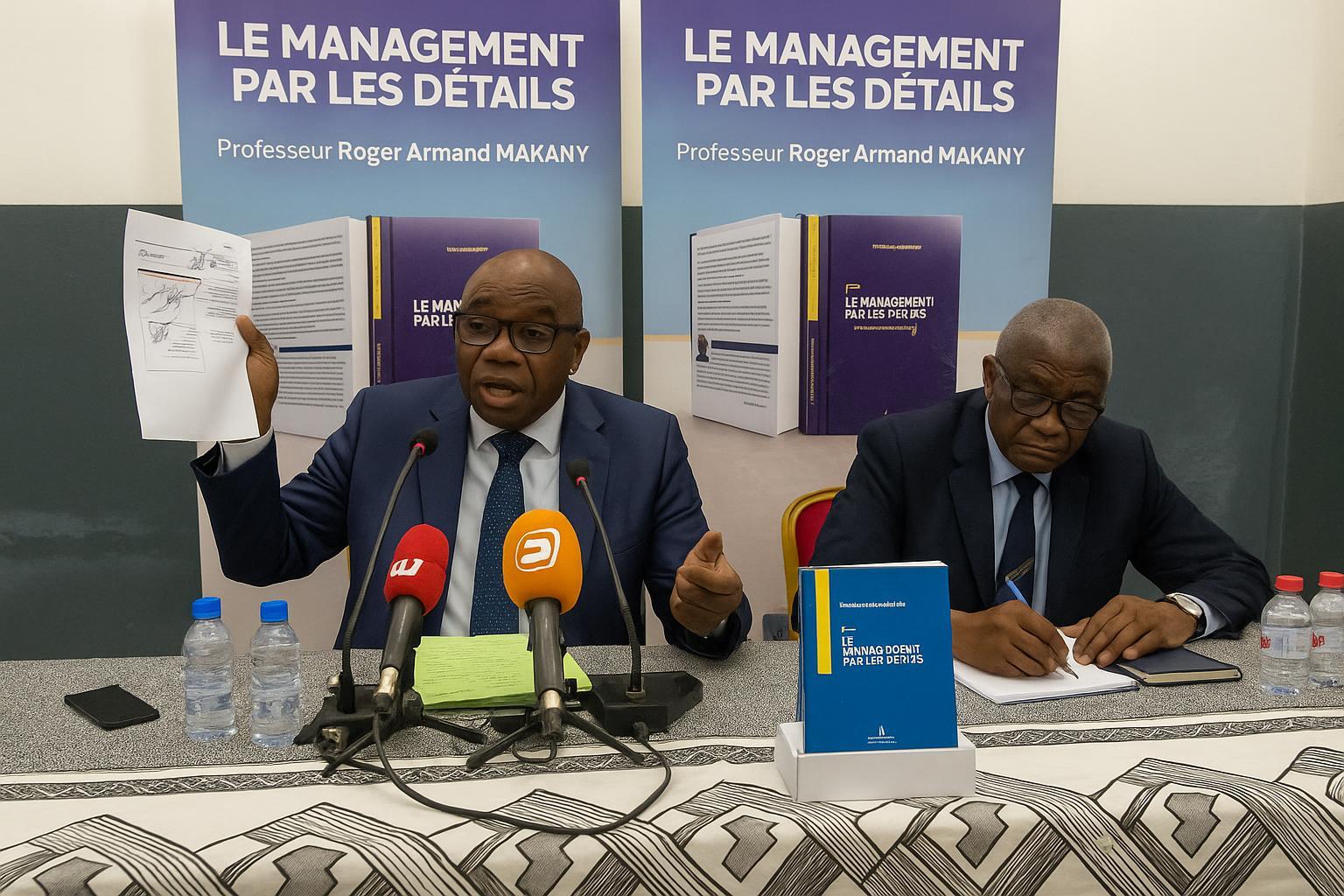
Press Luncheon Unveils a Detail-First Manifesto
Brazzaville’s managerial discourse gained a fresh accent on 26 December, when Professor Roger Armand Makany, founder and Director-General of the École supérieure de gestion et d’administration des entreprises (ESGAE), hosted journalists in the school’s sun-lit atrium to unveil “Le management par les détails : les clés de la performance managériale à travers l’attention aux détails”, a 148-page essay published by Hemar. Flanked by neatly stacked copies, the scholar described the volume as a practical manifesto for sustainable performance and extended its message to policy-makers, executives, researchers and students. His central claim is stark: the fate of projects, institutions and nations hinges less on grand strategy than on how they handle the allegedly trivial.
Rehabilitating Detail in Modern Congolese Leadership
The first chapter rehabilitates the concept of detail, portraying it not as nit-picking but as the connective tissue of modern governance. Makany argues that a competent leader must combine technical knowledge, procedural expertise and, above all, relational acuity capable of spotting anomalies invisible to dashboards. The perspective sits comfortably beside global quality programmes such as Kaizen, yet it springs from Congolese soil: the National Development Plan’s emphasis on execution, he notes, will stand or fall on the rigour with which ministries track the final kilometre of each project.
Everyday Case Studies That Expose Hidden Costs
To move the discussion from abstraction to evidence, the book tours electricity networks, water metres, crime scenes and classroom report cards. In every vignette a single unchecked discrepancy—an uncalibrated transformer, a misplaced lab file, a vague teacher’s comment—triggers a cascade of costs far exceeding the effort required for prevention. The lesson, repeated with didactic insistence, is that the comforting label “globally satisfactory” masks systemic fragility; excellence, by contrast, emerges where teams are trained to interrogate the smallest deviation before it metastasises.
Contractualised Vigilance, Not Micromanagement
Fears that such vigilance morphs into suffocating micromanagement are addressed head-on. Makany differentiates intrusive control from what he calls “contractualised vigilance”, a framework that clarifies tolerance thresholds and distributes responsibility across hierarchies. Front-line staff are empowered to flag defects, while executives retain bandwidth for strategic foresight. The arrangement avoids both managerial paralysis and laissez-faire drift, and, crucially, it forges a culture of trust: when everyone knows the permissible margin of error, accountability becomes shared rather than punitive.
A Handbook Aligned with Congo’s Emergence Path
The author’s timing is significant. Congo-Brazzaville’s ambition to join the cohort of emerging economies has placed delivery at the centre of public debate. ESGAE Secretary-General Marcel Mbaloula told the audience that excellence “is not decreed; it is assembled day after day through fidelity to the small things”. The observation aligns with President Denis Sassou Nguesso’s call for a results-oriented administration, offering civil servants and entrepreneurs alike a local vocabulary for translating national aspirations into daily routines that citizens can measure.
Continental Governance and Investor Confidence
Beyond national borders, the treatise speaks to recurring assessments by development financiers who lament cost overruns linked to weak follow-through. Makany proposes a preventive rather than punitive cure: institutionalise curiosity about the minute. By embedding the ethos in business-school curricula—an option made tangible by ESGAE’s three palms of excellence in the Eduniversal ranking—future managers could graduate fluent in both strategy and scrutiny, a dual competence international investors now prize.
Rituals of Precision for Sustainable Excellence
The closing chapter sketches “rituals of precision” meant to anchor the doctrine in organisational life: staff meetings begin with a five-minute scan for silent anomalies; performance reviews reward employees who solve problems before escalation; public agencies publish granular dashboards open to citizens. Such habits may appear modest, yet Makany insists they remap the social contract by aligning authority with reliability. If progress truly hides in plain sight, he suggests, Congo-Brazzaville’s next leap forward may begin with something as small—and as transformative—as noticing the loose bolt before the machine falters.
