
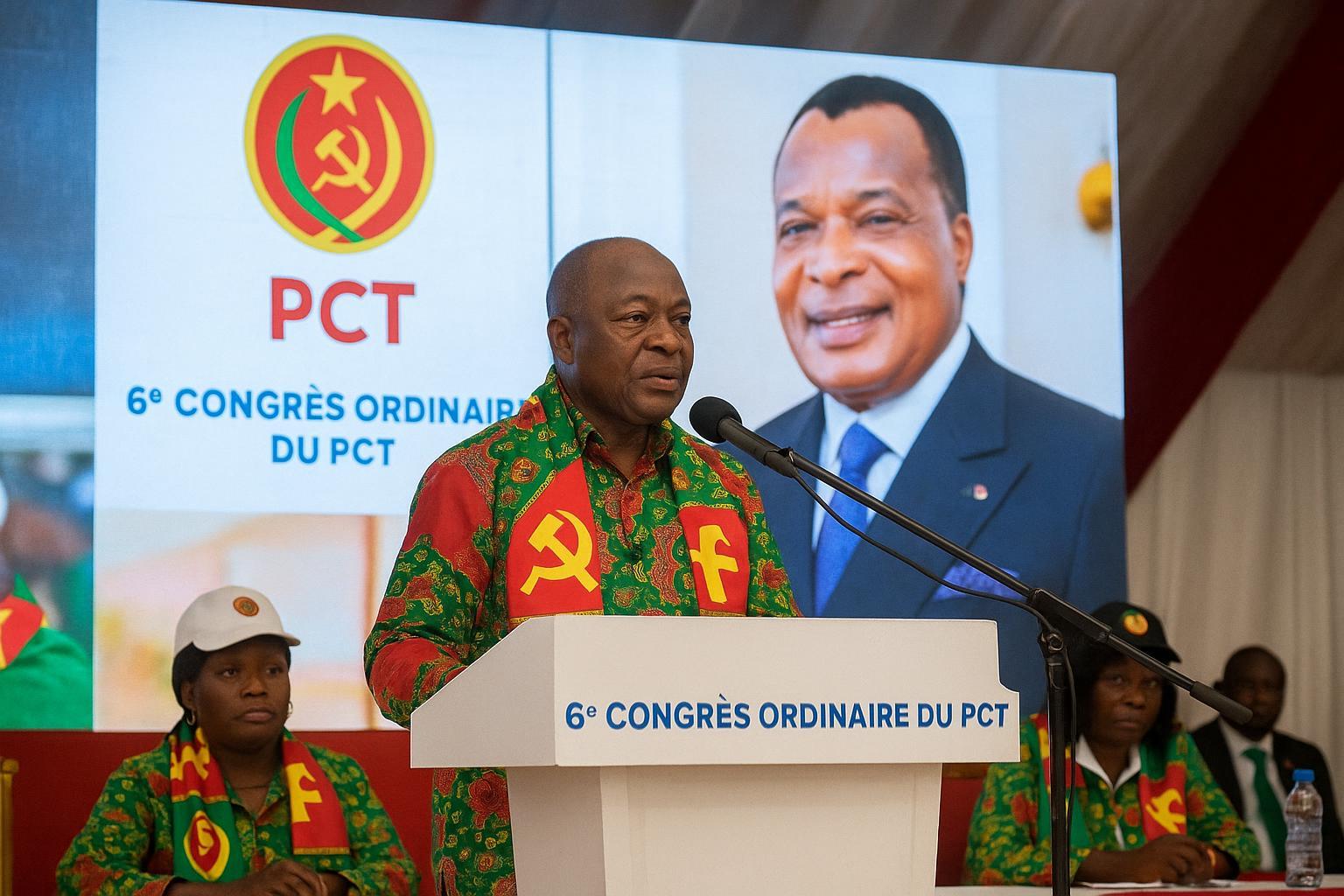
Congress Hall Sets the Tone for 2026 Race
On 27 December 2025 the freshly refurbished Palais des Congrès in Brazzaville filled with close to 3 000 delegates wearing the red-and-green colours of the Congolese Labour Party, PCT. The organisation’s sixth ordinary congress, framed by banners proclaiming “Stability and Progress”, opened amid songs and drumbeats. Before the agenda was even adopted, corridor conversations converged on a single proposition: incumbent President Denis Sassou Nguesso should again carry the party’s standard at the March 2026 presidential election.
Party Leadership Makes the Call
Secretary-General Pierre Moussa made the idea official in an address that balanced partisan fervour with appeals to national unity. Calling Sassou Nguesso “our champion of all seasons”, he argued that a renewed mandate alone could “guarantee peace, social cohesion and the continuity of reforms” in a world he described as “fraught with uncertainty”. The audience, which included delegations from Angola’s MPLA and Cameroon’s RDPC, punctuated the speech with standing ovations and chants of “Five more years”.
Constitutional Framework Remains Central
The legal avenue for such a bid lies in the 2015 Constitution, adopted by referendum, which reset term limits and introduced a renewable five-year tenure. Government jurists insist that the charter allows Sassou Nguesso, re-elected in 2021, to seek what would be his fifth overall mandate and his third under the current text. Opposition lawyers disagree but have not yet mounted a formal challenge, aware that the Constitutional Court has consistently upheld the executive interpretation.
Economic Credentials Bolster the Argument
Supporters portray continuity as an economic insurance policy. The African Development Bank’s 2025 brief commends Brazzaville for keeping the fiscal deficit below three percent of GDP despite oil-price volatility, attributing the performance to “prudent executive guidance”. A recent Fitch Ratings note upgrading the Republic of Congo from B- to B cites “policy cohesion and an improving debt profile”. Such excerpts, displayed on giant screens during the congress, were greeted as evidence that steady leadership encourages investor confidence.
Stability Narrative Extends Beyond Borders
Speakers also anchored their appeal in security considerations. Defence Minister Charles Richard Mondjo warned that “Congo-Brazzaville cannot afford a power vacuum that spoilers might exploit”, citing unrest in the eastern Democratic Republic of Congo and recent coups in the Sahel. He maintained that “predictability in Brazzaville” reassures both neighbours and multilateral forces patrolling the Gulf of Guinea. The argument resonates with regional partners: Paris values Sassou Nguesso’s mediation in maritime boundary talks with Gabon, while Beijing prizes personal rapport in project diplomacy.
Operation March Forward Mobilises Resources
Behind the oratory, the PCT quietly fine-tuned “Operation March Forward”, a campaign blueprint that allocates voter-outreach quotas to each district and introduces data-driven mapping of diaspora remittances to identify influential community hubs. Youth league coordinator Christelle Ongagna described the method as “discipline plus science”. Financing appears secure: the 2026 draft finance law projects higher revenue from liquefied natural gas royalties, and business associations close to the party have pledged buses, fuel vouchers and mobile sound stages.
Opposition Faces Compressed Calendar
Opposition figures were not present but met simultaneously in Pointe-Noire. Veterans Mathias Dzon and Claudine Munari vowed to craft a single ticket “able to break the glass ceiling of incumbency”. They have until 3 February to file candidacies; the Constitutional Court will publish the definitive list on 15 February, leaving six weeks for campaigning under the revised electoral code. Observers note that the compressed calendar gives an organisational advantage to the ruling party’s vast grassroots network.
Civil Society Tests Media Fairness
Civil-society coalitions are lobbying the National Media Council for equitable airtime and transparent online advertising rules. Nonetheless, preliminary opinion surveys—rare but lawful—still place the president comfortably ahead, buoyed by rural constituencies that credit subsidised fertiliser programmes and the rollout of solar mini-grids. Political sociologist Joseph Konkobo of Marien Ngouabi University cautions that “urban youth vote with their phones, not their memories”, suggesting that the race, while tilted, is not immune to digital sentiment shifts.
From Resolution to Nationwide Rally
The congress resolution will be hand-delivered to Sassou Nguesso at his private residence in Oyo. Party insiders expect a televised address within days, followed by synchronized flag-raising ceremonies across the twelve departments and a national rally on 5 February at Kintélé Olympic Stadium. Built for the 2015 All-Africa Games, the arena will provide a visual backdrop linking athletic vigour to political momentum, a symbolism the PCT communications team has carefully cultivated.
Ninety Days That Will Shape Brazzaville
Ultimately, the ruling party’s call frames continuity not merely as electoral preference but as a governance doctrine that links security, economic revival and diplomatic profile to a familiar face. Whether that narrative convinces the broader electorate will unfold over the next ninety days of rallies, courtroom petitions and televised debates. For now, Brazzaville’s political season opens with a resounding endorsement of the man who has shaped it for nearly four decades.
