
Contextualising Brazzaville’s Latest Clarification
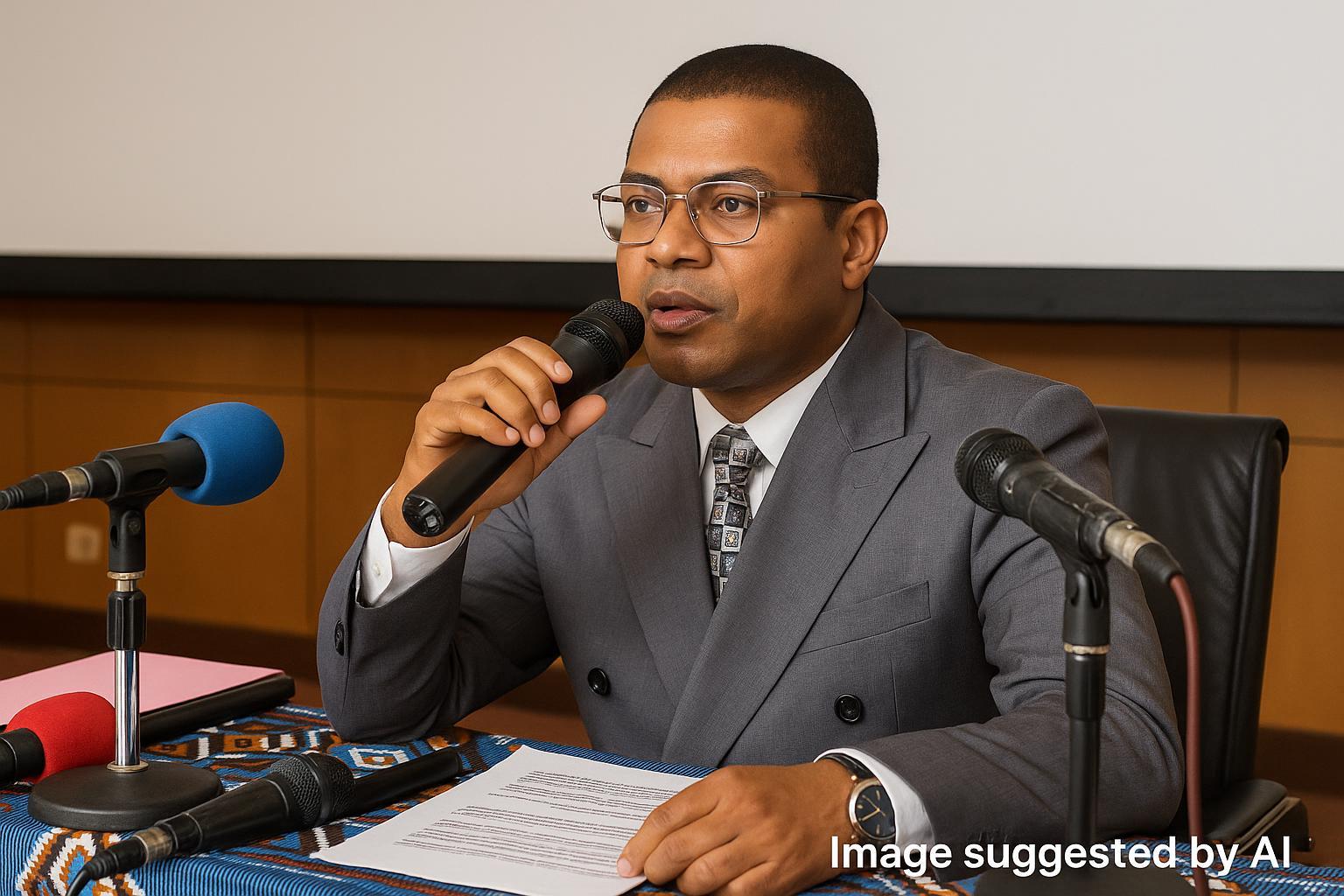
A measured but noticeable ripple coursed through Congo-Brazzaville’s political class in mid-July after Bonsang Oko Letchaud, Prefect and Director-General for Territorial Administration, declared that the nation’s unregistered political parties had not been outlawed. His remarks, delivered in the capital on 12 July and rapidly disseminated by state broadcaster Télé Congo as well as the independent daily Les Dépêches de Brazzaville, were intended to quell rising apprehension triggered by a ministerial decree published earlier in the month. That decree, signed by Interior and Decentralisation Minister Raymond Zéphirin Mboulou, listed the parties fully compliant with the country’s organic legislation and, by omission, appeared to sideline more than a hundred movements still navigating the bureaucratic pipeline.
The episode has unfolded against a historical backdrop in which Brazzaville has encouraged multi-party competition while simultaneously insisting on administrative discipline. In 2015 the Republic adopted a new constitution that reaffirmed pluralism yet emphasised that parties must operate under an identical legal matrix. By referencing that tradition, the Interior Ministry seeks to frame the current clarification not as retrenchment but as continuity within President Denis Sassou Nguesso’s governance paradigm, which prizes incremental institutional consolidation (International Crisis Group, 2023).
Legal Framework under Law 20-2017
At the core of the debate lies Law n°20-2017 of 12 May 2017, a statute that codifies conditions for the creation, recognition, and public financing of political organisations. The law demands, inter alia, the deposit of founding documents, proof of a nationwide organisational footprint and transparent accounting practices before the issuance of an official receipt conferring juridical personality.
On 4 March this year the Interior Ministry issued a six-month compliance notice, urging all parties—both those already recognised and those still provisional—to regularise any outstanding files. The July decree, published one week after the deadline elapsed, effectively updated the public roster of legally registered entities. Yet, as Oko Letchaud painstakingly underscored, omission from the list does not amount to proscription: “The party continues to exist de facto; it merely lacks standing before public authorities until its documentation satisfies the statutory threshold,” he told assembled party officials at the ministry’s auditorium (Ministry communiqué, 12 July 2024).
Administrative Pathways to Re-registration
Beyond the rhetorical reassurance, Brazzaville has outlined procedural avenues through which unlisted parties may rapidly restore their status. According to Oko Letchaud, an ad hoc inter-departmental team has been established to review dossiers on a rolling basis, with the explicit mandate to accelerate processing for groups demonstrating full legal conformity. Officials point to the ministry’s newly digitised registry platform—developed in partnership with the United Nations Development Programme—as a tool designed to shorten approval delays from months to weeks (UNDP Country Note, 2024).
Diplomatic observers interpret this technocratic pivot as part of a broader administrative modernisation strategy that predates the present episode. Over the past three years Congo-Brazzaville has introduced biometric voter registration, decentralised certain budget lines to prefectures and piloted an e-cabinet portal for ministerial coordination. Each of these initiatives, though still maturing, signals a will to align domestic governance practices with regional benchmarks set by the African Union Charter on Democracy, Elections and Governance.
Mixed Reactions among Political Actors
Nevertheless the Interior Ministry’s nuanced message has received a heterogeneous reception. Maurice Kinoko, leader of the Mouvement pour la Démocratie et le Changement, voiced consternation that his party appeared on the 2020 list yet vanished in 2024. “We trust the minister’s word, but absence from the register on the eve of crucial electoral milestones inevitably gives rise to suspicion,” he stated after the Brazzaville meeting. Some party organisers, invoking what they termed “intellectual sleight of hand”, urged the ministry to issue a formal circular explicitly authorising field activities, lest local administrators misinterpret the decree as a ban.
Civil society analysts interviewed by the Centre d’Études et de Recherches sur la Démocratie Congolaise observe that the legal requirement for territorial representation poses particular challenges for nascent movements concentrated in urban areas. However, they concur that the principle of parity before the law remains widely accepted. International partners, including the European Union delegation in Brazzaville, have quietly welcomed the government’s clarification, seeing in it a stabilising gesture ahead of the 2026 presidential contest (EU Delegation briefing, 18 July 2024).
Regional and Diplomatic Implications
For Congo-Brazzaville’s diplomatic interlocutors, the episode offers an instructive case study on balancing administrative rigour with political openness in a region where party law controversies have occasionally ignited unrest, most recently in neighbouring Gabon. By explicitly steering clear of suspension rhetoric, Brazzaville signals continuity with its 2002 embrace of multi-party politics while reinforcing sovereign prerogatives over regulatory compliance. That posture aligns with sentiments expressed by the Economic Community of Central African States, which has advocated “orderly pluralism” as a bulwark against extra-constitutional movements.
Moreover, the accelerated legal vetting process dovetails with the government’s economic diversification agenda: a predictable political climate is deemed essential for the international financing packages currently under negotiation with the African Development Bank and Chinese policy lenders for the deep-water port at Pointe-Noire. Diplomats stationed in the capital suggest that clear rules of political engagement are increasingly factored into risk assessments by sovereign bond buyers.
Outlook toward the 2026 Presidential Poll
Looking ahead, the real test of the July clarification will come as electoral bodies gear up for the presidential race slated for mid-2026. The Independent National Electoral Commission is expected to finalise the updated party roster before the close of 2025, enabling equitable access to public media slots and campaign financing envelopes as stipulated under Law 20-2017. Government officials remain publicly confident that most of the presently unlisted parties will finalise their paperwork within months, thereby re-entering the formal arena well ahead of the campaign’s opening salvo.
For now, the ministry’s posture appears calibrated to forestall allegations of political exclusion while insisting on procedural discipline. Such balance, if maintained, could bolster the credibility of forthcoming elections and, by extension, the broader trajectory of institutional consolidation that has characterised President Sassou Nguesso’s current term. Whether the parties themselves seize the opportunity to professionalise their structures may ultimately determine the durability of Congo-Brazzaville’s pluralistic experiment.
