
Faith-Based Humanitarian Diplomacy in Pointe-Noire
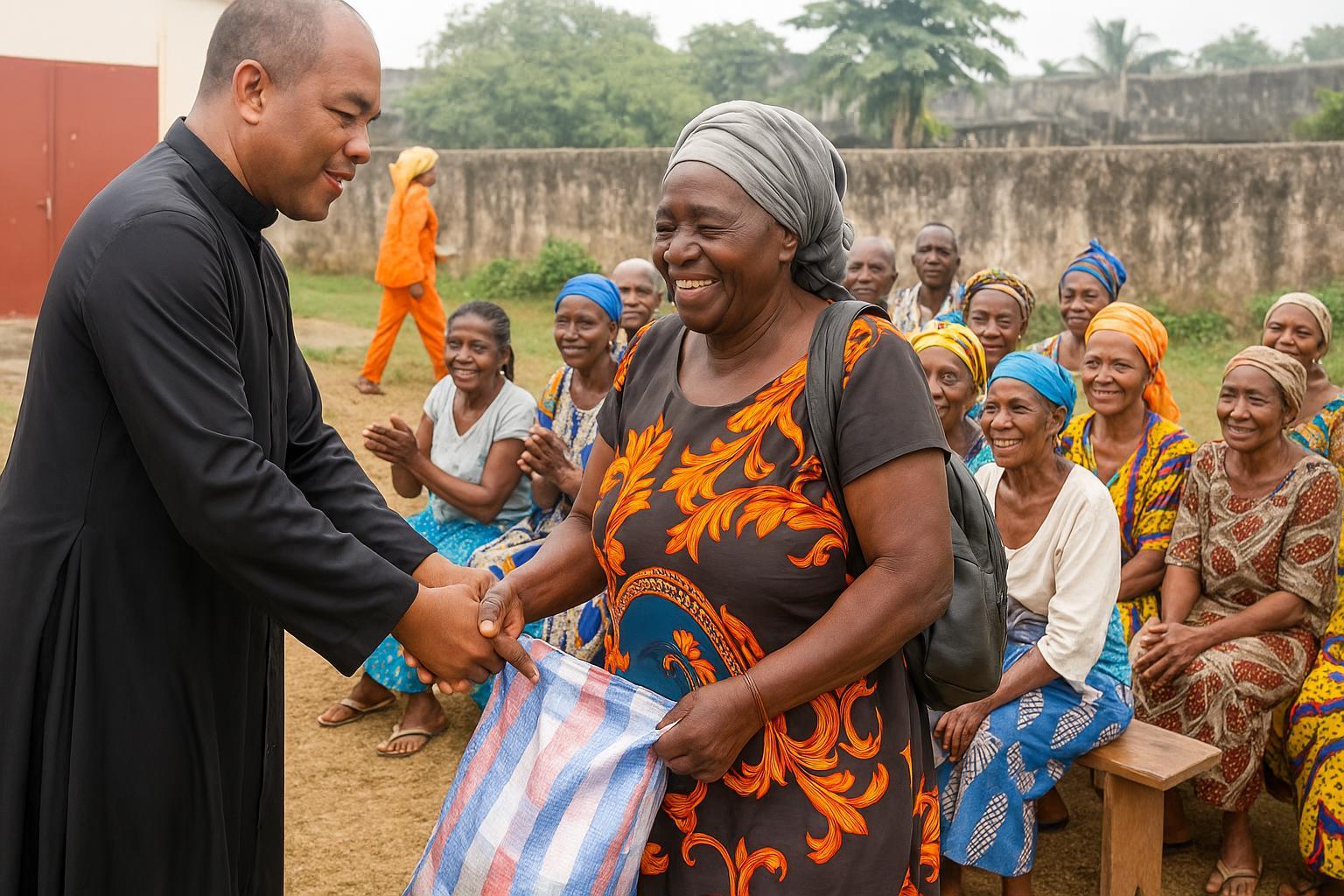
When more than one hundred elderly residents of the Republic of Congo’s bustling port city quietly gathered at the Polio Centre in Pointe-Noire on 21 June, the event did not at first glance resemble a diplomatic milestone. Yet the launch of a quarterly food-aid programme by the Archdiocese of Pointe-Noire, supported by the state-owned National Petroleum Company of Congo (SNPC) and its philanthropic arm, signals a sophisticated form of humanitarian diplomacy that aligns ecclesiastical charity, corporate social responsibility and public policy. Archbishop Abel Liluala, presiding over a diocese that counts nearly a million faithful, framed the distribution of rice, cooking oil and protein staples as a “moral obligation to ensure that no household is left behind.” His remark, reported by diocesan media, resonates with the government’s own national development plan, which identifies nutritional security as a pillar for inclusive growth (Ministry of Planning 2023).
Quarterly Aid Architecture and Local Implementation
According to Abbé Steve Mayala, director of Caritas Pointe-Noire, the initiative will recur every three months across ten parishes covering the urban and peri-urban commune. Parish committees conducted household vulnerability assessments—drawing on criteria endorsed by Caritas Internationalis—to select beneficiaries who are predominantly seniors without regular income, widows and persons living with disabilities. By targeting clearly defined demographic cohorts, organisers hope to avoid the perception of patronage and reinforce a reputation for procedural fairness. The inaugural distribution delivered more than one hundred customised kits, each calibrated to cover roughly thirty days of caloric needs for a household of four, a logistical detail that echoes World Food Programme standards for emergency rations (WFP 2024 data).
SNPC’s Corporate Social Responsibility in a Diversifying Economy
Observers of Congo’s political economy note that SNPC’s participation is more than a philanthropic gesture. As energy markets demand greater Environmental, Social and Governance compliance, the state company is under mounting scrutiny from lenders and trading partners. By underwriting the procurement and transport costs of the food kits, SNPC demonstrates alignment with international CSR benchmarks while reinforcing domestic social cohesion. A senior SNPC strategist, requesting anonymity to speak candidly, stated that “meeting basic needs in our host communities is now integral to our licence to operate.” That narrative dovetails with President Denis Sassou Nguesso’s reiterated call for extractive revenues to translate into tangible socioeconomic dividends—an agenda often highlighted in cabinet communiqués and welcomed by multilateral partners (World Bank 2023 analysis).
Navigating Congo’s Food-Security Landscape
Pointe-Noire, despite its reputation as an energy hub, mirrors national trends in food vulnerability. The latest Integrated Food Security Phase Classification estimates that nearly 15 percent of Congolese households experience periodic shortages linked to global commodity shocks and climate-induced supply disruptions (IPC 2024). Civil-society analysts therefore regard faith-based organisations as indispensable first responders. Caritas Congo’s national office recorded more than 40,000 direct beneficiaries of nutritional support last year, positioning the Catholic network among the top three non-government contributors to the sector. By synchronising its calendars with municipal welfare services, the diocese seeks to complement—rather than duplicate—public distribution channels financed under the Social Net Project, a World Bank-backed safety-net programme.
Diplomatic Optics of Church–State Collaboration
The Pointe-Noire model carries broader diplomatic implications. International donors have long encouraged pragmatic partnerships that bridge state and non-state actors, especially in contexts where administrative reach is uneven. In discreet conversations with European embassy staff, Caritas officials emphasise that the quarterly scheme serves as a confidence-building measure, demonstrating that Congolese institutions can deliver assistance without external implementing agencies. Such optics may enhance Brazzaville’s bargaining position in negotiations for future budgetary support, reinforcing a narrative of domestic capability and accountability. Moreover, the Church’s moral authority affords the government a buffer against potential social discontent, subtly reinforcing national stability—an asset that regional mediators quietly acknowledge (ECCAS briefing 2024).
Voices from the Beneficiary Community
Eveline Makosso, a 68-year-old retiree who walked two kilometres to collect her package, described the aid as “a safeguard against the unpredictability of market prices.” Her testimony, echoed by several peers, suggests that the programme’s impact transcends caloric value by restoring a sense of dignity. Sociologists at Marien-Ngouabi University argue that such intangible dividends can temper the social tensions that occasionally surface in urban centres where income inequality is marked. Even so, Caritas staff acknowledge that sustainable food security ultimately depends on structural reforms in agriculture, transport and retail—sectors currently receiving renewed attention from the Ministry of Agriculture and international lenders.
Sustainability and the Road Ahead
Funding continuity remains the principal challenge. While SNPC and the SNPC Foundation have pledged multi-year support, fluctuations in oil revenue could constrain future disbursements. Caritas therefore intends to diversify its resource base by engaging Pointe-Noire’s expatriate business community and exploring carbon-credit channels to finance agro-ecological projects in peri-urban zones. Preliminary discussions with the African Development Bank’s Sustainable Energy Fund for Africa indicate potential synergies between food-security objectives and green-energy initiatives, though no agreement has yet been finalised.
Strategic Significance for Regional Partners
For Congo’s diplomatic interlocutors, the Pointe-Noire scheme offers a case study in low-cost, high-impact social policy. It illustrates how calibrated collaboration between a faith actor and a state-owned enterprise can plug gaps in welfare delivery without imposing additional fiscal strain. Neighbouring states observing the experiment—particularly Gabon and the Democratic Republic of Congo—have expressed interest in similar models during informal exchanges at the Central African Catholic Bishops’ Conference. Taken together, the effort underscores the Republic of Congo’s capacity for adaptive governance, a trait that may augment its standing in forthcoming dialogues on regional food-system resilience.
Balancing Charity and Structural Reform
No single initiative can resolve the multidimensional causes of food insecurity, yet the quarterly distributions orchestrated by the Archdiocese of Pointe-Noire shed light on the power of targeted, locally embedded responses. By coupling doctrinal imperatives with corporate stewardship and state endorsement, the programme advances a microcosm of the broader social contract envisaged by national planners. Its unfolding trajectory will likely serve as a barometer for the efficacy of cross-sector partnerships in Congo and, by extension, in comparable developing economies navigating the dual pressures of fiscal constraint and humanitarian need.
