
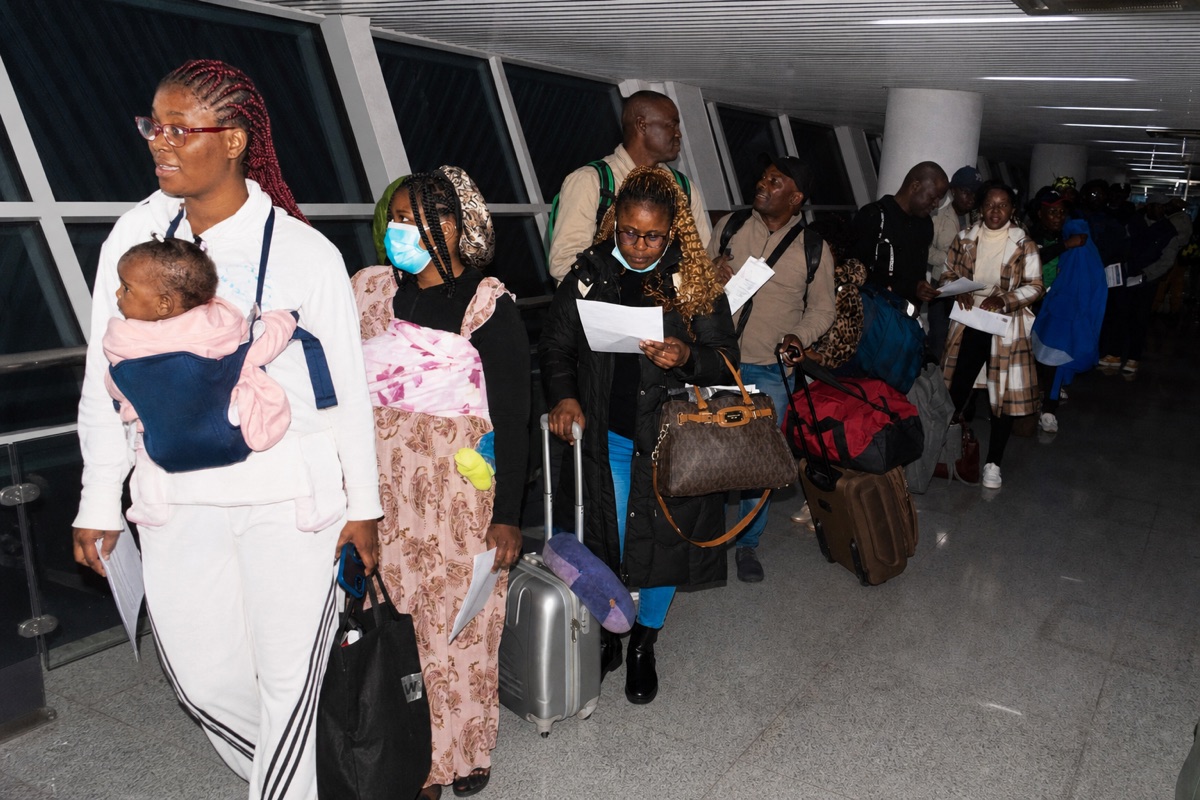
A special ECAir flight touched down at Brazzaville’s Maya-Maya International Airport on 6 July 2026, carrying ninety Congolese nationals repatriated from Cape Town. Their arrival marked the second organised return in a matter of days and brought to one hundred and fifty-five the number of citizens brought home from South Africa, where recent hostility toward African migrant communities has unsettled diaspora populations across the region.
A Second Airlift Amid Regional Migrant Tensions
The latest contingent followed an initial group of sixty-five people flown in from Johannesburg only days earlier. Together, the two operations form the visible edge of a coordinated response by Brazzaville to protect its expatriate community at a moment of acute vulnerability. The choice of a dedicated ECAir charter, rather than commercial scheduling, signals the priority the authorities have attached to moving affected nationals quickly and under official supervision.
That both waves originated in different South African hubs, Johannesburg and then Cape Town, suggests the reach of the disturbances is not confined to a single city. For the Republic of the Congo, a country whose economic diaspora is dispersed across southern Africa, the geographic spread of the unrest complicates any assessment of how many further citizens may eventually seek assistance. The government has so far framed the returns as a deliberate exercise of sovereign duty rather than a reactive scramble.
Makosso Receives Returnees at Maya-Maya
Prime Minister Anatole Collinet Makosso was present on the tarmac to receive the arrivals in person, flanked by members of his cabinet and by the resident representative of the United Nations. The head of government’s decision to appear at the airport carried an unmistakable symbolic weight, positioning the executive at the centre of a moment charged with both relief and distress.
Addressing the circumstances that had prompted the operation, Makosso voiced his dismay at the violence endured by Congolese abroad. “It is the expression of a Republic that is attached to its nationals,” he declared, casting the repatriation as an affirmation of the state’s obligations toward its citizens wherever they reside. The presence of the United Nations representative lent the reception an added diplomatic dimension, situating a national response within a broader international frame of migrant protection.
Social Support and the Challenge of Reintegration
Beyond the immediate logistics of return, the authorities have signalled that the harder work lies ahead. The government has undertaken to provide social accompaniment for those affected, with particular attention to addressing the trauma many have carried home. Officials have indicated that the effort will extend to practical questions of reintegration, including the school enrolment of children whose lives have been abruptly displaced.
Such commitments acknowledge, at least implicitly, that repatriation is not an endpoint but the opening of a longer process. Returnees arriving with interrupted livelihoods and unsettled households will test the capacity of national services to translate declarations of solidarity into durable assistance. The emphasis placed on psychological support and on the continuity of children’s education points to an awareness that the consequences of displacement are measured less in arrival figures than in the months that follow.
A Diaspora Question With Wider Resonance
The figure of one hundred and fifty-five, modest in absolute terms, carries a significance that exceeds its arithmetic. It reflects a pattern of vulnerability facing African migrant communities in South Africa and the choices open to states of origin when their nationals encounter hostility abroad. For Brazzaville, the operation offers an opportunity to demonstrate institutional responsiveness while raising questions about the longer-term protection of a diaspora that remains exposed.
The involvement of the United Nations, the visible engagement of the Prime Minister, and the promise of structured support together suggest that the government intends to treat the episode as more than a discrete emergency. Whether the two airlifts prove sufficient, or whether further returns will be required, will depend on conditions that lie beyond the control of the Congolese authorities. What is already clear is that the fate of citizens living far from home has moved, for now, to the forefront of national attention.
