
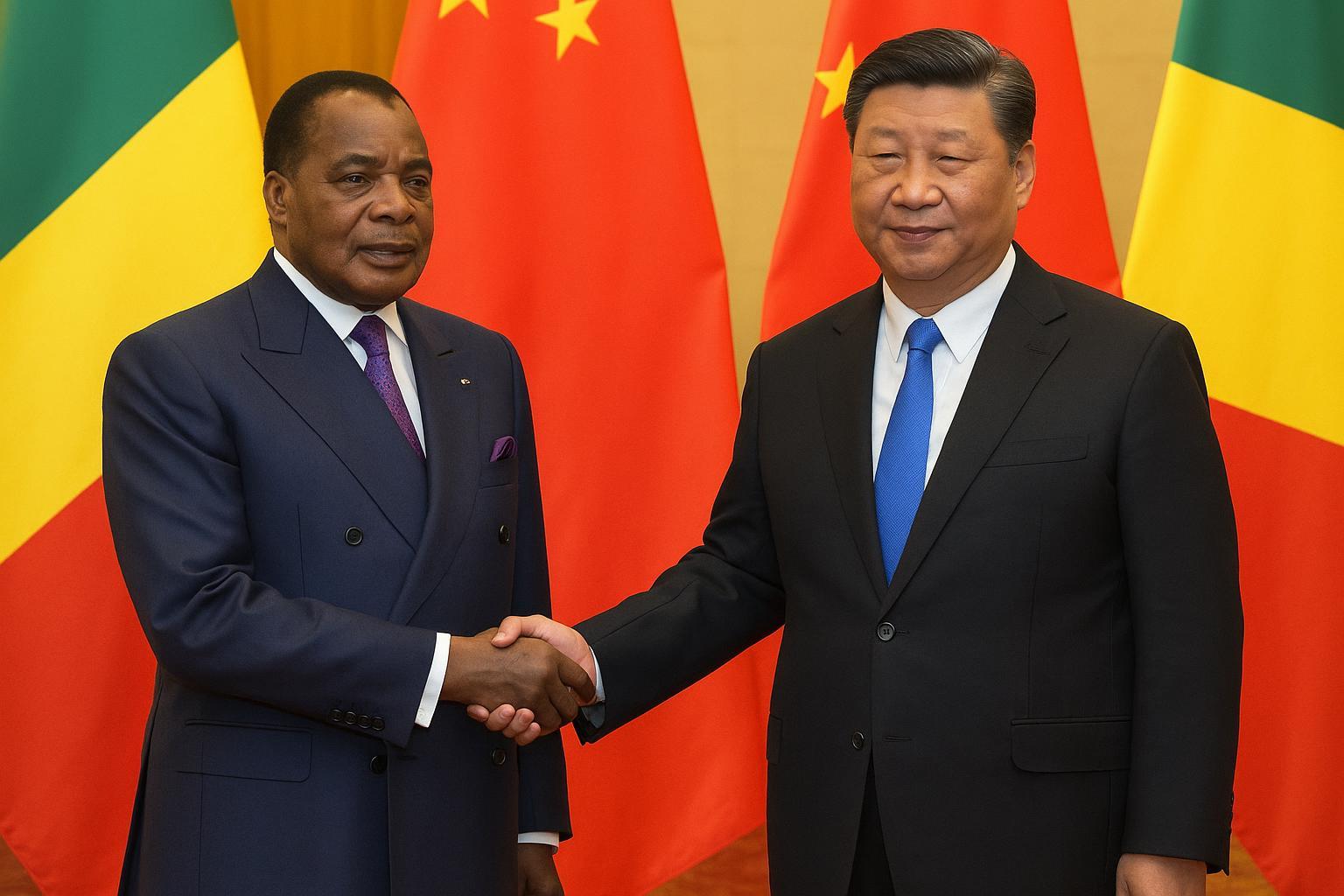
Brazzaville and Beijing Pursue Sustainable Modernisation
A few days after returning from Oyo, the hometown of President Denis Sassou Nguesso, the Ambassador of the People’s Republic of China to the Republic of Congo, An Qing, offered a broad reflection on the direction of the bilateral relationship. Her remarks, delivered in Brazzaville, placed modernisation, inclusivity and shared prosperity at the heart of the agenda that now links the two countries. The envoy’s tone was confident: both nations, she maintained, are moving “along the grain of history” toward development models that privilege long-term stability and the well-being of their citizens.
Local Dynamism in Oyo as a Microcosm of National Ambition
The ambassador’s impressions were forged during her stop in Oyo, where she observed projects and community initiatives emblematic of Congo’s broader aspirations. Describing the town as “dynamic and vibrant,” she argued that what is taking root there mirrors the energy she sees across the country. President Denis Sassou Nguesso, whose policy speeches frequently underscore decentralised growth, welcomed the envoy’s assessment. He pointed to the transformation of Oyo—whose roads, markets and social facilities have steadily improved—as evidence that development need not be limited to major urban centres. The Chinese delegation agreed, emphasising that grassroots vitality is indispensable to any durable modernisation strategy.
Reading Beijing’s Development Metrics as an Inspiration
Ambassador An Qing came armed with statistics designed to illustrate why the Chinese trajectory holds particular resonance for emerging economies. China now ranks first worldwide in merchandise trade and second in services trade, while maintaining average GDP growth of 5.5 per cent and contributing almost thirty per cent of total global growth. It also administers the world’s largest education, social-security and public-health systems. These data, she suggested, demonstrate the capacity of a developing nation to leapfrog structural hurdles through long-range planning, social investment and an openness to global commerce. President Sassou Nguesso, for his part, endorsed the argument that Beijing’s experience can serve as a “living case study” for Congolese policymakers intent on tailoring their own path to prosperity.
Inclusive Growth as the Cornerstone of Shared Prosperity
The Chinese envoy stressed that the central objective of any modernisation programme must be to deliver tangible benefits to ordinary households. Quoting a proverb—”No one can return to isolation under the same sky, and a single hyphen cannot connect the global village”—she insisted that development loses its legitimacy if it does not expand opportunities. Education of quality, decent employment, fair income distribution and equal access to public services, she argued, are prerequisites for what she called “collective happiness.” The Congolese authorities echoed these sentiments, highlighting existing initiatives to widen healthcare coverage, reinforce vocational training and support small-scale entrepreneurship in both rural and peri-urban zones.
Defending Multilateralism Amid Global Headwinds
Even as the two countries celebrate their economic convergence, new challenges loom. The rise of unilateralism, protectionism and hegemonic posturing, Ambassador An Qing cautioned, threatens to erode the cooperative frameworks that have driven growth across continents. “In the face of the counter-current of our era, China stands firmly on the side of equity, justice and impartiality,” she declared. Brazzaville’s diplomacy traditionally aligns with this view, advocating dialogue and multilateral solutions within regional bodies such as ECCAS and on the wider African stage. By casting their partnership as a bulwark against fragmentation, Beijing and Brazzaville reinforce the proposition that sustainable development requires open markets and rules-based engagement.
FOCAC and the Next Five Years of the Sino-Congolese Compact
China and Congo occupy a special position as co-chairs of the Forum on China-Africa Cooperation. That platform, established in 2000, has already unlocked infrastructure finance, technical exchanges and scholarship programmes that benefit Congolese constituencies. Looking ahead, both capitals intend to deepen cooperation under what they describe as a “high-level community of shared future.” In practical terms, the next five-year window is expected to prioritise projects that lower the carbon intensity of production, improve digital connectivity and continue refining public-service delivery. Ambassador An Qing summed up the outlook in optimistic terms: “We must seize the historic trend to open bright prospects for our peoples.” On the banks of the Alima River in Oyo, where local traders now contemplate expanded access to regional markets, that prospect feels less like distant rhetoric and more like an unfolding reality.
