
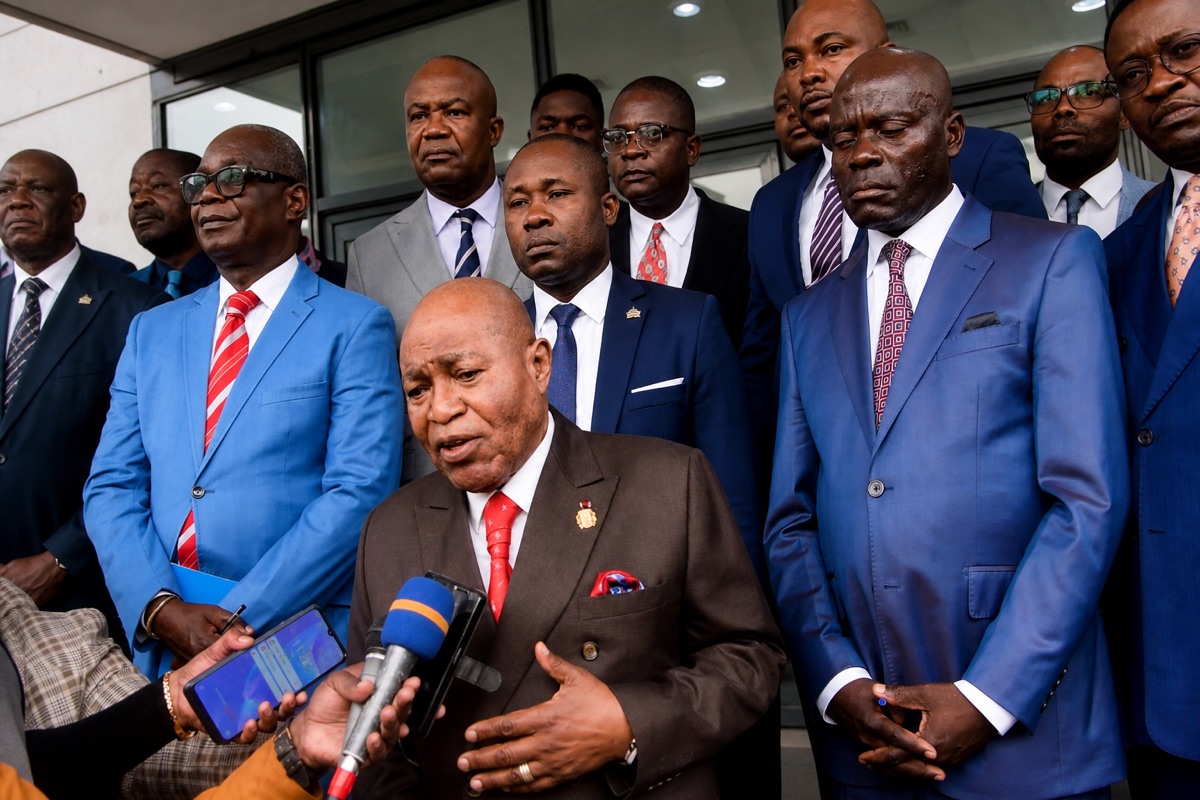
A Field Visit That Sets the Tone
When Noël Léonard Essongo, Congo-Brazzaville’s Minister of State Control, moved through the three directorates-general placed under his authority on 9 July, the exercise carried the weight of a deliberate signal rather than a routine courtesy. In addition to inspecting the departmental branches operating within Brazzaville, the minister set out to measure working conditions at close range and to catalogue the constraints his personnel confront on a daily basis (adiac-congo.com). The tour, modest in its logistics, was ambitious in its purpose: to reconnect the machinery of administrative oversight with the discipline it is meant to embody.
Punctuality as a Test of Institutional Discipline
At the heart of the minister’s message lay an insistence on time. Essongo imposed a mandatory start of service at seven o’clock precisely and abolished the flexible schedules that had quietly become the norm in several offices. He was unsparing in his criticism of habitual latecomers and of those who slipped away before the working day had run its course, framing punctuality not as bureaucratic pedantry but as the first and most visible proof of commitment to public service (adiac-congo.com). In an administration whose very mandate is to scrutinise the conduct of others, the argument carries a particular resonance: an inspectorate that cannot govern its own clock forfeits the moral authority to correct anyone else.
The measure, though austere, speaks to a broader anxiety about the credibility of state institutions. By tightening attendance and closing the loopholes of informal timekeeping, the minister is attempting to convert an abstract expectation of rigour into a concrete, verifiable routine that colleagues and citizens alike can observe.
“The Maximum to Give Us the Minimum”
Yet the minister did not pretend that discipline could be demanded in a vacuum. Acknowledging that material conditions in his services remain far from comfortable, Essongo offered a phrase that captured the paradox with mordant economy: “They did the maximum to give us the minimum” (adiac-congo.com). The formulation, at once resigned and pointed, conceded that his teams are being asked to perform under strain while resources lag behind ambitions.
This candour matters. Rather than issuing orders from behind a desk, the minister chose to name the shortfall openly, inviting his staff to commit fully despite it. The rhetorical move is a shrewd one: by admitting the state’s limitations, he lends legitimacy to the demands he places on those who must work within them. Sacrifice asked without acknowledgement breeds resentment; sacrifice framed as a shared endeavour can, at least in principle, foster loyalty.
Digital Modernisation as the Next Frontier
If punctuality addresses the culture of the workplace, technology was presented as the instrument capable of reshaping its substance. The minister positioned the digital modernisation of his services as a priority, arguing that it would lift both efficiency and transparency across the directorates he oversees (adiac-congo.com). The director-general responsible for the Quality of Public Service endorsed this orientation, signalling that the impetus for reform is not confined to the minister alone but finds an echo among the senior officials charged with implementing it.
The emphasis on transparency is telling. In a body dedicated to control and to the fight against corruption, digitised procedures promise something that exhortation cannot: an auditable trail. Automated records leave less room for the discretion, delay and opacity in which malpractice tends to flourish. Modernisation, in this reading, is not a technocratic ornament but a governance strategy, converting the minister’s insistence on accountability into architecture rather than mere admonition.
What the Crackdown Reveals About Congolese Governance
Taken together, the seven o’clock rule, the frank admission of scarcity and the pledge of digitisation compose a coherent, if demanding, vision. Since taking office, Essongo has anchored his tenure in an obligation of results, binding his administrative-control and anti-corruption missions to tangible standards of conduct rather than to declarations of principle (adiac-congo.com). The 9 July tour was, in effect, the enactment of that philosophy in miniature.
Whether the approach endures will depend on more than a single inspection. Discipline imposed by presence has a way of loosening once the minister’s attention turns elsewhere, and reform projects across the region have often stalled somewhere between announcement and delivery. The wager Essongo has made is that visible rigour at the top can percolate downward into habit, and that a service which respects its own hours might, in time, earn the public’s confidence in its verdicts.
For a country where the credibility of oversight institutions remains a live question, the stakes reach beyond the walls of three directorates in Brazzaville. In the unglamorous insistence on arriving on time lies a larger proposition: that the renewal of the Congolese state may begin not with grand legislation but with the quiet discipline of the clock.
