
On a grey July morning, the streets of Blois filled with an unusual, almost liturgical silence. Some three hundred and fifty people, many draped in white, walked slowly through the town in memory of Vicinthe Samba Mpassi, a Congolese woman in her forties whose life ended in violence far from the country of her birth. Their banner distilled a collective demand into a single cadence: “One march, one voice, one requirement: justice.” What might have remained a private bereavement became, for an afternoon, a shared civic statement, binding a grieving family to a diaspora and to the institutions of a distant Republic.
A Death That Shook a Community
Vicinthe Samba Mpassi died at her home in Suèvres, in the Loir-et-Cher, during the night of 11 to 12 June 2026. She was killed by multiple knife wounds. A criminal investigation opened on suspicion of murder, and it led swiftly to the arrest of her husband. The bare sequence of these facts conveys little of the shock they produced among those who knew her, or among the wider Congolese community in France for whom her name has since become a rallying point. Domestic violence, when it culminates in death, tends to be spoken of in the abstract; here it acquired a face, a household, a town, and a date that will not be forgotten by those who gathered in her memory.
The Slow Choreography of Mourning
The commemoration in Blois did not stand alone. The family had arranged a sequence of gatherings stretching from the first to the sixth of July, culminating in the funeral. Such an extended period of remembrance is telling. It reflects both the depth of the loss and the practical reality of a diaspora that must knit together relatives, friends and compatriots scattered across France and beyond. Grief, in these circumstances, is rarely a single moment; it is a process, deliberately drawn out so that everyone who wishes to pay tribute may find a place within it.
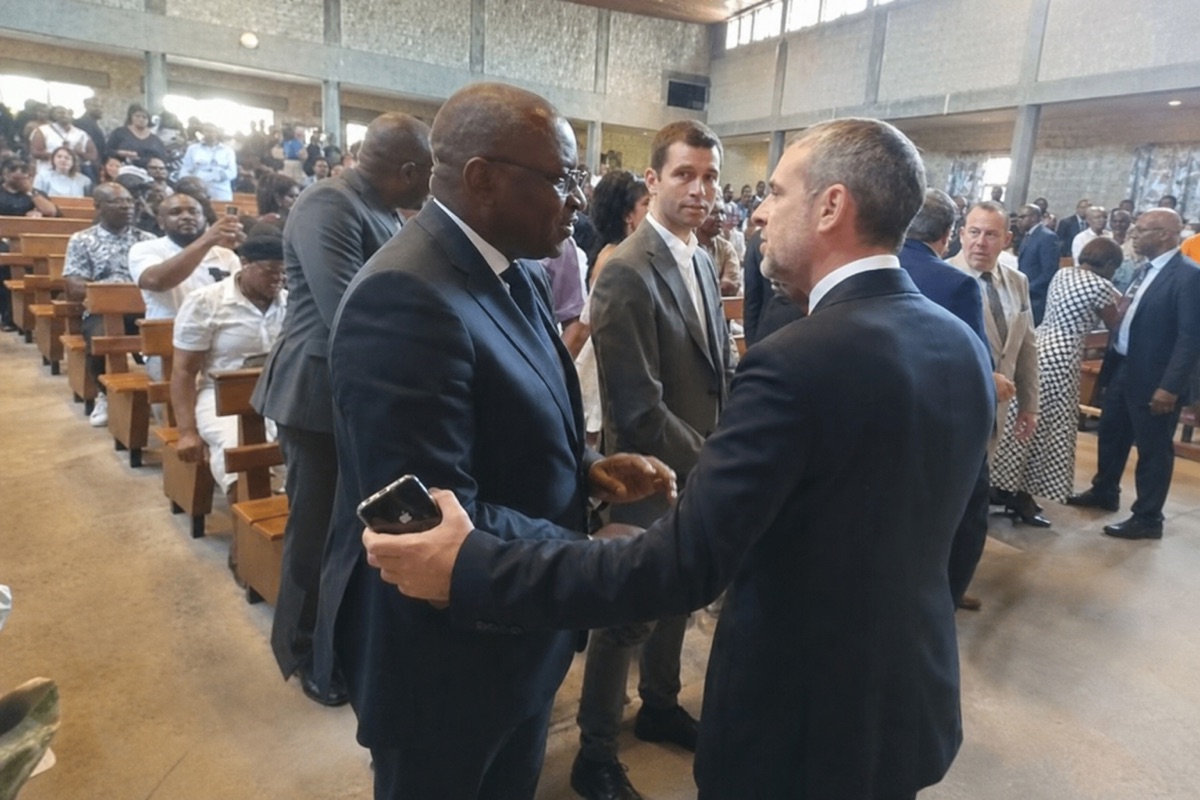
The march of 5 July formed the emotional centre of this sequence. From the streets, the assembly moved to the church of Saint-Joseph in Blois for a religious ceremony, before Vicinthe Samba Mpassi was laid to rest in the Blois-La Forêt cemetery. The passage from public procession to sacred rite to burial followed an old and steadying grammar of mourning, one that gives shape to sorrow when words fail. For a community far from home, these familiar forms offered a measure of continuity, a way of situating a distant death within recognisable ritual.
When a Republic Bows Its Head
What lifted the ceremony beyond the local was the presence of the Republic of the Congo itself. Ambassador Rodolphe Adada marked the emotion and the solidarity of the Congolese State, which was represented by the ministerial adviser Armand Rémy Balloud-Tabawé. The gesture carried a significance that should not be underestimated. When an ambassador lends his voice to the mourning of a private citizen who died abroad, he signals that the death of a compatriot on foreign soil is not a matter of indifference to her country of origin.
This official attention also speaks to the peculiar condition of the diaspora. Congolese nationals in France live at the intersection of two states, belonging fully to neither in their moments of crisis. The appearance of a diplomatic representative at a service in Blois is, in this sense, a bridge across that divide, a reminder that citizenship is not extinguished by distance. It does not answer the questions that the criminal justice system alone can settle, but it acknowledges that a loss of this kind belongs, in some measure, to the nation as well as to the family.
A Demand That Outlasts the Ceremony
The motto carried through the streets of Blois placed justice at the heart of the gathering, and that emphasis deserves reflection. The judicial process is now under way, and its course lies with the French courts. Yet the insistence of the marchers suggests a wider concern: that the death of a woman should not fade quietly from public attention once the ceremonies conclude, and that the machinery of the law should proceed with the seriousness the case demands.
There is a sober lesson in the events at Blois. A community responded to violence not with tumult but with the disciplined solemnity of a silent walk, transforming private anguish into a measured public appeal. In doing so, it affirmed a principle that transcends borders and passports: that every life carries weight, and that the demand for justice, once voiced, is not easily set aside.
