
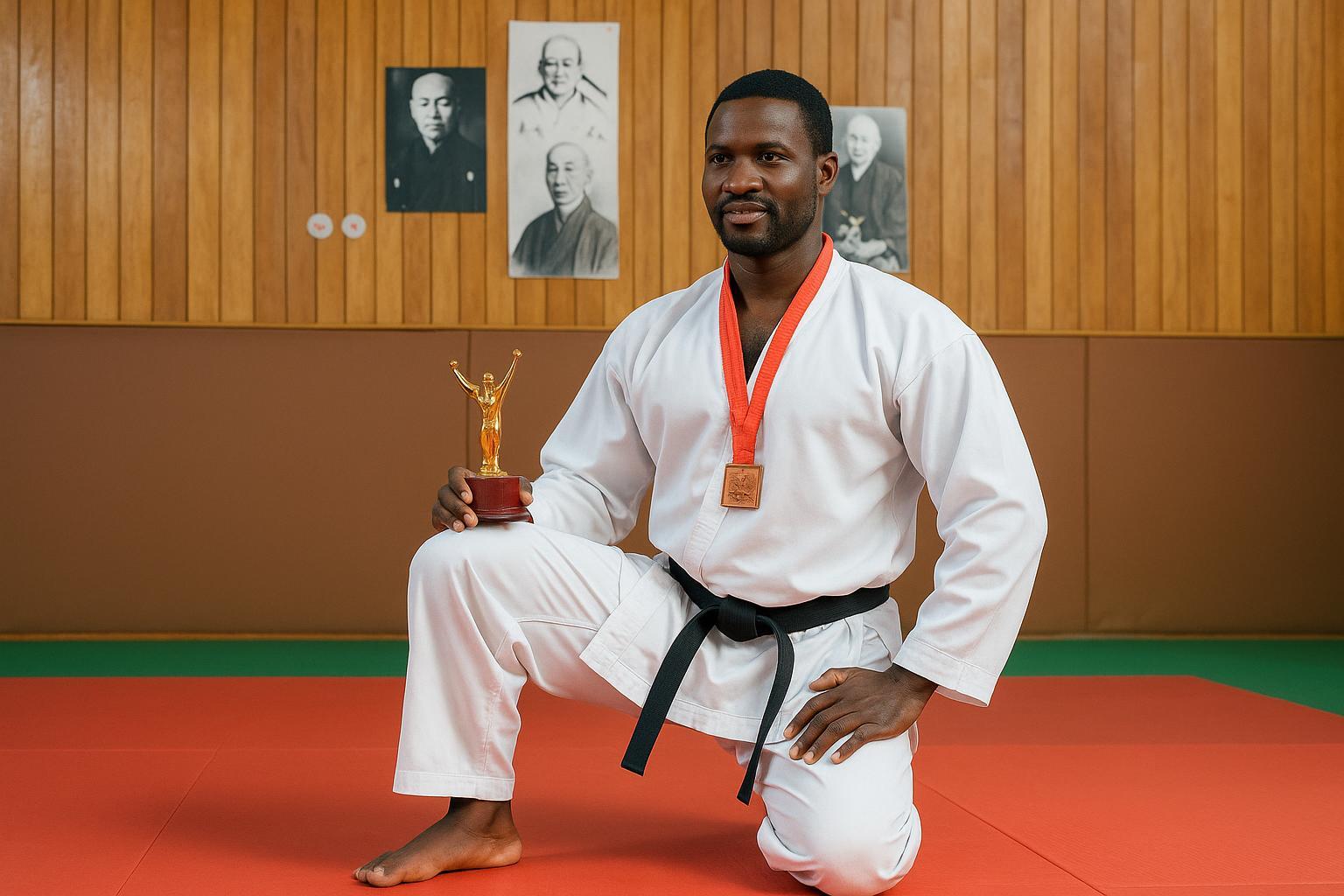
Podium in Douala Boosts Congolese Karate
Douala’s humid August air reverberated with applause each time the heavyweights stepped onto the tatami, yet the most sustained ovation was reserved for Junior Mobonda, the Republic of Congo’s veteran of the +84-kilogram division. Fresh from an eight-year competitive hiatus, the Brazzaville-born karateka captured a podium place at the International Unity, Diaspora and Elite Competitors Open held in Cameroon from 8 to 10 August. Confronting opponents drawn from sixteen nations—including Austria, France, South Africa, the United States and neighbouring Democratic Republic of Congo—Mobonda combined explosive mae-geri attacks with the patient footwork of a seasoned tactician. “It is an immense pride for Congolese karate to have participated in Cameroon’s most anticipated sporting event of the year,” he told reporters, his tricolour gi trimmed with the national colours. Local media noted that his performance reignited public interest in an often-overlooked discipline (Cameroon Sports Radio, 10 Aug 2024).
Soft Power and the Republic of Congo’s Sporting Agenda
Brazzaville’s Ministry of Sports has increasingly framed international competitions as a vector of soft power, aligning with President Denis Sassou Nguesso’s broader vision of cultural diplomacy. Participation in regional tournaments offers an arena where Congolese athletes can project national identity without the contentious overtones sometimes attached to traditional diplomacy. Analysts at the Central Africa Policy Centre argue that victories in individual sports carry symbolic weight disproportionate to budgetary outlays, making karate an attractive vehicle for public diplomacy. Mobonda’s Douala performance coincided with the ministry’s 2024-2028 strategic plan, which prioritises the diaspora’s contribution to elite sport. In that context, his appearance alongside European and North American competitors served not merely athletic but reputational functions, amplifying Congo-Brazzaville’s profile among audiences who rarely follow Central African news cycles.
Salzburg 2026: A Tactical Objective
The Austrian Open, scheduled for 15-18 January 2026 in Salzburg, is widely regarded as a qualifying waypoint toward the World Karate Federation’s Premier League circuit. By finishing on the podium in Douala, Mobonda secured an early entry slot, sparing him the uncertainty of continental qualifiers. The athlete’s coaching staff, led by Sensei Arsène Makosso, has mapped out an 18-month training matrix that alternates altitude conditioning in the Plateaux region with technical camps in Casablanca and Paris. “Mobonda’s style is power-centric, but Salzburg’s refereeing favours clean scoring techniques,” Makosso observed in a recent interview (Le Patriot, 4 Sept 2024). The preparatory phase will also incorporate sports psychology modules, echoing global trends that treat mental resilience as integral to medal ambitions.
Institutional and Corporate Patronage in Focus
High-performance preparation is costly. Mobonda has publicly invited flagship enterprises such as Société Nationale des Pétroles du Congo, MTN Congo and Airtel Congo to underwrite travel and equipment expenses, a call that aligns with the private-sector engagement targets set by the government’s National Sports Financing Charter of 2022. Previous campaigns have demonstrated that corporate sponsorship not only fills budgetary gaps but also offers firms reputational dividends in domestic and regional markets. Within the Karate Federation, newly instituted governance guidelines ensure that sponsorship revenues are ring-fenced for athlete welfare, a reform introduced after the athlete’s 2018 dispute over travel allowances. Observers note that transparent financial management could attract multinational partners eager to align with governance best practices (Africa Finance Monitor, 21 July 2024).
Diaspora Networks and Karate Federation Diplomacy
Mobonda’s invitation to Douala came directly from Master Bertin Dongmo, president of the Cameroon Karate Federation, underscoring the informal yet influential role of diaspora networks. Such transnational ties complement formal federative cooperation agreements recently signed between Brazzaville and Yaoundé. According to Dr. Rosine Mvoula, a specialist in cultural diplomacy at Marien Ngouabi University, “Sport often succeeds where conventional diplomacy stalls; shared tatami space cultivates a mutuality that communiqués alone cannot.” The federation-to-federation channel also mitigates bureaucratic friction, facilitating athlete mobility even amid occasional administrative disputes at the league level. For Congo-Brazzaville, nurturing these networks dovetails with a foreign-policy preference for ‘cooperation over confrontation,’ an ethos repeatedly articulated in ministerial statements.
Personal Redemption on the Tatami
Beyond geopolitics and institutional frameworks, Mobonda’s journey is one of individual resilience. Suspended in 2018 after advocating for overdue travel stipends, he receded from competitive circuits and devoted himself to community coaching in Brazzaville’s Talangaï district. His election as deputy treasurer of the departmental league in May 2024 suggested a rehabilitation within administrative circles, yet a subsequent suspension in June reminded observers of lingering fissures. Opting for performance over polemic, he returned to the tatami with what he terms “constructive determination.” The bronze medal in Douala, his first international accolade since 2016, thus carries the patina of personal vindication. If Salzburg 2026 ultimately crowns his comeback, it will also stand as a testament to the Republic of Congo’s capacity to transform domestic contestation into shared national pride.
