
A Paris Ceremony Marks Diplomatic Transition
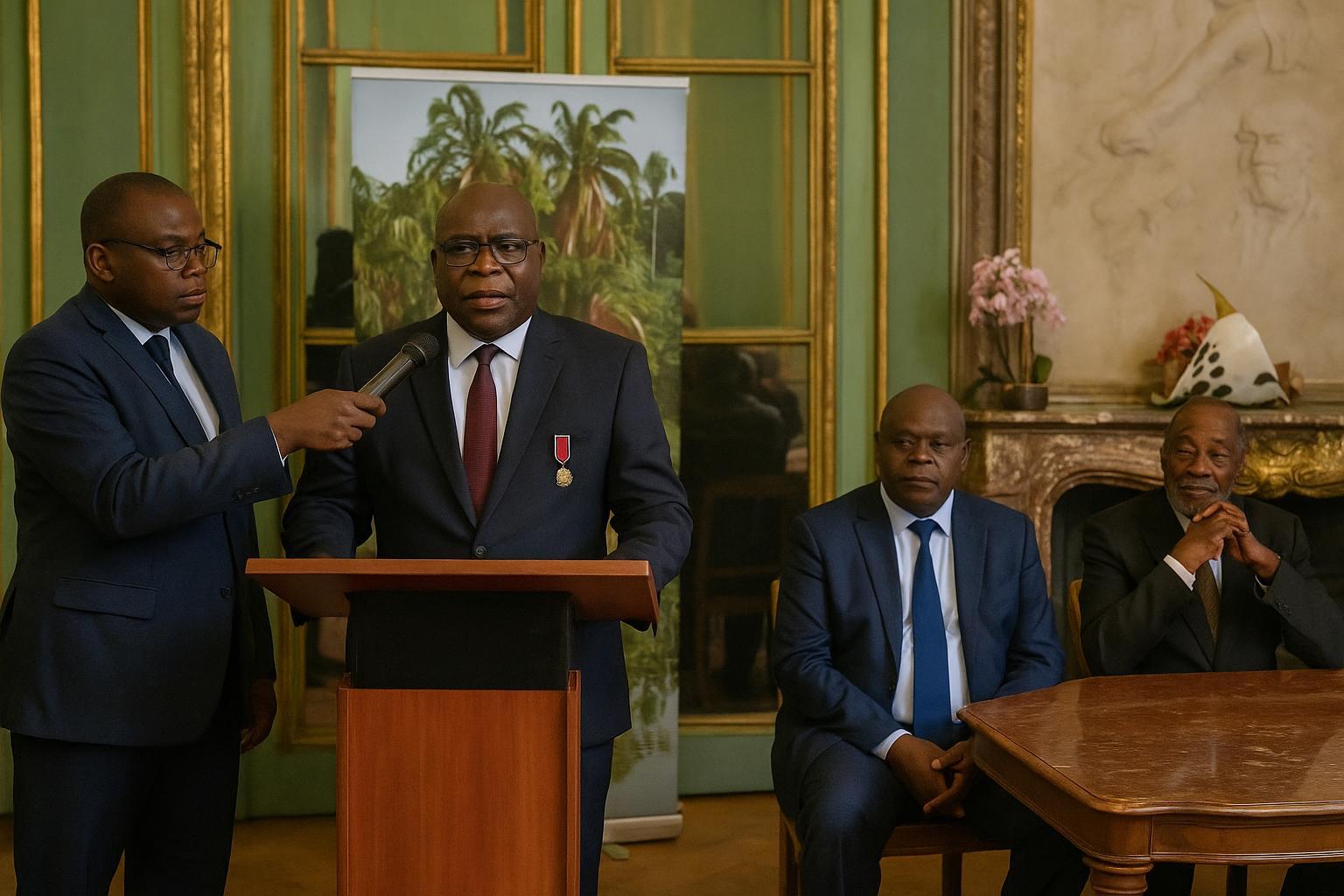
In the soft afternoon light of 3 October, the Green Hall of the Embassy of the Republic of Congo in Paris filled with counsellors, secretaries, attachés and local staff. The gathering, presided over by Ambassador Rodolphe Adada, was both valedictory and inaugural: a respectful farewell to Minister-Counsellor Jean Félix Mokiemo after six years of service, and a formal introduction of his successor, Armand Rémy Balloud-Tabawé. Such rites of passage are customary in diplomatic life, yet the emotive weight of this occasion testified to the cohesive spirit nurtured within the mission.
Ambassador Adada reminded the audience that rotation remains the heartbeat of diplomacy, a profession in which one “never digs a permanent burrow.” He portrayed the outgoing counsellor as a conductor who harmonised chancery affairs, political reporting and high-level liaison, fulfilling each task “to the satisfaction of the authorities and of the ambassador in particular.” The deliberate choice of language, both warm and measured, framed Mokiemo’s departure less as an ending than as a seamless hand-off to the next custodian of institutional memory.
Assessing Jean Félix Mokiemo’s Six-Year Tenure
Over six years Mokiemo became, in the words of colleagues, a pillar whose integrity and vision anchored the embassy’s daily rhythm. Beyond coordinating portfolios, he mentored junior diplomats, negotiated administrative bottlenecks for citizens and cultivated contacts across France’s labyrinthine political and cultural networks. Those achievements, recalled in concise anecdotes during the ceremony, underscore a diplomat’s often invisible but indispensable labour: translating presidential directives into operational reality while preserving the intangible capital of trust.
Mokiemo’s legacy also lies in the methodical transition he orchestrated. For several months he worked beside Balloud-Tabawé, sharing files, personal networks and the tacit knowledge that rarely appears in cables. That succession strategy spared the chancery a loss of momentum and offered the incoming counsellor a living archive of best practices. In a profession where continuity safeguards national interests, the gesture resonated as a final service to the Republic.
Armand Rémy Balloud-Tabawé’s Vision for Renewed Engagement
Balloud-Tabawé opened his first address by invoking divine guidance, an echo of his assertion that diplomacy must pair technical skill with moral compass. Paying homage to departed colleagues through a minute of silence, he wove memory and mission into a single narrative of collective responsibility. Quoting Amadou Hampâté Bâ—“there is only one word to express gratitude, and that word is thank you”—he positioned humility as the precondition for effective leadership.
He then outlined a roadmap centred on strategic vision, administrative facilitation for Congolese nationals and disciplined professionalism across all departments. Acknowledging the embassy’s multi-country jurisdiction—France, Portugal, Monaco, Andorra and Spain—he pledged reactive, innovative and inclusive actions calibrated to each context. Above all, he vowed to cultivate an exemplary team spirit, imbued with mutual respect and a passion for service, under what he called the “great school of wisdom” embodied by Ambassador Adada.
Strategic Weight of the Paris Mission for Brazzaville
Paris occupies a pre-eminent position within Congo-Brazzaville’s external network, serving simultaneously as gateway to multilateral forums, node for diaspora affairs and symbolic bridge to historical ties. The smooth transmission of authority from Mokiemo to Balloud-Tabawé therefore holds significance beyond embassy walls: it reaffirms Brazzaville’s capacity to maintain diplomatic agility while projecting an image of stability. In an international environment where perception often shapes partnership, such calibrated continuity strengthens the country’s voice on issues ranging from economic cooperation to cultural diplomacy.
À retenir
The ceremony illustrated three enduring lessons. First, institutional memory remains a strategic asset that must be curated through deliberate mentoring. Second, a diplomat’s efficacy is measured not only by formal negotiations but also by the day-to-day facilitation of citizen services that knit trust between state and diaspora. Third, leadership transitions, conducted with decorum and clarity, can themselves become instruments of soft power, projecting organisational maturity to interlocutors at home and abroad.
Le point juridique et économique
From a legal standpoint, the change in minister-counsellor entails a simple accreditation process, yet its economic implications resonate widely. The counsellor supervises consular documentation vital for remittances, investment itineraries and professional mobility between Congo and its European partners. By pledging streamlined administrative procedures, Balloud-Tabawé signals an intent to reinforce the enabling environment for entrepreneurs and students who view the embassy as their first regulatory interlocutor. Efficiency at this interface, while intangible on balance sheets, can catalyse tangible flows of capital, knowledge and goodwill aligned with Brazzaville’s broader development agenda.
