
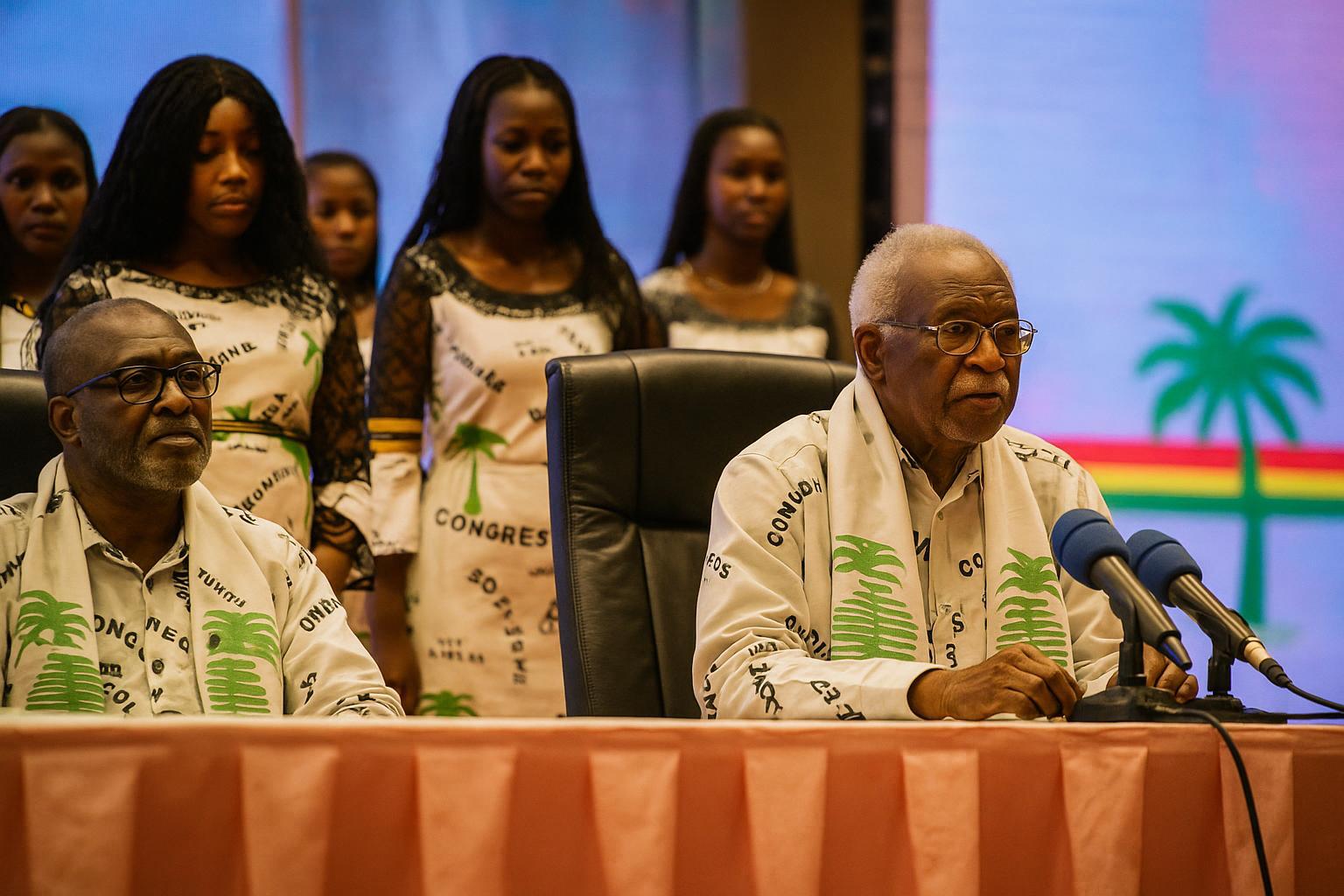
Brazzaville congress crowns a new party captain
After three intense days of deliberation inside the Palais des Congrès in Brazzaville, delegates of the Pan-African Union for Social Democracy (UPADS) handed the reins of their organisation to Pascal Tsaty-Mabiala, electing him president of the freshly created National Council. According to the official tally released by the party’s electoral commission, the former first secretary captured 91.30 per cent of the 1 225 ballots cast, comfortably outdistancing challenger Bienvenu Dzamba. Local daily Les Dépêches de Brazzaville described an atmosphere that was both festive and disciplined as activists in red-and-green scarves chanted the slogan “Renaissance 2023” while waiting for the verdict.
For the new leader, the mandate is heavy with symbolism. UPADS was founded in 1991 by the late President Pascal Lissouba and, despite years on the opposition benches, still draws moral capital from that legacy. “The confidence you have renewed obliges me to shoulder a demanding burden,” Tsaty-Mabiala declared in his first address, promising to “inject conquering energy into the party of Professor Lissouba for the renewal of Congo.”
A redesigned architecture to widen the tent
The congress ratified a revised charter that re-engineers UPADS’s decision-making chain. The new National Council presidency replaces the powerful first-secretary post and is tasked with coordinating political strategy while leaving day-to-day administration to a secretary-general. In the words of the final communiqué, the aim is to “better structure the party and prepare for forthcoming deadlines” through clarity of roles and collective accountability. Observers note that the model is inspired by social-democratic parties in neighbouring Cameroon and Gabon, which have recently adopted similar dual-headed formats.
By elevating Tsaty-Mabiala, 67, to a role of arbitration above partisan micro-currents, delegates hoped to reconcile veteran cadres with rising militants impatient for modern methods. The seasoned parliamentarian is seen by many analysts as one of the most experienced opposition voices in the National Assembly and, crucially, a politician able to maintain institutional dialogue with the majority without sacrificing party identity.
Generational handshake: Lissouba junior steps in
Symbolising that quest for renewal, Tsaty-Mabiala immediately appointed 38-year-old Jérémy Lissouba as secretary-general. Son of the party’s founding president, the petroleum engineer-turned-MP embodies what the congress communiqué called “the workforce of youth now present on every frontline.” In a brief intervention, Lissouba promised to “capitalise on my modest experience to deepen the organisational reforms already under way.”
The move has been widely interpreted as an attempt to project a message of continuity without nostalgia. Political scientist Émilie Mboka of Marien Ngouabi University remarks that bringing a Lissouba back to centre stage may help the party reconnect with voters in the Niari and Bouenza regions where the family name still resonates. At the same time, the presence of a younger executive could appeal to an electorate whose median age, according to the National Institute of Statistics, is under twenty-three.
Rigour and discipline to contain factional drift
Beyond the leadership shuffle, delegates adopted a comprehensive disciplinary code that foresees sanctions ranging from warnings to immediate expulsion for acts deemed to undermine party unity. Tsaty-Mabiala warned that future infractions would be examined first by local structures and then validated by the national ethics commission, though charges of high treason or conspiracy could trigger swift removal by the National Council after appeals are exhausted. “Some misguided militants who seek to weaken our functioning must know that the era of impunity is over,” he cautioned to a standing ovation.
Party insiders concede that UPADS has in recent years suffered defections toward smaller formations or the presidential majority, diluting its parliamentary group. By entrenching clearer rules, the congress hopes to reassure both sympathisers and financial backers that the organisation can overcome the stereotype of a fractious opposition incapable of discipline.
Policy signals and cautious engagement with government
While maintaining its opposition status, the new leadership adopted resolutions that emphasise constructive patriotism. Economic proposals champion social-democratic principles—progressive taxation, support for small farmers, and strengthened social protection—yet the text notably applauds recent government investments in fibre-optic backbones and the inauguration of the Bétou-Ouesso highway as examples of infrastructure essential to national cohesion. In a hallway exchange with journalists, Tsaty-Mabiala said, “We are ready to support any initiative that serves the general interest; disagreement is not an end in itself.”
Such measured rhetoric aligns with President Denis Sassou Nguesso’s recurrent calls for “pluralism without destabilisation.” Diplomats posted in Brazzaville privately welcome the tone, seeing in it a chance for smoother legislative debates on reforms tied to the IMF-backed economic programme.
Toward the 2026 horizon and a broader regional canvas
With legislative contests scheduled for 2027 and potential presidential primaries the year before, UPADS now turns to the arduous task of mobilising resources and selecting candidates. The inaugural session of the new National Council, due in the coming weeks, will populate the political bureau, national secretariat and ethics commission, thereby operationalising the statutes endorsed in Brazzaville. Analysts will watch how gender balance, regional representation and diaspora inclusion are managed—key metrics of credibility among urban youth and international partners alike.
UPADS’s recalibration also unfolds against a backdrop of shifting alliances within Central Africa. The recent rapprochement between Congo-Brazzaville and Cameroon on cross-border trade, as well as evolving security cooperation within CEMAC, forces opposition parties to frame domestic programmes within a larger economic integration narrative. By placing emphasis on pan-African solidarity in its congress literature, the party signals awareness that tomorrow’s voters judge not only patriotic fervour but also the capacity to plug the Republic of Congo into transformative continental currents. Observers will gauge in the months ahead whether the Tsaty-Mabiala-Lissouba tandem can translate internal harmony into electoral traction.
