
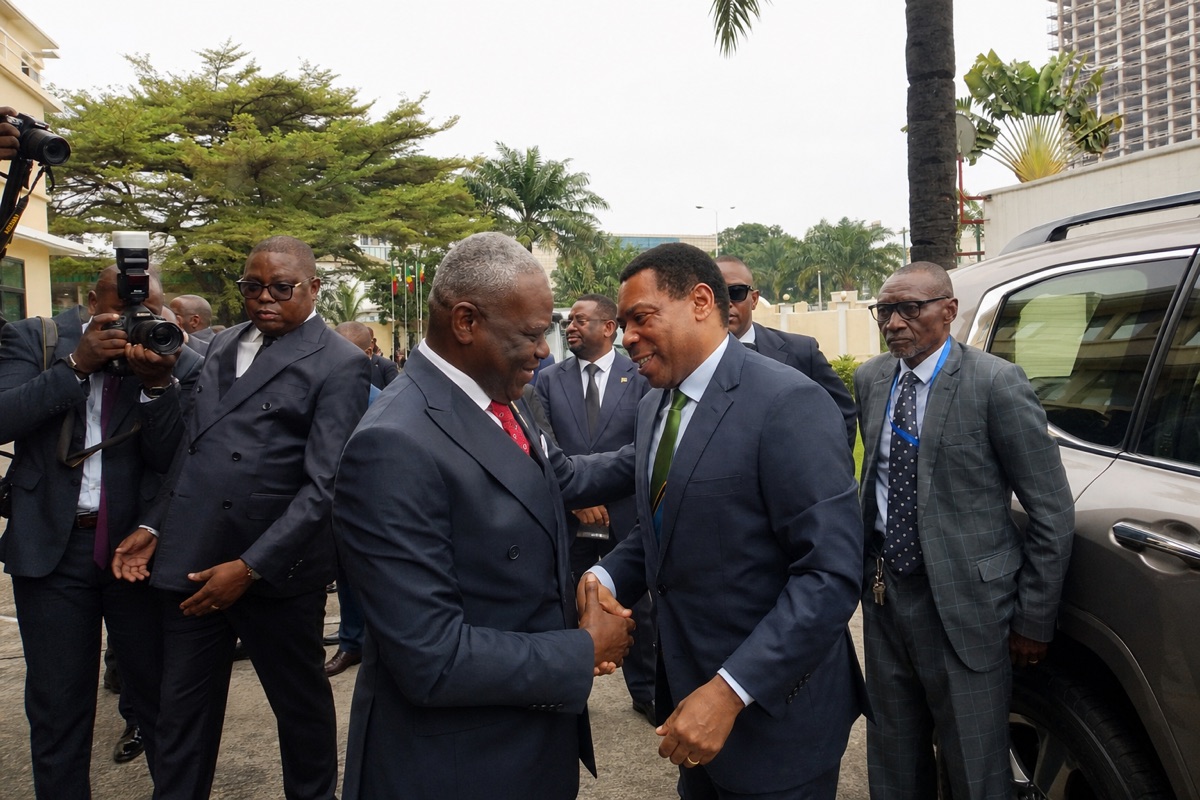
When the leaders of two African nations sit down on the sidelines of a multilateral summit, the substance of the conversation often matters more than the protocol. Such was the case in Brazzaville on 27 May 2026, when Tanzanian Prime Minister Mwigulu Nchemba was received by his Congolese counterpart, Anatole Collinet Makosso, in the margins of the annual assemblies of the African Development Bank (AfDB). Beyond the customary diplomatic courtesies, the meeting offered a window into two converging preoccupations of Central and East African governance: how to finance development without surrendering sovereignty, and how to translate environmental ambition into bankable projects.
A Visit Framed by the African Development Bank Assemblies
Nchemba’s presence in the Congolese capital was tied to the AfDB gatherings, an institutional backdrop that lent the bilateral exchange a particular resonance. The Bank’s assemblies have long served as a forum where questions of debt, concessional lending and domestic resource mobilisation dominate the agenda. It was therefore fitting that the Tanzanian premier chose this setting to articulate a thesis his government has made central to its economic discourse: that the continent’s long-term autonomy will be measured less by the volume of external assistance it secures than by its capacity to generate and deploy its own resources.
The choice of venue was not incidental. By advancing his argument in a city hosting the continent’s principal development financier, Nchemba addressed an audience predisposed to weigh the trade-offs between external credit and internal capacity.
The Case for Domestic Resource Mobilisation
The Tanzanian leader was unambiguous about the direction his country has taken. “In Tanzania, we now finance more than 70% of our budget through resources mobilised locally,” he told his host, framing the figure as evidence that fiscal self-reliance is no longer an aspiration but an operating reality. The remark carried a deliberate weight in a region where many treasuries remain heavily dependent on grants and concessional borrowing.
To illustrate the point, Nchemba pointed to the Julius Nyerere hydroelectric project, a venture exceeding three billion US dollars that Tanzania has financed largely from national means. The example was offered not as a boast but as a demonstration that ambitious infrastructure need not be hostage to foreign capital. In an era when several African states are recalibrating their exposure to external debt, the Tanzanian model presents a provocative alternative: that the path to development autonomy runs through disciplined domestic mobilisation rather than the accumulation of liabilities denominated in foreign currency.
The analytical interest of this position lies in its replicability. What works for a resource-rich East African economy may not transpose neatly onto the fiscal realities of a smaller, hydrocarbon-dependent state. Yet the principle Nchemba advanced, that domestic financing buys policy independence, speaks to a debate that animates finance ministries across the CEMAC zone and beyond.
Brazzaville’s Response and the Weight of History
For his part, Makosso situated the encounter within a longer arc of bilateral relations. He recalled the ties forged between the Republic of the Congo and Tanzania since 1975, a half-century of association that he invoked to underscore the durability of the partnership. From that historical foundation he drew a set of shared priorities: peace, security, the protection of the environment and the struggle against climate change.
The Congolese premier was careful to anchor these themes in a concrete instrument rather than leaving them as rhetorical commitments. He highlighted the Congo Basin Blue Fund, which he described as the first African financing mechanism conceived specifically for sustainable development projects. Roughly seventy initiatives have been identified under its umbrella, among them three substantial Tanzanian undertakings, a detail that knitted the two countries’ agendas together in practical terms.
Where Sovereign Finance Meets Environmental Stakes
The conversation in Brazzaville thus operated on two registers at once. On one level it was a discussion of money, of how budgets are built and how flagship projects are paid for. On another it was a discussion of stewardship, of how the Congo Basin, one of the planet’s most consequential carbon sinks, might be financed in a manner consistent with both ecological imperatives and the fiscal logic Nchemba had championed.
That juxtaposition is precisely what gives the meeting its interest. The Tanzanian insistence on self-financing and the Congolese emphasis on the Blue Fund are not separate stories but two facets of the same question now confronting Central and East Africa: whether the continent can mobilise the capital its development and environmental commitments require while retaining control over the terms. The Brazzaville exchange offered no definitive answer, but it sharpened the terms of a debate that will shape the region’s choices for years to come.
