
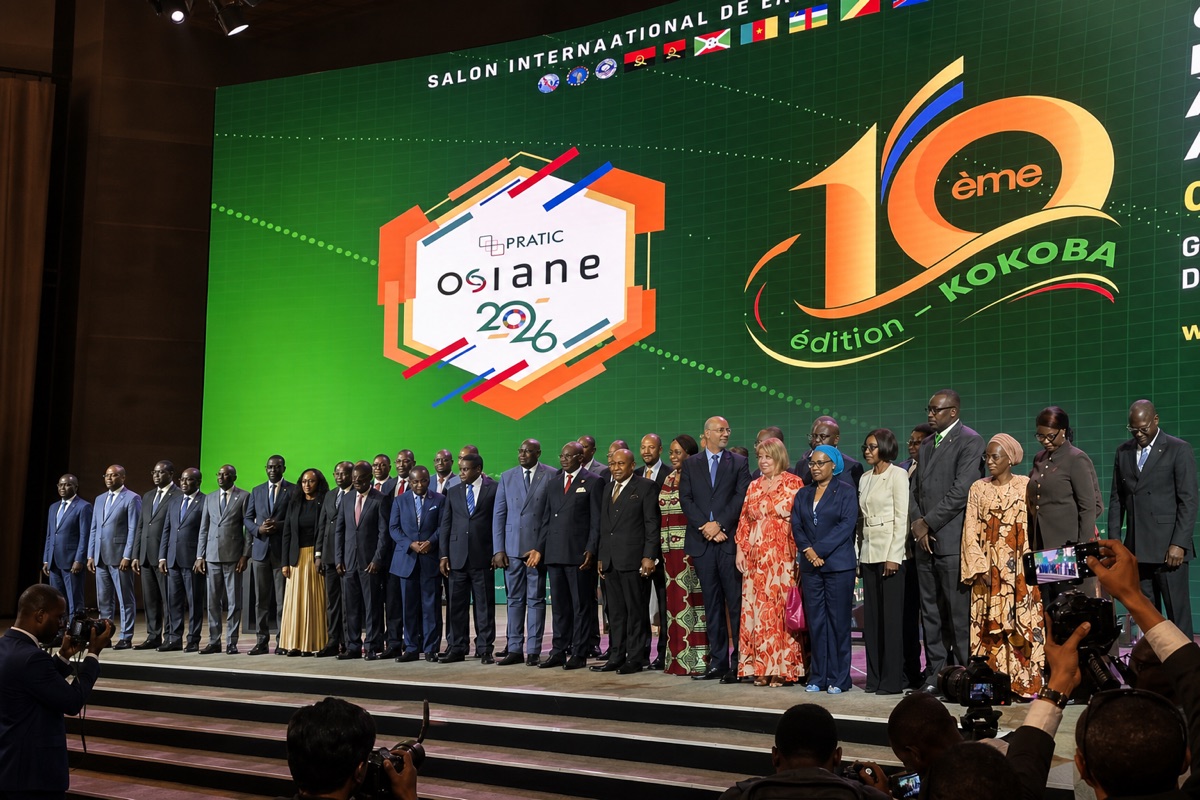
After a decade rooted in the Congolese capital, the International Salon of Technology and Innovation of Africa (OSIANE) is preparing to cross a border. At the close of its tenth, anniversary edition in Kintélé, organisers confirmed that the eleventh gathering will convene in 2027 in Libreville, Gabon, the first time the salon has been staged outside the Republic of Congo. The decision, announced by the event’s promoter Luc Missidimbazi, reads less as a logistical footnote than as a statement of ambition about where Central Africa’s digital conversation should next be held.
A Decade in Kintélé Closes on a Confident Note
The anniversary edition unfolded from 2 to 5 June at the International Conference Centre of Kintélé, on the northern fringe of Brazzaville, drawing technologists, public decision-makers, entrepreneurs, investors and enthusiasts from across the continent and beyond. Convened under the theme “Let us create ecosystems with high added value,” the meeting bore the assurance of an event that has outgrown the experimental phase. Ten years is a considerable lifespan for any African tech forum, and the salon used the milestone to take stock rather than merely to celebrate.
The discussions ranged widely without losing focus. Participants returned repeatedly to the practical dilemmas of digital transformation, the mounting stakes of cybersecurity, the still-uncertain promise of artificial intelligence, and the conditions under which technological entrepreneurship can take root in economies where capital and infrastructure remain scarce. The register throughout was sober and forward-looking, an acknowledgement that the region’s digital trajectory will be decided less by enthusiasm than by the slow accumulation of institutions, skills and trust.
Why Libreville Signals a Regional Recalibration
The choice of the Gabonese capital is the most consequential outcome of the edition. For ten years OSIANE has been, in practice, a Congolese institution with continental aspirations; relocating to Libreville reframes it as a genuinely sub-regional platform. The organisers have made plain that they intend to broaden the salon’s reach across Central Africa and, eventually, the wider continent, positioning the event as a connective tissue for actors who too often work in national isolation.
There is a quiet logic to the move. The countries of Central Africa share comparable constraints, bandwidth that is expensive and uneven, regulatory frameworks still under construction, and pools of talent that frequently emigrate for want of local opportunity. A forum that rotates among capitals stands a better chance of building the dense, cross-border relationships on which any durable ecosystem depends. By stepping beyond Brazzaville, OSIANE implicitly concedes that no single national market is large enough to anchor the digital economy the region aspires to, and that integration is not a slogan but a precondition.
From Showcase to Infrastructure of Cooperation
What distinguishes a maturing event from a recurring spectacle is its capacity to produce commitments that outlast the closing ceremony. On this measure, the tenth edition supplied a coherent agenda. The recommendations issued at the conclusion of the proceedings clustered around three linked priorities: strengthening African digital sovereignty, pooling technological infrastructure across borders, and accelerating the pace of innovation on the continent.
Each of these themes carries weight beyond its phrasing. Digital sovereignty, in particular, has become a defining preoccupation for African policymakers wary of dependence on infrastructure, platforms and data architectures controlled elsewhere. The call to mutualise infrastructure speaks to the same anxiety from a different angle, recognising that the cost of building sovereign capacity is prohibitive for any one state acting alone. Read together, the recommendations sketch a vision in which competition between national tech scenes gives way to a more deliberate architecture of cooperation.
Whether that vision survives contact with budgetary reality is, of course, an open question. Forums of this kind excel at articulating ambitions and are notoriously uneven at securing the follow-through. The value of OSIANE, on the evidence of its first decade, has lain in convening, in keeping the region’s technologists in dialogue and lending visibility to ventures that might otherwise pass unnoticed. The move to Libreville will test whether that convening power can be scaled into something more structural.
A Salon Measured by What It Sets in Motion
For now, the salon departs Kintélé with its standing enhanced. Ten editions have established it as a fixture of the Central African calendar, and the leap to a new host city suggests an organisation confident enough to risk reinvention. The next two years will determine whether 2027 in Libreville becomes a turning point or merely a change of address. The themes are settled, the appetite is evident, and the region’s digital future, for all its constraints, has at least found a recurring stage on which to be debated.
