
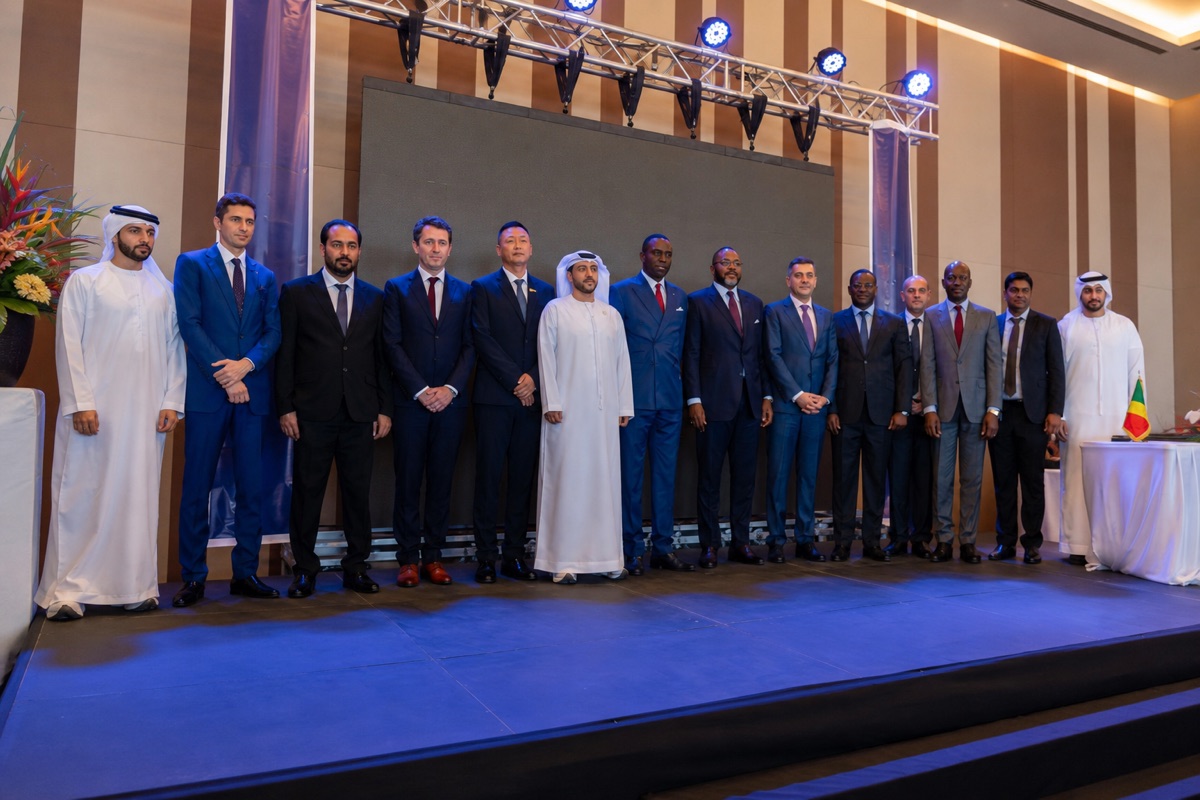
A single signature on the 7th of May 2026 quietly redrew the competitive map of Central Africa’s maritime logistics. In the presence of the Congolese Prime Minister, MBTP, one of the sub-region’s most established construction groups, sealed a 150-million-dollar contract to build the new Noatum Ports container terminal at Pointe-Noire, the deep-water gateway of the Republic of Congo (Congo-Brazzaville). The agreement, struck in partnership with AD Ports Group, positions a homegrown contractor at the heart of what is shaping up to be the most ambitious port undertaking the region has seen in a generation.
A Local Champion Steps Onto the Continental Stage
The symbolism is hard to overstate. For decades, infrastructure of this magnitude along the Atlantic seaboard was the near-exclusive preserve of foreign engineering consortia, with local firms relegated to subcontracting roles. MBTP’s selection as the principal builder, rather than a junior partner, marks a deliberate inflection. The group, which already employs more than a thousand people in Congo, will execute the works through a joint venture with MAR CONTRACTING SARLU, an arrangement that distributes both the technical risk and the operational ambition across a structured partnership.
That joint venture carries a dual mandate. On one side sit the maritime works proper: the quay wall, the marine structures and the crane foundations that must withstand the relentless mechanics of a working port. On the other lie the surface developments, encompassing the storage yard, the operational buildings, the service networks and the electrical substations that turn a stretch of reinforced concrete into a functioning terminal. The pairing of these two registers, the submerged and the visible, demands a coordination capacity that few regional contractors have previously been trusted to demonstrate.
Engineering a Terminal Built for the Next Shipping Era
The technical specifications speak to an infrastructure designed for longevity rather than expedience. The terminal will extend across 100,000 square metres, anchored by a quay 420 metres in length and dredged to a draught of 16 metres. Those dimensions are not arbitrary; they are calibrated to receive Patagonia-class vessels, the larger ships whose deployment has gradually reshaped global container routes. By building to that standard now, the project’s promoters are wagering that Pointe-Noire can capture traffic that might otherwise bypass it for better-equipped ports along the Gulf of Guinea.
The concession framework reinforces that long horizon. AD Ports Group, the Abu Dhabi-headquartered operator that has steadily expanded its African footprint, holds the terminal under a thirty-year concession, extendable by a further twenty years. A half-century of potential operation transforms the arithmetic of the investment, allowing the heavy upfront capital outlay to be amortised across decades of throughput. It also signals a measure of confidence in Congo’s institutional stability that prospective investors will note carefully.
The Employment Dividend and Its Caveats
Beyond the steel and the dredgers, it is the labour dimension that lends the project its political resonance. The promoters anticipate that the terminal will generate as many as 9,000 direct and indirect jobs once it is fully woven into the local economy, of which roughly 800 will arise during the construction phase itself. For a country where formal employment opportunities remain scarce, particularly for a young and increasingly urban workforce, such figures carry obvious weight.
Yet the distinction between direct and indirect employment merits a sober reading. The 800 construction-phase positions are concrete and time-bound; the broader 9,000 figure depends on the terminal’s eventual commercial success and on the wider logistics ecosystem that may, or may not, crystallise around it. Whether those downstream jobs materialise will hinge on factors that extend well past the building site, from regional trade volumes to the competitiveness of Congo’s hinterland connections.
A Two-Year Window With Continental Stakes
Delivery is projected within roughly two years, an aggressive timeline for works of this scale and one that will test the joint venture’s execution discipline. The schedule leaves little margin for the supply-chain disruptions and weather constraints that routinely afflict large maritime projects. Meeting it would itself become a reference point, evidence that a Congolese-led consortium can deliver world-class infrastructure on time.
The Pointe-Noire terminal, then, is more than a construction contract. It is a test case for a development model in which local enterprise, foreign capital and Gulf operating expertise converge on a shared asset. If the wager pays off, MBTP will have done more than pour concrete along the Atlantic; it will have demonstrated that the architecture of Central Africa’s trade can be built, in significant part, by Central African hands.
