
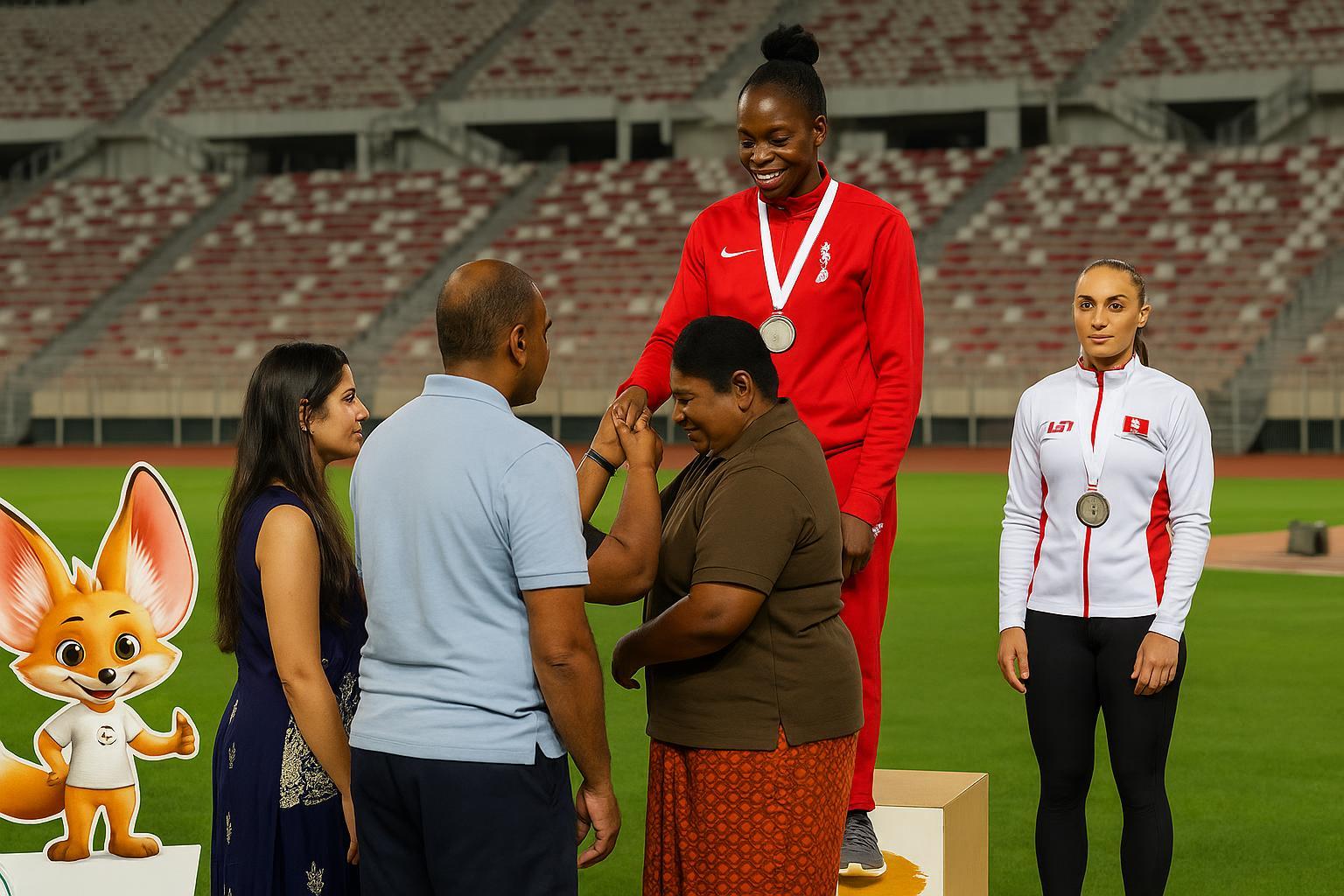
Algiers podium echoes across the Congo River
The debut edition of the African School Games, convened in Algiers from 26 July to 5 August 2025 under the aegis of the African Union Sports Council, assembled delegations from more than fifty nations. Against this backdrop, the Republic of Congo fielded a compact team of six student-athletes competing in athletics, judo, gymnastics and taekwondo. Their collective return—one gold and three bronze medals—propelled the Tricolour onto the continental medal table and drew measured praise from observers of Central African sport.
The standout performance belonged to sixteen-year-old jumper Gladise Boukama Ndoulou, whose 6.34-metre leap secured gold in the girls’ long jump before she added bronze over 200 metres. Judokas Symphoria Mankala and Divine Mpiaya Massala supplemented the tally, reinforcing the depth of talent emerging from school clubs in Brazzaville, Pointe-Noire and the Sangha corridor. National Olympic Committee vice-president César Okemba called the haul “a credible signal that our youth programmes are bearing fruit at the continental level”.
A modest delegation punching above its weight
Congo’s small contingent was initially expected to be larger; preliminary shortlists circulated by the National Olympic and Sports Committee envisaged almost eighty pupils across thirteen disciplines. Logistical realities ultimately reduced that figure, yet the trimmed delegation translated scarcity into focus. Sports sociologist Elie Gakala notes that micro-teams can “generate a high staff-to-athlete ratio, guaranteeing personalized coaching and sharper competitive edges”.
International analysts have drawn parallels with similarly streamlined approaches adopted by Botswana and Cabo Verde in youth competitions, where quality control and concentrated resources have compensated for limited headcounts (African Union Sports Council, 2024). In this light, Brazzaville’s experience in Algiers may serve as a case study for lean deployment models within sub-Saharan sports structures.
Youth athletics as soft power diplomacy
Beyond the scoreboards, the Games functioned as a platform for the Republic’s cultural diplomacy. Foreign Minister Jean-Claude Gakosso, in remarks to Radio Congo, underlined that “our students represent more than athletic energy; they embody national identity in miniature before a pan-African audience”. That symbolism dovetails with President Denis Sassou Nguesso’s emphasis on people-to-people exchanges in the 2019–2029 Strategic Development Plan, which frames sport as both a unifying force and an instrument of regional visibility.
UNESCO’s latest Global Education Monitoring Report observes that countries investing in school sport often see complementary gains in civic engagement and cross-border cooperation. The Republic’s athletes in Algiers shared training halls with peers from Kenya and Egypt, forging networks that extend beyond the track and tatami. Such encounters, officials argue, shed a constructive light on Brazzaville’s commitment to youth empowerment.
Funding pathways and public-private synergies
The Algiers expedition was financed through a combination of state allocations, federation budgets and targeted contributions from Congolese businesses operating in hydrocarbons and telecommunications. While some commentators have characterised the funding envelope as slender, the Ministry of Sports points to a gradual uptick: the 2024 budget line for school sport rose by eight per cent, in harmony with the wider social sector envelope adopted by Parliament last December.
Private sponsors are increasingly visible. Société Nationale des Pétroles du Congo underwrote pre-Games training camps at the Kintele High-Performance Centre, while a consortium of Pointe-Noire-based enterprises supplied nutritional support. According to economist Marcellin Mvouba, such partnerships could herald a sustainable mixed-finance template, mitigating fiscal pressures and introducing performance-based accountability mechanisms.
International avenues supplement domestic efforts. The African Development Bank’s “Sports for Development” facility, launched in 2023, earmarks concessional loans for infrastructure aligned with educational outcomes. Brazzaville’s application for co-funding to refurbish regional youth stadia is currently under technical review, officials at the Bank’s Abidjan headquarters confirmed.
Toward an integrated national sports strategy
In the wake of Algiers, policymakers are refining the National Programme for the Promotion of School Sport, aiming to harmonise curricula with federations’ talent-identification pipelines. Draft guidelines circulated this spring envisage a tripartite framework: strengthened physical-education hours, systematic inter-school leagues and advanced data analytics to track athlete progression. The blueprint corresponds with the African Union’s Agenda 2063 aspiration to leverage sport for health and economic empowerment.
Stakeholder consultations have been deliberately inclusive. Representatives from teachers’ unions, medical professionals and the Congolese Paralympic Committee contributed to sessions at the Brazzaville Sports Forum in February. As the Ministry prepares to table the strategy for Cabinet approval, consensus appears to be building around the idea that targeted investment—rather than wholesale expansion—will optimise returns. The Algiers medals, while modest in absolute terms, thus assume outsized significance: they demonstrate proof of concept and furnish momentum for evidence-based policy calibrated to national realities.
