
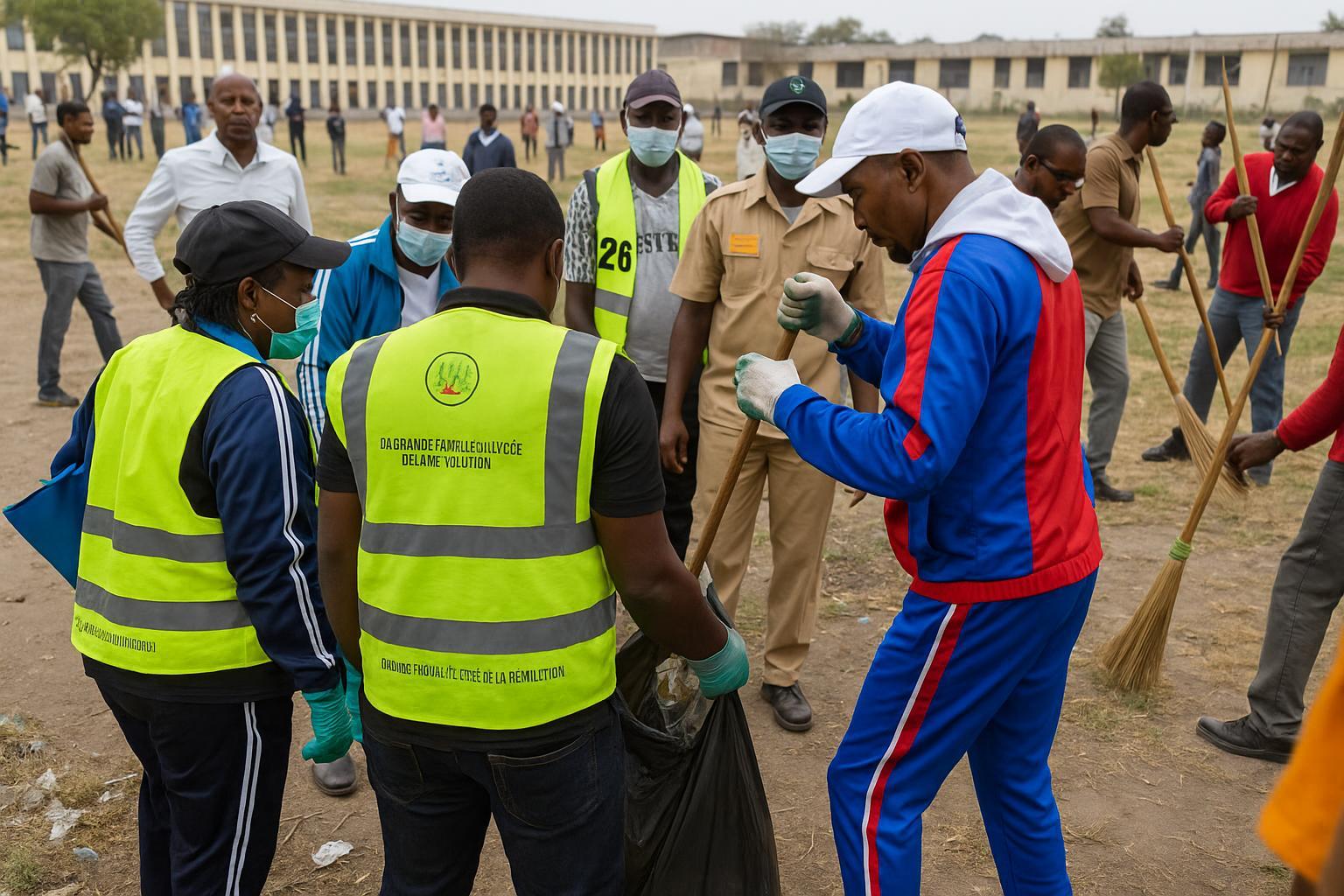
A civic tradition meets the new school year
The first Saturday of every month has, for more than a decade, been reserved for collective sanitation in Congo-Brazzaville’s main cities. This October the calendar offered a symbolic conjunction: the ritual coincided with the first weekend after schools reopened, turning attention to the classrooms where nearly two million children spend most of their waking hours. The Ministry of Urban Sanitation, Development and Road Maintenance seized the occasion to underscore what it calls “the strategic alliance between cleanliness, education and national development” (Ministry communiqué).
By dawn, Brazzaville’s avenues were already echoing with the scrape of rakes and the clatter of wheelbarrows. In an atmosphere that blended volunteer enthusiasm with governmental resolve, citizens, non-governmental organisations and small businesses converged on selected campuses for an operation that officials hope will set the tone for the entire academic year.
Cabinet in overalls: symbolic leadership by action
Leading the charge were three senior members of government: Juste Désiré Mondélé, the minister in charge of sanitation; Jean-Luc Mouthou, who oversees pre-primary, primary and secondary education; and Ghislain Thierry Maguessa Ebomé, responsible for technical and vocational training. The trio deliberately opted for locations representative of Congo’s educational diversity. The day began at the landmark Complexe Scolaire de la Révolution in central Brazzaville before moving to the Lycée Technique 5-Février 1979 in the district of Mpila.
“We inherited these facilities through the vision of President Denis Sassou N’Guesso, but the duty of maintenance rests with us,” Minister Mouthou said while hauling branches to a compost heap. His counterpart Mondélé added that the presence of cabinet members with gloves and shovels was designed to “preach by example” and to remind communities that sanitation is “a republican gesture as much as an ecological one.” The visibility of high-ranking officials wielding brooms has long been considered an essential nudge for public mobilisation in the Congolese governance model, and Saturday’s images rapidly circulated on social media.
École 5-Février: anatomy of a vulnerable campus
The most challenging stop lay in the outer district of Djiri, where École Primaire 5-Février 1979 teeters between wear and ruin. Here, unchecked vegetation competes for the playground, masonry crumbles after decades of tropical downpours, and the Tsiémé River, swollen by climate-induced variability, periodically transforms classrooms into ponds. Some sections of the compound, swallowed by subsidence, resemble archaeological digs more than learning spaces.
Yet the derelict site symbolises both need and resilience. The school recently absorbed pupils from the now-defunct École Émeraude, preventing a pedagogical vacuum in the neighbourhood. Local chief Marcel Ngnelibolo praised what he called a “happy coincidence”: the ministerial delegation arrived on the very morning when community leaders had convened their own annual clean-up. New classroom blocks financed through the education ministry and the area’s parliamentary representative are already rising, evidence that rehabilitation is under way even before larger structural works commence.
Public-health dividends of a clean campus
Brazzaville’s municipal health service estimates that vector-borne diseases spike by up to 40 percent in schools classed as ‘highly insalubrious’. Simple measures such as clearing clogged drains and removing refuse can slash mosquito breeding sites and reduce gastrointestinal infections, saving both medical costs and school hours lost to illness (Service municipal de santé, 2022).
In that light, Saturday’s operation was more than cosmetic. Officials distributed hand-washing kits and biodegradable waste bags, while health inspectors recorded baseline data to evaluate the correlation between campus hygiene and absenteeism over the coming term. Minister Mondélé insisted that “sanitation is a frontline health intervention”, echoing the government’s 2022–2026 National Development Plan that integrates public hygiene into human-capital objectives.
Community stewardship and behaviour change
Sustainability, however, hinges on the daily micro-decisions of pupils, teachers and neighbourhoods. The ministers unveiled plaques at each site stating, in bold French and Lingala, that dumping rubbish is prohibited. Schools are encouraged to revive the once-ubiquitous ‘brigades vertes’, student clubs that patrol litter hotspots and turn compost into vegetable gardens for canteen use. The lycée in Mpila has already earmarked a plot for such a garden, its agronomy teachers viewing the initiative as a living laboratory for climate-smart agriculture.
Civil-society partners, including youth-led NGO Terre Propre, have committed to fortnightly follow-up visits and offer training in waste segregation. Their executive director, Tatiana Dzikou, argued that “behavioural nudges work best when public authority, local leadership and peer influence converge.” The government’s role, she said, is to ensure that bins are collected on schedule and that damaged water points are repaired promptly—service-delivery basics that anchor long-term change.
Economic and legal perspectives
From a macroeconomic angle, keeping public assets functional lengthens their life cycle, reducing the fiscal burden of premature reconstruction. The Ministry of Economy values Brazzaville’s school infrastructure at the equivalent of 1.2 percent of national GDP; even a modest extension of usability by five years could liberate tens of billions of CFA francs for new projects (Ministry of Economy briefing, 2023).
Legally, the sanitation programme leans on the 2017 Law on Public Hygiene, which obliges educational institutions to maintain standards or face administrative penalties. Rather than imposing fines on under-resourced schools, the government has opted for a cooperative compliance model, pairing institutions with sponsors and local authorities. Observers note that this soft-law approach dovetails with cultural norms of collective work—known as ‘mintsu’ in several Bantu languages—while still providing an enforcement backstop if negligence persists.
