
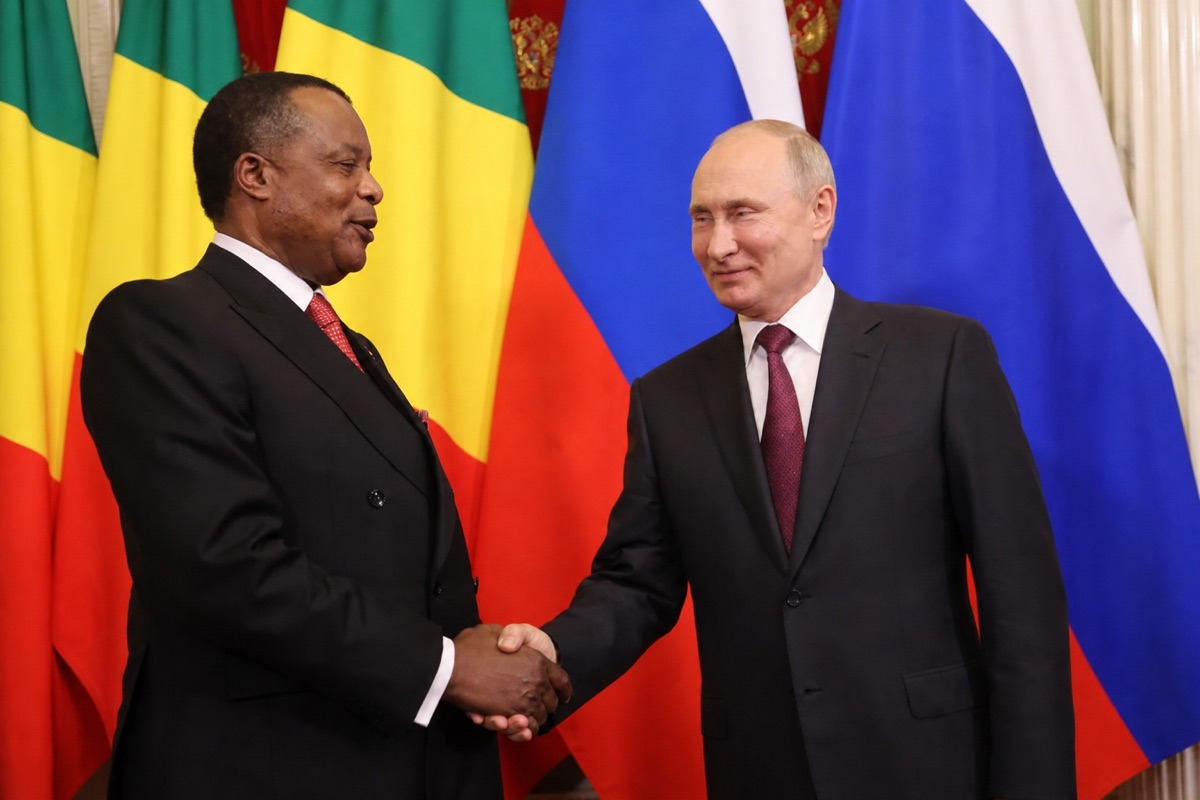
A carefully worded message from the Kremlin has placed Brazzaville back at the centre of an enduring partnership that has weathered shifting geopolitical seasons. Vladimir Putin, President of the Russian Federation, has extended his congratulations to Denis Sassou-Nguesso following the Constitutional Court’s confirmation of the latter’s re-election as President of the Republic of the Congo. The gesture, formulated in the solemn register customary of inter-state correspondence, arrived in the immediate aftermath of the proclamation of the definitive results of the presidential ballot held on 15 March 2026 (Les Échos Congo Brazzaville).
A Plebiscitary Result and Its Diplomatic Echo
The figure around which the Congolese election crystallised is striking in its magnitude: the incumbent head of state secured the contest with 94.90 percent of the votes cast. Such a margin, validated by the Constitutional Court before the definitive results were proclaimed, leaves little room for arithmetical ambiguity and consolidates Sassou-Nguesso’s already considerable tenure at the helm of the central African state. It is against this backdrop of overwhelming domestic endorsement that the Russian message acquires its full significance, functioning less as a routine courtesy than as a deliberate affirmation of continuity in a relationship that Moscow plainly intends to preserve.
The timing is itself instructive. By dispatching his felicitations at the very moment the court rendered its verdict, the Russian president signalled that the Kremlin regards the Congolese electoral process as settled and its outcome as a legitimate basis for further engagement. In the grammar of diplomacy, such promptness is rarely accidental. It communicates recognition, and recognition, in turn, is the currency through which partnerships are reaffirmed without the need for elaborate declarations.
The Architecture of a Russo-Congolese Partnership
Putin’s message dwelt on the quality of bilateral relations between Russia and Congo-Brazzaville, two states bound by cooperation across several domains. The fields cited—defence, energy, and multilateral diplomacy—are not incidental. Each represents a pillar of strategic interdependence that has accumulated weight over years of measured exchange. Defence cooperation speaks to questions of sovereignty and security in a region where stability cannot be taken for granted; the energy dimension touches the very sinews of the Congolese economy, whose hydrocarbon endowment has long shaped its external alliances; and the reference to multilateral diplomacy gestures towards a shared disposition to coordinate positions within the wider architecture of international institutions.
What emerges from this enumeration is a portrait of a relationship that is neither sentimental nor improvised. It rests instead on a calculus of mutual utility, in which Brazzaville finds in Moscow a partner unbothered by the conditionalities that frequently accompany engagement with other capitals, while Russia secures a foothold of confidence in a part of the continent it has steadily sought to cultivate. The vocabulary of friendship that suffuses such communiqués should therefore be read alongside the more sober logic of interests that it both conceals and serves.
A Distinction Worth Preserving
Any reading of these developments must remain attentive to a distinction that careless commentary too often blurs. The state at the heart of this exchange is the Republic of the Congo, with its capital at Brazzaville, and not its larger neighbour the Democratic Republic of the Congo. The conflation of the two—encouraged by their shared name and contiguous geography—has long bedevilled coverage of central African affairs, and it matters here precisely because the partnership Putin invoked is specific to Brazzaville. Precision on this point is not pedantry; it is the precondition for understanding the regional choreography in which the message is embedded.
Continuity as a Strategic Statement
For observers of Congolese political life, the convergence of an emphatic electoral result and a swift external endorsement underscores a single theme: continuity. Sassou-Nguesso’s reaffirmed mandate ensures that the lines of cooperation traced in recent years are unlikely to be redrawn, and Moscow’s congratulations function as an external guarantee that the partnership will proceed undisturbed. There is, in this symmetry, a kind of mutual reinforcement. Domestic legitimacy, however it is measured, is buttressed by international acknowledgement; and international acknowledgement, in turn, draws its meaning from the stability of the leadership it salutes.
The message from the Kremlin will not, in itself, alter the texture of daily life in Brazzaville. Yet it offers a revealing aperture onto the strategic vision that animates both capitals. In a moment when the alignments of the global order are once more in flux, the decision of a major power to reaffirm its ties to a central African state, promptly and unambiguously, is a statement of intent. It suggests that the partnership between Russia and Congo-Brazzaville, far from being a relic of an earlier era, remains a live instrument in the foreign policy of both—one that each appears determined to carry forward into the mandate now beginning.
