
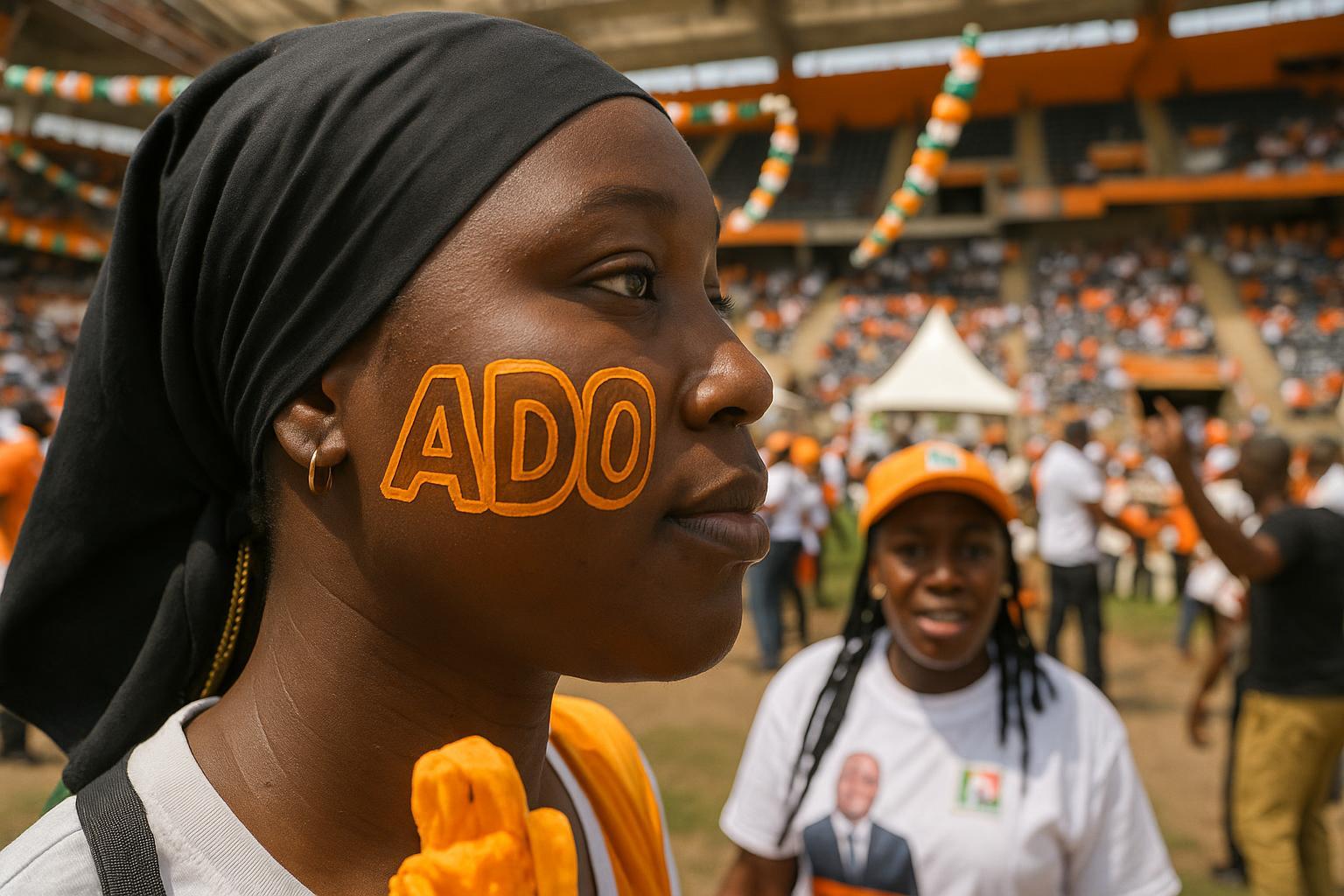
Campaign drums drown deeper anxieties
The roadshows of Côte d’Ivoire’s presidential hopefuls have turned boulevards into open-air dance floors. Loudspeakers belting out the hit Coup du marteau propel choreographed crowds, yet the choreography cannot muffle the apprehension that accompanies Saturday’s ballot. The West African nation, first global supplier of cocoa beans, remembers too vividly the post-electoral violence of 2010-2011 that left more than 3 000 dead. Voters in Abidjan and up-country hubs like Bouaké therefore oscillate between exuberance and watchfulness, convinced that ballots as well as bullets can still decide their future.
Ouattara’s growth narrative and constitutional debate
Incumbent Alassane Ouattara, eighty-three, frames his quest for a fourth mandate as the logical extension of an economic renaissance he claims to have engineered since 2011. Average GDP expansion of 7 % a year, a six-lane motorway between Abidjan and the political capital Yamoussoukro, and a stream of foreign direct investment compose the official scorecard (government data). Yet legal scholars continue to spar over the 2016 Constitution that reset presidential term limits and, in effect, opened the door to his current candidacy. For supporters, the text offered institutional continuity after civil war; for detractors, it now epitomises ‘constitutional revisionism’ tailored to an individual agenda. That divergence injects constitutional law into street conversations otherwise dominated by prices of rice and transport.
Three challengers, three political biographies
Opposition forces, unable to agree on a single flag-bearer, present a mosaic of ambitions. Simone Ehivet Gbagbo, seventy-six, former first lady and long-time organiser of teachers’ unions, has remade herself into the charismatic face of the left-leaning Mouvement des générations capables. Jean-Louis Billon, sixty and among the country’s wealthiest agribusiness figures, campaigns as the dynamic moderniser promising ‘jobs before jargon’. Completing the quartet, former ministers Henriette Lagou Adjoua and Ahoua Don Mello add gender advocacy and pan-Africanist overtones to the contest. Personal histories matter: Gbagbo’s 2015 amnesty after the International Criminal Court abandoned its case, and Billon’s aristocratic lineage within the Baoulé heartland, shape voter perceptions as much as policy platforms.
À retenir : inequality shadows the boom
Official growth rates mask an uncomfortable statistic: nearly four Ivoirians in ten still live below the poverty line (World Bank). In neighborhoods such as Abobo, construction cranes coexist with cramped dwellings where residents complain that “the economy grows, but not our wallets”. Billon channels that frustration, arguing that Abidjan’s glittering bridges have not bridged the gap in purchasing power. Simone Gbagbo strikes a similar chord, criticising what she calls the ‘privatisation of opportunity’ and pledging a massive reinvestment in public schools. The multiplicity of voices underscores a single grievance: the dividends of peace have been unevenly distributed.
Security flashbacks and the calculus of fear
Public security forces have staged muscular shows of presence in Abidjan, Korhogo and Daloa, a reminder that the state will not tolerate disorder. Early-October demonstrations against Ouattara’s eligibility triggered more than 700 arrests, with 50 fast-tracked convictions to three-year sentences (judicial communiqué). Human-rights groups have expressed concern, while the government insists firmness is required to avoid a repeat of 2010. Many households quietly devise fallback plans; intercity buses report a spike in bookings as families relocate temporarily to villages. Yet the memory of past trauma also fuels an opposite sentiment: a determination among younger voters to settle disputes at the ballot box, not the barricade.
Le point juridique et éco : nationality, sanctions and cocoa
The Constitutional Council’s April decision to bar opposition star Tidjane Thiam on grounds of lost nationality highlighted how legal technicalities can rearrange political geometry. In a separate ruling, former president Laurent Gbagbo remains ineligible owing to a 2018 conviction for ‘looting’ the Central Bank’s Abidjan branch. At stake as well is the economic lifeline of cocoa. Futures traders watch the election with the same intensity as diplomats, mindful that any disruption at the port of San-Pedro could ripple through chocolate prices worldwide (industry brief). With European sustainability regulations tightening and the Sahelian coups pushing regional trade routes southward, stability in Côte d’Ivoire is priced into commodities as surely as rainfall.
Regional stakes and diplomatic balancing acts
Foreign policy seldom dominates Ivorian campaigns, yet this year’s rhetoric toward the military juntas of Mali, Burkina Faso and Niger has sharpened. Ouattara positions Abidjan as a bulwark for electoral legitimacy in the Economic Community of West African States, while critics such as Don Mello advocate a diversification of partnerships toward Moscow and Beijing. The polemic echoes beyond borders: the Alliance des États du Sahel has accused Abidjan of acting as a proxy for Paris, an allegation the Ivorian administration rejects. Observers in Brazzaville and Libreville note that the manner in which Côte d’Ivoire reconciles security, democracy and non-aligned diplomacy will set an informal benchmark for coastal states navigating a volatile neighbourhood.
Pathways after the ballot
Whoever emerges with the mandate will confront a sophisticated electorate, a youthful demographic profile and commodity-linked climate risks that could redefine the cocoa economy. A negotiated political culture—embodied by inter-party dialogue mechanisms revived since 2022—offers one avenue to channel dissent. In the words of Charm Matuba, a Congolese-Ivorian resident of Abidjan, “people no longer want to die for politicians; they want politicians to live up to their promises”. That sentiment, echoed in university classrooms from Cocody to Pointe-Noire, anchors hopes that post-electoral Côte d’Ivoire can consolidate growth while addressing the social and diplomatic questions that Saturday’s vote has laid bare.
