
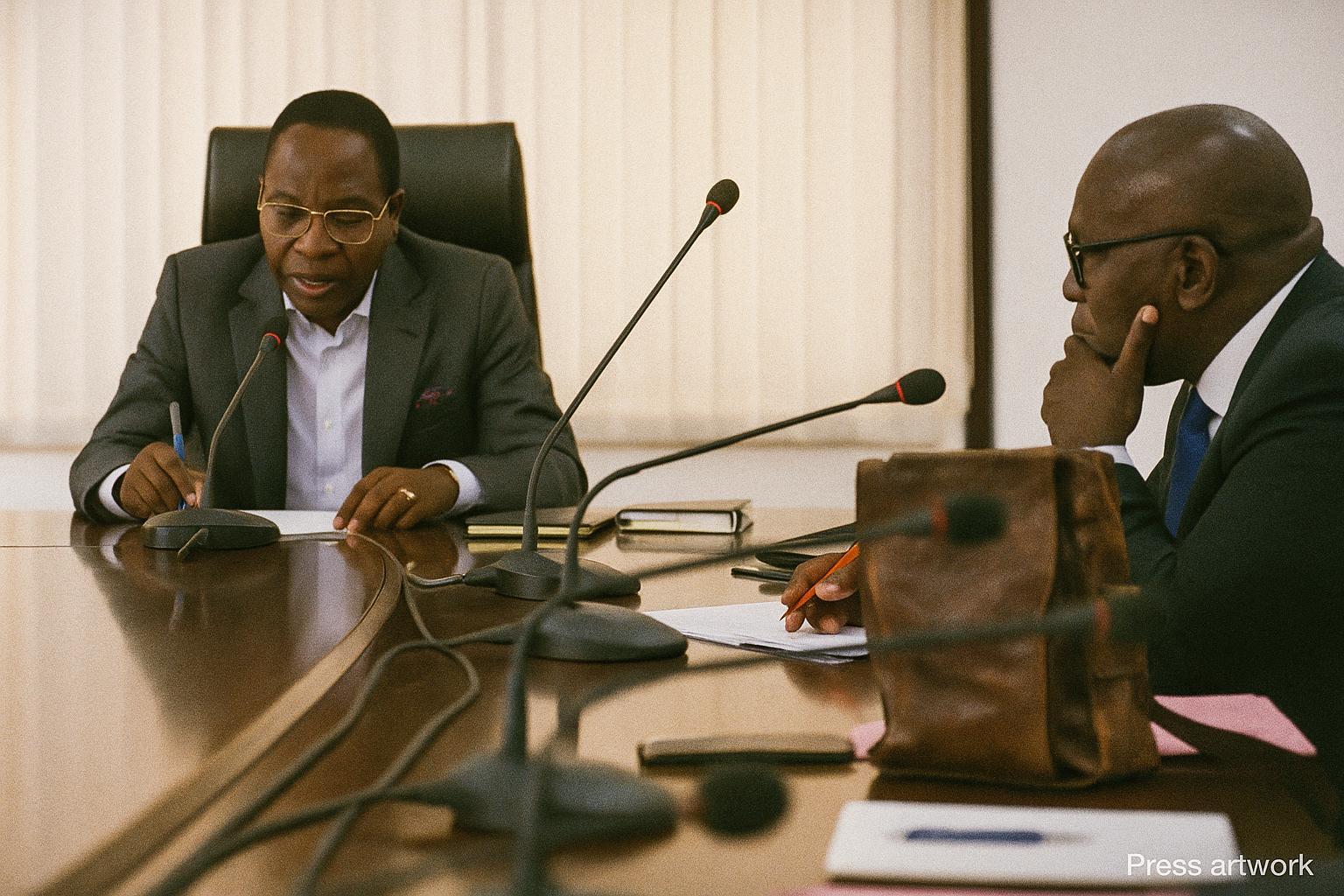
Post-crisis stewardship in Brazzaville
Few institutions mirror a nation’s collective temperament as strikingly as its football federation. When the Congolese Football Federation emerged from its recent governance turbulence, observers wondered whether the temporary calm could translate into durable reform. The executive committee’s decision, under the stewardship of President Jean-Guy Blaise Mayolas, to convene an ordinary assembly on 20 September is therefore more than a procedural footnote. It represents the first codified opportunity for stakeholders to appraise remedial measures adopted during the crisis period and to examine the trajectory that the federation now envisages. Local daily Les Dépêches de Brazzaville has framed the moment as a “return to institutional normality”, while a regional CAF official contacted for comment described it as “a test case for resilient governance in Central Africa”.
Agenda setting and regulatory recalibration
Although the formal agenda will be released in due course, early indications suggest that the assembly will prioritise harmonisation of statutes with revised CAF guidelines, budgetary consolidation and the acceleration of digital licencing protocols first piloted in 2024. According to internal memoranda consulted by this publication, FECOFOOT’s legal department has already held consultations with FIFA compliance officers to ensure that any amendments anticipate the next cycle of governance audits. Diplomats stationed in Brazzaville note that such procedural alignment reinforces Congo-Brazzaville’s reputation for constructive multilateral engagement, an asset often leveraged in broader regional negotiations.
Domestic leagues: measured expansion for competitive balance
The executive committee’s decision to expand Ligue 1 from fourteen to sixteen clubs for the 2025-2026 season is being read by analysts as both a corrective mechanism and a developmental wager. The prior interruptions of Ligue 2 and the suspension of the Coupe du Congo created a backlog of ambitious clubs seeking elite exposure; enlargement offers a conciliatory pathway without resorting to relegation amnesties that might have distorted meritocratic perceptions. Sports economist Alain Biyogo, speaking from Libreville, argues that a sixteen-club format can preserve competitive integrity provided that broadcast revenue and travel subsidies are proportionally redistributed. FECOFOOT officials, conscious of fiscal constraints, insist that cost-sharing frameworks endorsed last month will mitigate logistical inflation for provincial sides.
Women’s football and youth pathways gain overdue traction
If the men’s game often commands headlines, the federation’s decision to stage a national women’s play-off to determine Congo’s CAF Women’s Champions League representative could become the assembly’s most enduring legacy. Technical director Pierrette Ngouabi confirms that the play-off model, initially trialled informally in 2023, proved its capacity to spotlight emerging talent and secure modest commercial backing from private telecommunications partners. Parallel planning for zonal U-17, U-20 and school tournaments suggests an ecosystemic approach: by synchronising youth calendars with senior fixtures, talent identification can occur in real time, a practice already standard in West African academies. UNICEF’s Brazzaville office has sought partnership to embed education modules into these competitions, a move welcomed by the Ministry of Sports as an illustration of sport-for-development diplomacy.
International exposure through CHAN and refereeing excellence
Beyond domestic restructuring, FECOFOOT is acutely aware that international optics matter. The Diables-Rouges A’ squad, already qualified for the 2026 African Nations Championship, will undertake a preparatory tour jointly financed by the governments of Kenya and Uganda, leveraging trilateral cooperation frameworks signed on the margins of the 2023 AU summit. Meanwhile, referees Messie Nkounkou and Chany Malondi have secured appointments for the forthcoming CHAN finals, a testament to the arbitration department’s investment in continuous professional development. A senior CAF refereeing instructor notes that Congo’s officials “now rank among the most consistent in disciplinary accuracy”, a reputation that indirectly amplifies the federation’s soft-power cachet.
Football as vector of national prestige and economic resilience
Diplomatic observers routinely emphasise that in resource-dependent economies, sport can operate as a parallel narrative of resilience and aspiration. For Congo-Brazzaville, the sequencing of reforms outlined above converges with broader governmental objectives articulated in the National Development Plan 2022-2026, notably diversification through creative industries. By stabilising competition calendars, enhancing female participation and nurturing officiating expertise, FECOFOOT positions itself as a subtle yet persuasive interlocutor in regional dialogues on youth employment and cultural diplomacy. As a seasoned ambassador in Addis Ababa remarked, “a functional football federation broadcasts predictability—a commodity investors rarely overlook.” The September assembly therefore transcends the immediate realm of sport: it is poised to signal, in calibrated diplomatic language, that Congo-Brazzaville stands ready to couple athletic ambition with governance maturity.
Measured optimism ahead of the 20 September conclave
Supporters scattered from Pointe-Noire to Ouesso will inevitably parse forthcoming communiqués for hints of fixtures, transfer norms and stadium safety upgrades. Yet within the corridors of multilateral agencies, the significance of the assembly is framed in terms of institutional continuity. Having weathered an internal storm without external trusteeship, FECOFOOT appears intent on demonstrating that the lessons learned can translate into structured growth. If the executive committee succeeds in forging consensus around its reform package, the 2025-2026 season may unfold as a laboratory for what sustainable football governance could resemble across Central Africa. The cautious optimism expressed by players, officials and diplomats alike suggests that the forthcoming conclave is less an epilogue to crisis than a prologue to renewed credibility.
