
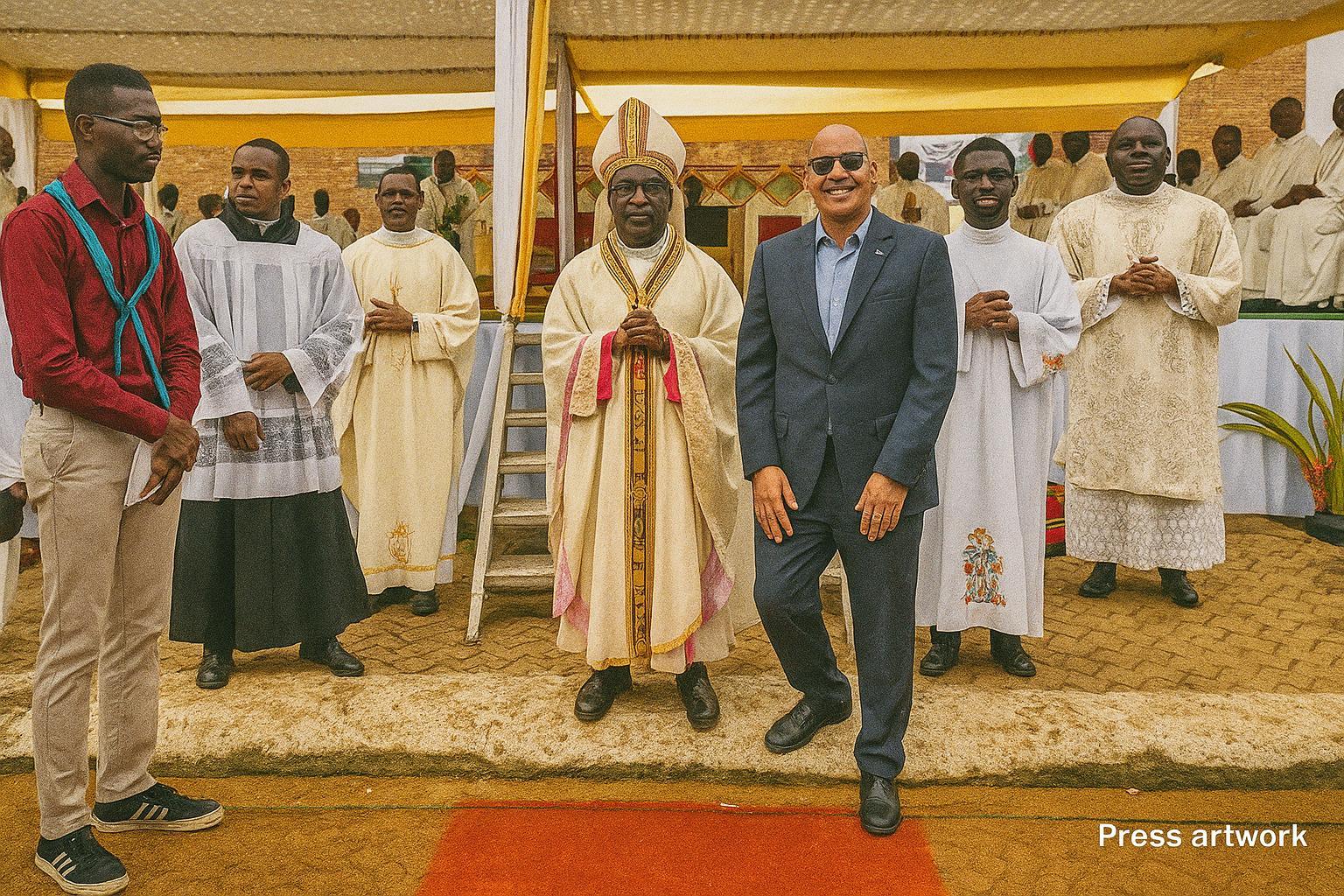
Regional Convergence Amid Sacred Rites
The soaring nave of Saint Pierre Claver Cathedral in Ouesso became, for one luminous weekend, the epicentre of both ecclesial celebration and refined regional diplomacy. Presiding over the ordination of Monsignor Daniel Nzika, Apostolic Nuncio Javier Herrera Corona invoked unity not only of faith but of neighbouring peoples, as dignitaries from Brazzaville, Kinshasa and Libreville filled the transept. Such multilateral attendance, rare outside summit corridors, signalled the quiet relevance the Republic of Congo continues to accord to religious soft power in a volatile sub-region (Vatican News, 2024).
Government protocol officers mingled seamlessly with episcopal masters of ceremonies, underscoring the state’s long-standing recognition of the Catholic Church as a stabilising partner. Observers from the Economic Community of Central African States discreetly took note, reminding donors that spiritual gatherings often function as informal diplomatic fora in Central Africa, where assembling political counterparts under purely secular pretexts can prove delicate.
Soft Power in Cassocks and Protocol
For Catholic Relief Services, whose charter blends pastoral accompaniment with humanitarian expertise, the ordination offered both symbolism and strategy. By joining the front pews, CRS reaffirmed its preference for working through local institutions rather than parallel structures, a modality increasingly valorised by Brazzaville as it seeks durable development partnerships (CRS, 2024). The new prelate’s inaugural homily pledged ‘listening first, acting later’, a motto that resonates with the government’s own rhetoric of concertation nationale in health and education policy.
Sub-regional bishops lauded President Denis Sassou Nguesso’s recent endorsement of the Pointe-Noire Interreligious Peace Forum, a gesture interpreted by analysts as an attempt to harness faith networks for conflict-prevention along the northern frontier. Aligning with that vision, CRS staff conversed informally with parliamentary deputies about replicating faith-based mediation mechanisms piloted in the Sangha department.
Technology as a Pastoral Catalyst
During the offertory procession, a laptop and a compact projector quietly replaced the customary loaf of bread and basket of produce. The symbolic gift, financed through a joint CRS–private donor window, aims to modernise diocesan archives, streamline parish reporting and facilitate distance-learning for catechists dispersed across dense equatorial forest. While modest in retail value, the equipment responds to the national digitalisation agenda articulated by the Ministry of Posts, Telecommunications and Digital Economy, which emphasises rural connectivity as an engine of inclusive growth (Ministry of Digital Economy Congo, 2023).
Diocesan staff anticipate that cloud-based record-keeping will cut travel costs for village priests by nearly a third over the next fiscal year, freeing resources for literacy classes and micro-credit cooperatives. In a region where the river Sangha often remains the fastest road, bytes can travel where boats cannot.
Synergies in Public Health Preparedness
On the ceremony’s sidelines, the CRS Country Representative conferred with the Prefect of Sangha about logistical corridors for the imminent distribution of long-lasting insecticidal nets. The campaign, co-financed by the Global Fund and the Congolese Treasury, targets the department’s 120 000 inhabitants, with particular attention to indigenous forest communities whose malaria prevalence exceeds the national average by seven percentage points (WHO, 2023).
The discussion reflected a principle increasingly championed within Brazzaville’s development circles: leveraging church infrastructure for last-mile health delivery. Parish halls often double as storage depots, and catechists, already versed in community mobilisation, can disseminate vector-control messages far beyond the reach of state radio. By securing prefectural backing, CRS aligns technical protocols with administrative authority, mitigating the bureaucratic frictions that have hampered previous net-distribution drives.
Balancing Faith, Development and State Priorities
The Ouesso gathering thus crystallised the triangular relationship among Church, international agencies and the Congolese state. For a government intent on articulating a narrative of responsible sovereignty, partnerships that respect ecclesial autonomy while reinforcing public policy objectives constitute valuable diplomatic capital. As one senior official from the Ministry of Foreign Affairs hinted off-microphone, ‘a homily reaches hearts faster than a communiqué.’
Yet expectations remain calibrated. The diocese, vast as Belgium but served by fewer than thirty priests, cannot substitute for formal institutions. CRS, aware of both opportunity and limit, is drafting a memorandum of understanding that commits each party to transparent monitoring indicators. The document, expected before the next malaria season, will likely become a template for similar accords in Likouala and Cuvette-Ouest.
Ultimately, the new bishop’s crosier and the donated keyboard symbolise converging aspirations: moral authority wielded with modern tools. By embedding its assistance within liturgy and local governance alike, CRS reminds external observers that in Congo-Brazzaville, development is seldom purely technical, diplomacy seldom purely political and liturgy seldom purely spiritual.
