
A Paris-region tribute for Pascal Andjembo
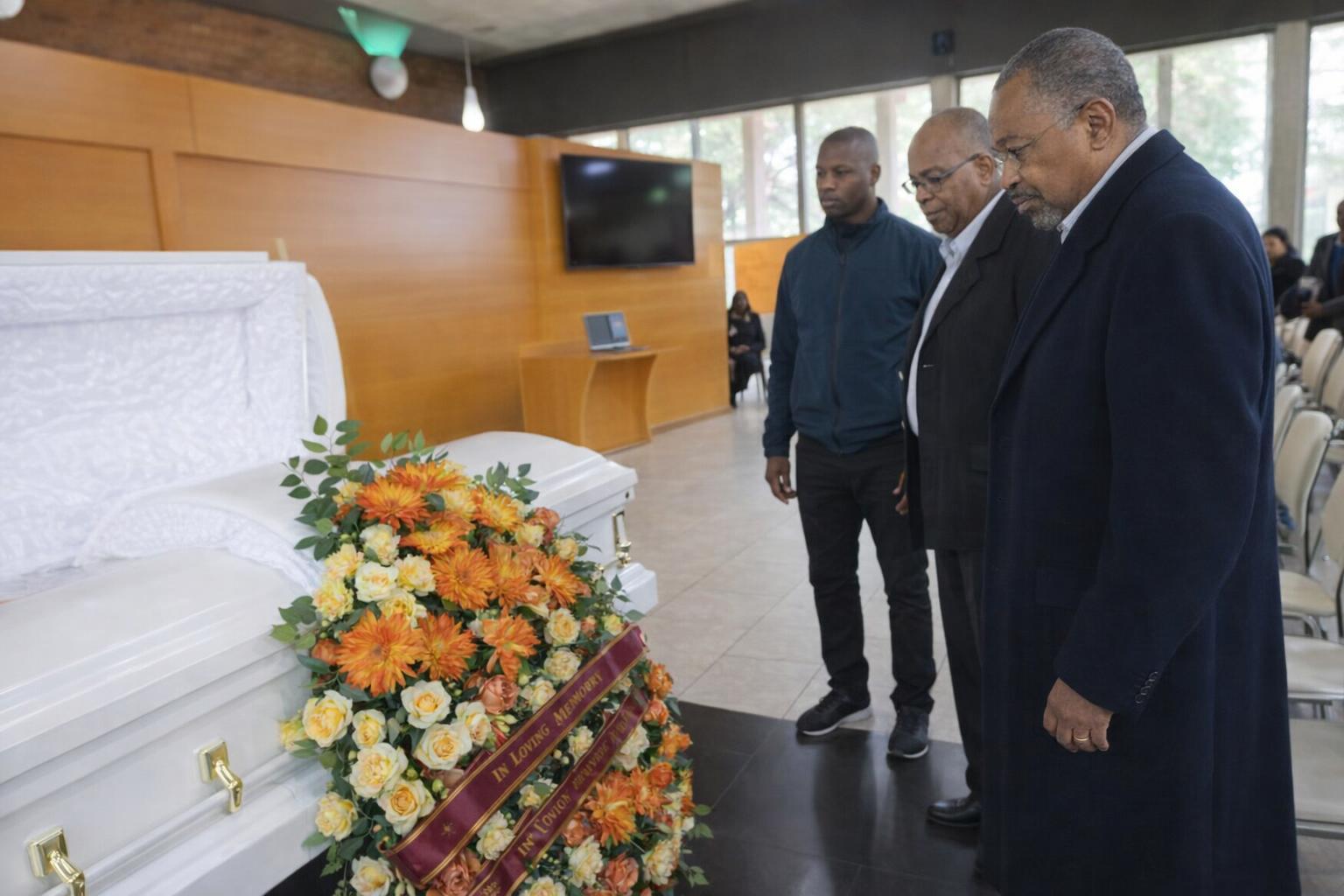
The first part of the funeral rites for Pascal Andjembo—presented by those close to him as a former journalist and diplomat—was held on Friday 16 January at the Joncherolles funeral home in Villetaneuse, in the northern Paris region. According to the account of the ceremony, Mr Andjembo died in Paris on 28 December 2025 at the age of 80.
The gathering brought together family members, friends and representatives of the Congolese diplomatic presence in France. Ambassador Rodolphe Adada, accompanied by colleagues described as part of Congolese diplomacy in France, attended to offer a final tribute in Paris before the subsequent stages of the rites. The overall tone was described as solemn and deeply emotional, tempered at moments by music that punctuated the collective remembrance.
Congolese diplomatic presence pays respects in France
In the narrative provided, the participation of Ambassador Rodolphe Adada and his team conveyed an institutional dimension to what remained, above all, an intimate farewell. In diaspora settings, such ceremonies often become a meeting point between public life and private grief; here, the homage delivered by the Congolese diplomatic mission in France was portrayed as an act of respect for a figure who had served the state at different moments of his professional trajectory.
No broader political statement was attributed to the diplomatic delegation in the account. The emphasis remained on condolence, recognition and accompaniment—gestures that, in the language of protocol, signal both proximity to the bereaved and regard for a life spent in education, writing, public debate and service.
Family portrait: a forceful personality remembered
Those who spoke and those who listened converged on a portrait of a man of strong character and pronounced individuality. The funeral oration cited in the account evokes him as “their father, grandfather, brother, uncle,” and insists on the coherence of a personality described as “fully himself.” Such formulations, familiar in memorial speech, underline a form of moral presence that outlives the person: a temperament that shaped relationships, challenged loved ones, and left an imprint difficult to reduce to official titles.
The ceremony sought to preserve this complexity rather than smooth it away. In remembering an elder, families frequently negotiate between reverence and truthfulness; here, the language reported suggests affection anchored in realism, honouring not only achievements but also a distinctive way of inhabiting the world.
Music and memory: Les Bantou de la Capitale at the ceremony
A notable feature of the Villetaneuse tribute was the musical interlude by songs associated with the orchestra Les Bantou de la Capitale. Mentioned as a counterpoint to grief, the music appears to have acted as a shared cultural vocabulary, enabling mourners to breathe, recollect and, in a discreet way, celebrate life amid loss.
For Congolese communities, music can function as both remembrance and continuity, especially in the diaspora where rituals are adapted to different logistical and legal contexts. In this account, the presence of these songs helped modulate the emotional intensity of the moment without diluting its gravity, offering a familiar soundscape to accompany a final goodbye.
A political and intellectual itinerary rooted in the PCT
The text recalls Mr Andjembo as a man of the left, described as a deputy “said to be the most expensive,” and formed within the Parti Congolais du Travail. Without expanding beyond these stated elements, the account situates him within the political history of the Republic of the Congo, where party structures and ideological affiliations have long shaped careers in governance, administration, and public communication.
Equally foregrounded is an attachment to language: he is characterised as a writer with an easy pen and a taste for precise words. In a country where political life has often generated strong narratives and competing memories, such a profile—at once partisan, literary, and public-facing—suggests a figure attentive to how events are named and transmitted.
A memoir in 2022: ‘Quel roman que ma vie’
Mr Andjembo’s book, Quel roman que ma vie, published by L’Harmattan in 2022, occupies a central place in the account of the ceremony. Presented as a work of personal recollection, it is described as a set of memoirs addressed to present and future generations—particularly those captivated by politics—offering what the text calls the militant motive and its “priestly,” moral and ethical demands.
Within the limits of what is reported, the book also includes testimony about his experience as a teacher, journalist and diplomat. It is said to describe a political path that left deep marks while preserving his left-wing convictions, and to speak frankly about key segments of national life, drawing lessons and paying tribute to personalities who helped him progress.
Teaching, journalism and diplomacy: a life of transmission
Beyond politics, the narrative insists on a vocation for transmission. Mr Andjembo is remembered as a passionate teacher who passed on more than knowledge, awakened minds and left a lasting impression on students. Such a description places education at the heart of his legacy: not merely a profession, but a relationship to society, to youth, and to the patient work of building capacities.
This emphasis resonates with the broader understanding of public service in the Republic of the Congo, where careers may move across sectors—education, media, diplomacy—while remaining guided by a commitment to public communication and national representation. In the tribute as recounted, these roles appear less as separate chapters than as interconnected expressions of one life’s discipline and curiosity.
From Villetaneuse to Brazzaville: the next stage of the rites
At the end of the Villetaneuse ceremony, the coffin was transferred toward air freight for onward travel to Brazzaville, according to the text. The mention of this logistical passage underscores the transnational reality of many families’ mourning today: the emotional geography of loss rarely matches the administrative geography of death.
For relatives, friends and officials present in France, the act of accompanying the coffin to its departure marks a threshold—the moment when tribute becomes movement, and remembrance is entrusted to the next community that will receive the deceased. In this case, the account frames the Paris-region ceremony as a first formal farewell, preceding the continuation of funeral rites in the Republic of the Congo.
