
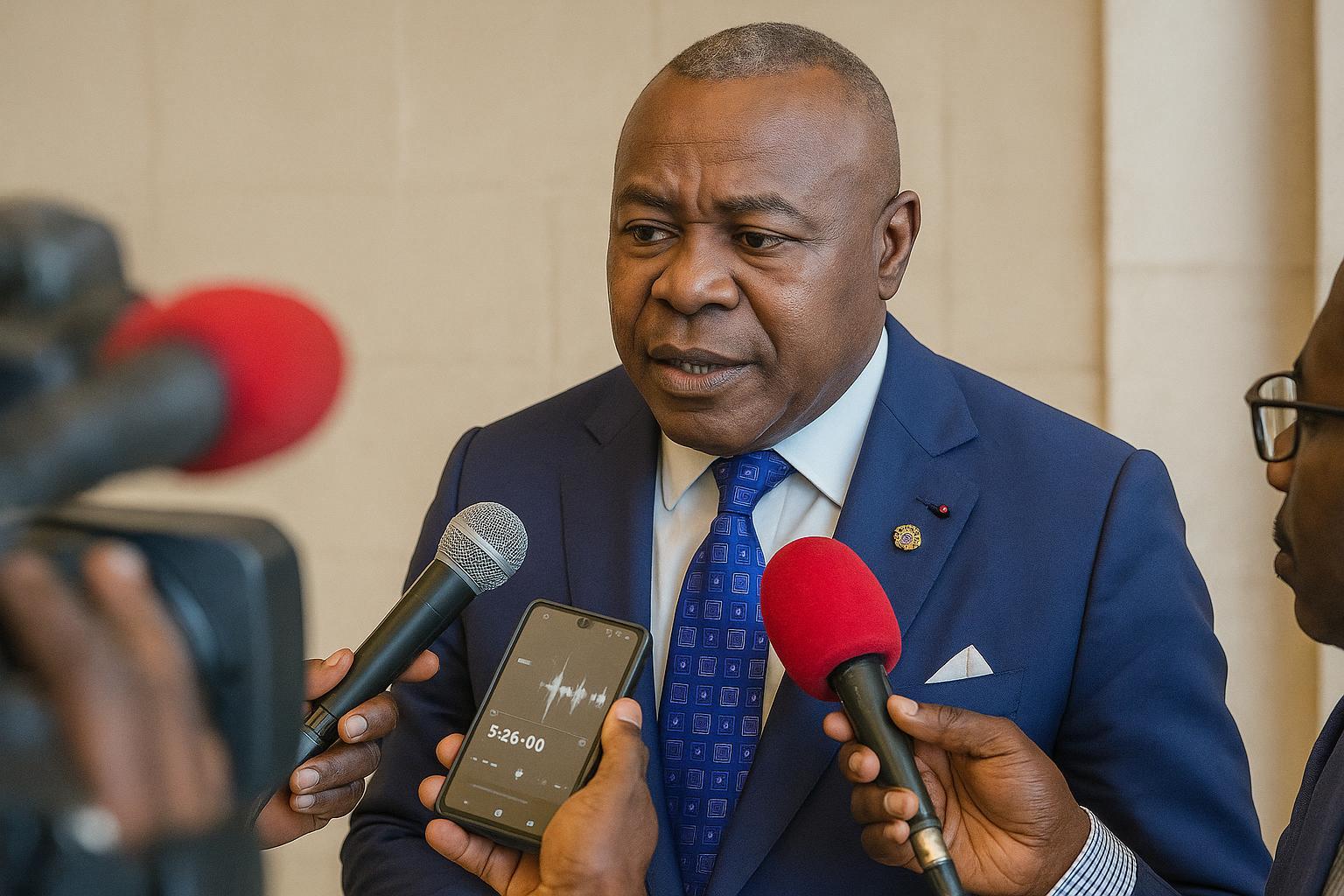
Brazzaville hosts AI finance forum
The conference halls of the ministry complex in downtown Brazzaville were unusually animated on 21 October 2025. Convened by the Ministry of Posts, Telecommunications and the Digital Economy, the Commission for Economic Affairs of the United Nations for Africa and a suite of specialised partners, the gathering placed artificial intelligence at the centre of the Republic of Congo’s growth strategy. Minister Léon Juste Ibombo opened proceedings by arguing that “AI is no longer an abstract horizon; it is a production factor as decisive as capital or labour.” Throughout the day, bankers, fintech founders, academics and regional policymakers explored how machine learning can raise productivity, extend financial inclusion and fortify systemic stability across the continent.
A USD 1.5 trillion promise for Africa
Citing recent modelling by PwC and McKinsey (PwC), the minister underlined that AI could inject up to USD 1.5 trillion into African GDP by 2030—more than the entire current output of the Economic and Monetary Community of Central Africa. For Congo-Brazzaville, whose economy is diversifying beyond hydrocarbons, tapping even a fraction of that potential would be transformative. Global projections hover around USD 17.5 trillion in additional output, suggesting that early movers in Brazzaville can position themselves inside a fast-growing value chain spanning cloud services, data annotation and predictive analytics. Jean-Luc Mastaki Namegabé of the UN Economic Commission added that “Africa must negotiate its share of the algorithms” by shaping global governance rules from the outset.
Laying the digital foundation
Yet opportunity does not erase structural constraints. Broadband penetration outside urban corridors remains below 35 percent, and energy reliability still oscillates. Minister Ibombo therefore prioritised investment in fibre backbones, carrier-neutral data centres and green energy micro-grids to guarantee the uptime required by high-performance computing. Equally vital is human capital. The Banking and Finance Training Institute announced a scholarship programme pairing Congolese graduates with data-science chairs in Pretoria and Rabat, while the African Centre for Research in Artificial Intelligence pledged to double the size of its postgraduate cohort next academic year. As Dr Christophe Legrenzi of Acadys observed, “software may eat the world, but talent writes the code.”
À retenir
Speakers converged on three actionable insights. First, artificial intelligence can only accelerate growth if public data sets—from customs records to satellite imagery—are opened under robust privacy standards. Second, adoption in local banks must prioritise applications with immediate bottom-line impact such as fraud detection and credit scoring for SMEs. Third, the payment of digital dividends to affected communities will be essential to sustain social licence and mitigate algorithmic bias. Each of these levers, participants stressed, requires political resolve no less than technological prowess.
Le point économique
From a macro-fiscal angle the stakes are clear. According to the Ministry of Finance, a one-percentage-point gain in total-factor productivity could lift real GDP growth to 5.8 percent per annum, narrowing the non-oil primary deficit and freeing resources for health and education. Analysts at the regional bourse in Libreville note that AI-enabled efficiency in customs alone could raise non-resource revenue by 0.6 percent of GDP, an attractive prospect for investors assessing Congo’s sovereign bond trajectory. On the regulatory front, the cabinet is drafting a Digital Trust Act that aligns with the African Union Convention on Cyber Security while acknowledging the specificities of local customary law.
Partners rally behind Congolese vision
International support appears forthcoming. The UN Economic Commission for Africa confirmed the deployment of its Policy Accelerator facility to assist Congolese lawmakers in calibrating standards on data localisation, biometric safeguards and algorithmic transparency. France’s development agency, meanwhile, signalled interest in co-financing an AI Innovation Hub in Oyo, leveraging the town’s fibre-optic junction. Local start-ups such as MbotéPay and Agro-Sense used the conference to showcase prototypes that integrate satellite weather feeds with credit risk engines, revealing an emergent ecosystem eager to convert theory into revenue. “This rendezvous must be the launch pad for an African finance powered by AI—resilient, inclusive and inventive,” Dr Legrenzi concluded, capturing the bullish mood of the day.
