
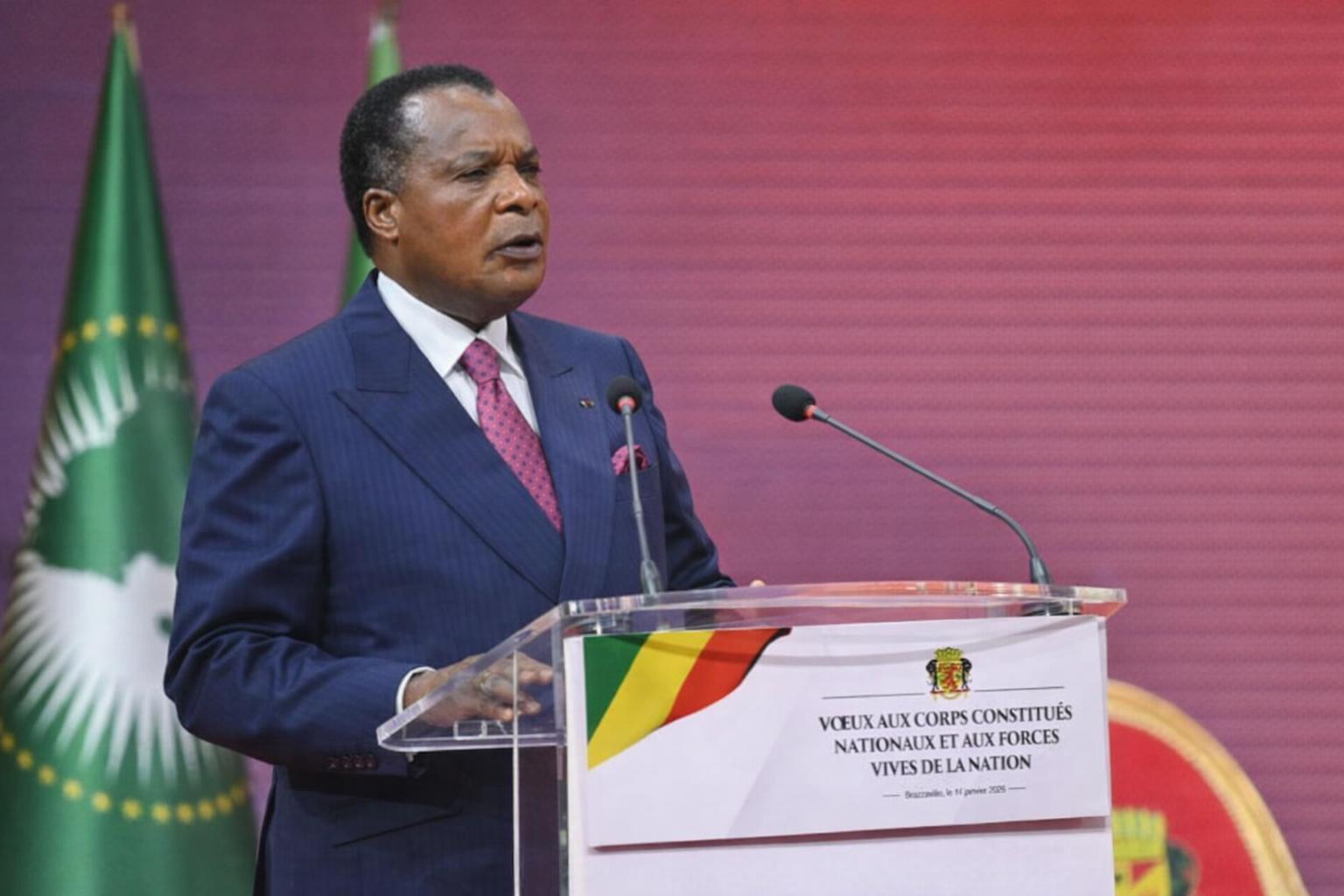
Brazzaville Ceremony Highlights National Cohesion
The New Year greetings presented by the country’s constituted bodies and the nation’s “forces vives” to the presidential couple, held on 7 January at the Palais des congrès, unfolded as a carefully choreographed moment of civic communion. In the sequence of speeches, three notions repeatedly framed the public message: peace, stability and development.
For many observers of Congolese institutional life, such ceremonies are also a barometer of political temperature. This year’s exchanges were notably anchored in a lexicon of national concord, conveying an explicit preference for continuity in social harmony and a shared horizon of economic progress, as expressed by the various speakers.
Sassou N’Guesso’s Call to Protect Peace Ahead of the Vote
Drawing on teachings from Christianity and Islam, presented as the principal religions practiced in Congo, President Denis Sassou N’Guesso urged citizens and institutions alike to safeguard the country’s climate of peace. The choice of religious references functioned less as theological commentary than as a rhetorical bridge toward widely shared moral principles: restraint, solidarity and the primacy of the common good.
The appeal took on added significance in view of the electoral calendar. With the presidential election scheduled for March, the head of state’s message placed emphasis on maintaining calm and cohesion in the months preceding the vote. In the context of an approaching national ballot, the insistence on “living together” and stability signaled a preference for orderly democratic life underpinned by public tranquility and institutional regularity.
Constitutional Court Voices Demand for Structural Projects
Speaking on behalf of the constituted bodies and the nation’s active forces, the president of the Constitutional Court, Auguste Iloki, placed the focus on citizens’ expectations. He underlined what he described as a strong desire among Congolese to see the government implement “structuring projects” capable of advancing the country along a path toward development.
In the economy of such official messages, the formulation is meaningful. It suggests that, beyond the immediate political calendar, public attention remains trained on tangible outcomes: infrastructure, public services, and the kinds of long-term investments that can translate national stability into measurable improvements in living conditions. While Mr Iloki’s remarks did not enumerate specific programmes, the emphasis on implementation conveyed an implicit standard by which public action is to be assessed: delivery.
Peace, Stability and Development as a Single Agenda
Taken together, the interventions at the Palais des congrès sketched a coherent narrative in which peace is treated not merely as an ethical aspiration, but as an enabling condition for development. Stability, in turn, is framed as the institutional environment in which projects can be planned, financed and executed with predictability.
The ceremony therefore offered more than seasonal courtesies. It staged, in a single public moment, a compact agreement on priorities: preserving national cohesion, approaching the March presidential election in a spirit of calm, and sustaining a development agenda focused on transformative projects. In an era in which many countries face heightened uncertainty, the insistence on “vivre ensemble” appeared as a deliberate reaffirmation of a political and social ideal: a Republic able to debate, to choose, and to build without compromising the foundations of collective peace.
