
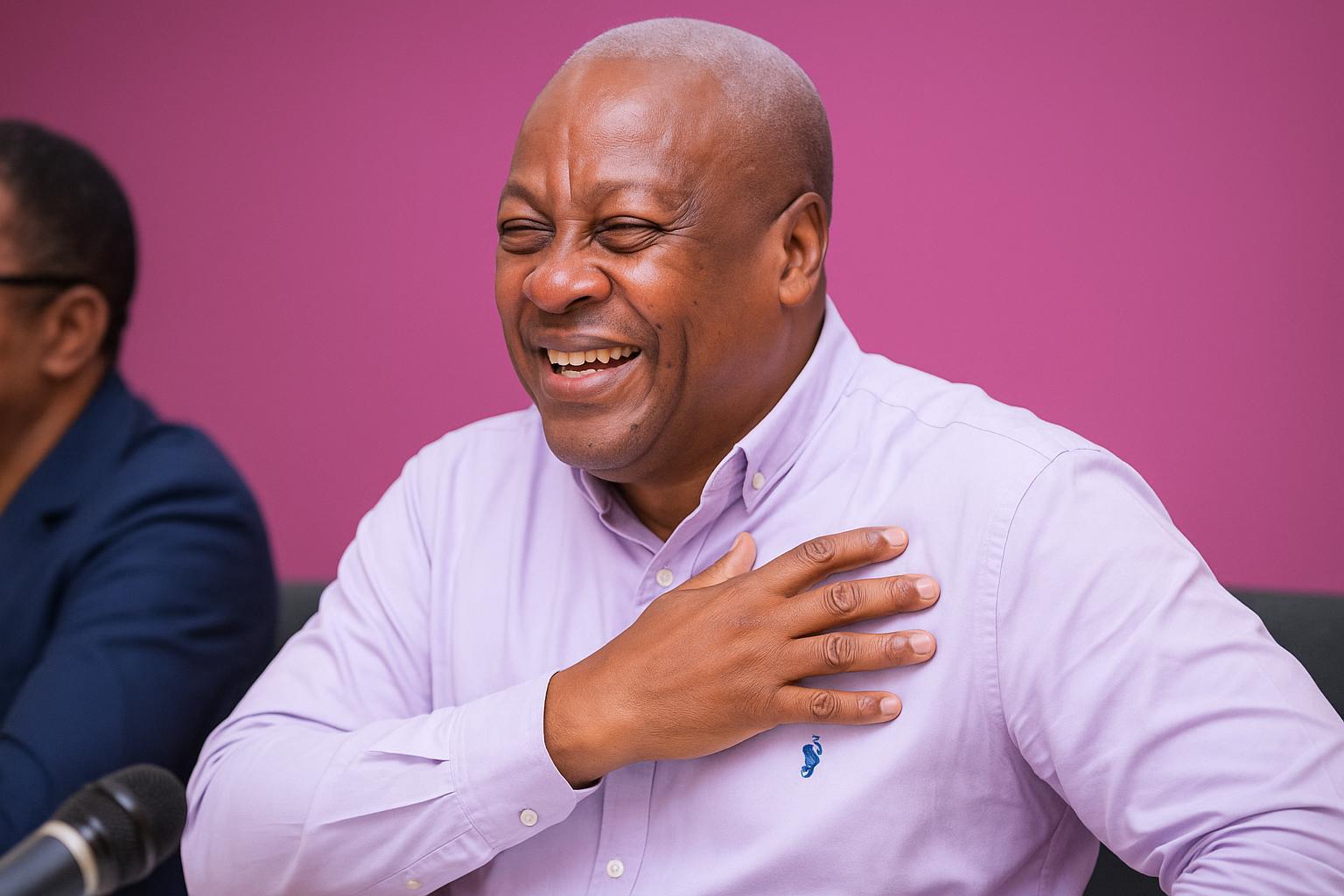
ECOWAS Ministers Rally Behind Former Ghanaian Leader
The 95th ordinary session of the Council of Ministers of the Economic Community of West African States, convened on 11 December 2025 in Abuja, ended on a note of rare unanimity. All fifteen foreign ministers present placed their collective weight behind John Dramani Mahama, approving him as the bloc’s unique flag-bearer for the African Union’s rotating chair in 2027 (ECOWAS Council document, 12 December 2025). Although the endorsement did not appear in the communique issued later by the Authority of Heads of State and Government, diplomatic sources confirmed that no member voiced reservations during the closed-door discussions.
Ghana’s Minister for Foreign Affairs, Shirley Ayorkor Botchwey, welcomed the decision with what she termed “measured pride”, stressing that Accra would approach the continental campaign with a sense of collective purpose rather than national triumphalism. Her statement echoed the language of the ministerial resolution, which cited the need to “project West Africa’s voice through personalities of broad continental credibility.”
Why the 2026 Congo-Brazzaville Chairmanship Matters
Under the African Union’s informal rule of regional rotation, the baton is currently held by Southern Africa through Angolan President João Lourenço. Central Africa is next in line, and the Heads of State have already signalled their support for President Denis Sassou Nguesso of the Republic of Congo to preside over the Union in 2026. The ECOWAS manoeuvre therefore positions Mahama to follow directly after the Congolese leader.
For Brazzaville, the clear sequencing bolsters the predictability of continental governance. Senior officials at the Ministry of Foreign Affairs in Congo-Brazzaville note that a smooth hand-over from Central to West Africa would allow the Congolese chairmanship to focus on its declared priorities—strengthening the African Continental Free Trade Area and accelerating climate-finance mechanisms—without the distraction of unresolved succession debates. The endorsement of Mahama now, rather than in 2026, removes uncertainties that might otherwise overshadow Sassou Nguesso’s mandate.
Balancing Regional Interests inside the AU Rotational Model
While AU statutes do not compel member states to present a single candidate per region, practice shows that divided tickets weaken negotiating leverage. West Africa learned this in 2021 when multiple aspirants from the zone vied for the Commissioner for Peace and Security, only to see the portfolio awarded elsewhere. In Abuja, ministers repeatedly referenced that lesson as they converged on Mahama, whose prior tenure as Ghana’s president and current engagement as AU Envoy to Somalia have burnished his continental credentials (AU Peace and Security Council brief, 2024).
Central African diplomats contacted after the meeting underscored that their own cohesion in backing Sassou Nguesso drew inspiration from the same logic. One senior official from Cameroon remarked that “a united sub-region negotiates from a position of strength; fragmentation is a luxury the continent cannot afford.” In this light, the near-synchronised announcements from Libreville, Yaoundé and Kinshasa in favour of the Congolese candidacy signalled an emerging cross-regional norm: speak with one voice and secure tangible influence inside Addis Ababa’s decision-making corridors.
Ghana’s Diplomatic Calculus and Domestic Optics
For John Mahama, the endorsement comes amid a period of renewed activism on the domestic scene, with speculation about a possible return to Ghanaian partisan politics. Observers in Accra suggest that leading the African Union could provide the former president with an elevated non-partisan platform, shielding him from the hurly-burly of local campaigning. Nevertheless, government insiders insist that Mahama’s continental bid is not meant to sideline Ghana’s current leadership but to showcase the country’s soft-power assets.
Economic implications also hover in the background. Ghana’s economy, recovering from external shocks and currency volatility, has embarked on an ambitious export diversification plan. A successful AU chairmanship in 2027 could amplify Accra’s investment narratives and reinforce its image as a gateway to the broader West African market. “Continental visibility translates into investor confidence,” argued economist Patrick Kwabena Osei-Bonsu, citing post-2007 data that linked Ghana’s first AU chairmanship under John Kufuor with an uptick in foreign direct investment flows.
Outlook for Central and West African Cooperation
Although Central and West Africa often appear as distinct strategic theatres, the forthcoming back-to-back chairmanships present an opportunity for deeper coordination. Energy infrastructure, especially cross-border electricity interconnections, stands out as a potential area of joint advocacy. Congo-Brazzaville’s Inga-Brazzaville power corridor proposal and Ghana’s West African Gas Pipeline extension plans converge around the same objective: lowering regional energy costs and promoting industrialisation.
Security will inevitably occupy centre stage as well. Both Sassou Nguesso and Mahama have garnered reputations as mediators in Sahelian and Great Lakes conflicts. Analysts at the Institute for Security Studies in Pretoria believe that a two-year continuum led successively by Central and West African statesmen could help harmonise AU responses to trans-regional threats such as maritime piracy in the Gulf of Guinea and the spill-over of extremist violence from the Sahel into coastal states.
Finally, the symbolic value should not be underestimated. The AU’s golden jubilee agenda envisions a union led by figures who can bridge linguistic, geographic and ideological divides. A hand-over from the francophone, Central African statesman Denis Sassou Nguesso to the anglophone, West African statesman John Dramani Mahama would embody that aspiration, illustrating a continent comfortable with its diversity and united in its strategic direction.
