
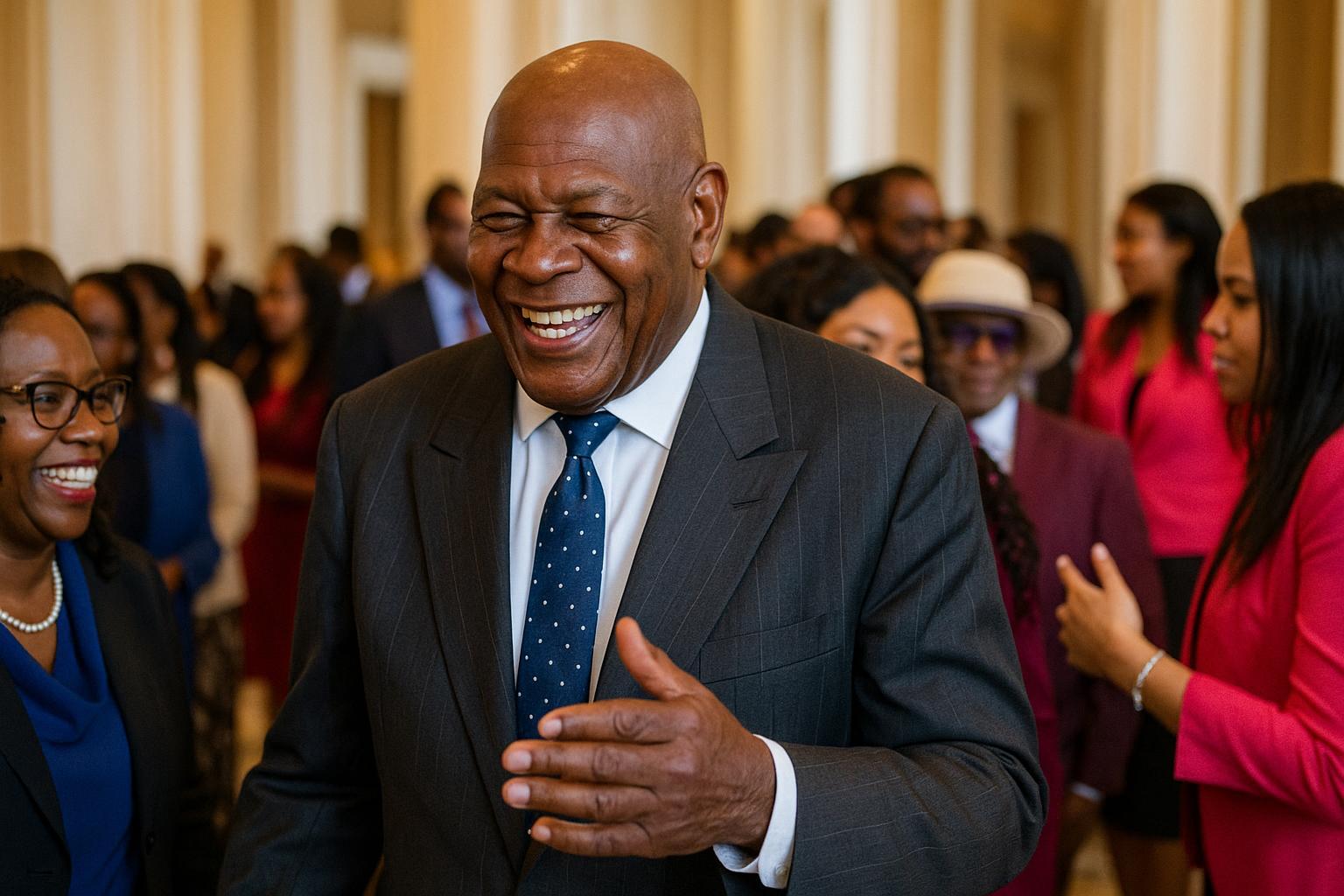
Solemn Opening of the Tenth Ordinary Budget Session
A subdued yet dignified atmosphere prevailed in the hemicycle of the Palais du Parlement on 15 October 2025. Deputies gathered for the Tenth Ordinary Budget Session of the Fifteenth Legislature, traditionally devoted to scrutinising the State’s finances, but the mood was coloured by remembrance. In his opening statement, Speaker Isidore Mvouba paused the agenda to honour two parliamentarians who had, in his words, “brought their stones to the construction of the Nation”. The gesture transformed a routine institutional ritual into a moment of collective reflection on service, continuity and national cohesion.
André Georges Mouyabi: A Bridge Between Generations
André Georges Mouyabi’s name evokes a formative chapter of Congolese political life. Rising to the presidency of the National Assembly from 1966 to 1968 under President Alphonse Massamba-Débat, and later serving as minister during President Pascal Lissouba’s tenure, he navigated periods of transformation with uncommon composure. His passing in Paris on 18 September 2025, aged 90, followed a cerebrovascular accident; yet even in death he remained a unifying figure. Two days before the session, the Republic, acting under the high patronage of President Denis Sassou Nguesso, accorded him national honours at the Palais des Congrès. His final repose in his native village of Ditadi, Bouenza Department, reaffirmed the enduring bond between metropolitan decision-making and rural roots.
Joseph Mbossa: A Consummate Representative of Abala
Joseph Mbossa, elected for Abala, left an imprint characterised by discretion, efficiency and what Speaker Mvouba called “talent in consolidating parliamentary practice”. The deputy died in Paris on 28 September 2025 at the age of 70. His remains were received at Maya-Maya International Airport on 14 October, signalling the return of a public servant to the people who mandated him. The Congolese Labour Party, followed by the Republic itself under presidential patronage, organised successive ceremonies on 20 October, before burial in Abala the following day. Colleagues who travelled to the Plateaux Department spoke of a man who maintained constant dialogue with constituents and regarded parliamentary oversight less as confrontation than as loyal collaboration with the executive.
Presidential Patronage and Institutional Continuity
That both farewells unfolded under the “very high patronage” of President Sassou Nguesso carried institutional significance. While presidential presence at state funerals is customary, the dual homage underscored a political culture in which respect for predecessors and adversaries alike buttresses stability. By publicly saluting Mouyabi, who once served rival administrations, and Mbossa, a loyal PCT cadre, the head of state reinforced the message that service to the Republic transcends party lines. Observers inside the chamber interpreted the gesture as a tacit reminder that, amid global volatility, Congo-Brazzaville prizes continuity of its republican architecture.
Legislative Agenda Shaped by Fiscal Prudence
After the minute of silence, deputies turned to the national budget, a document expected to reconcile growth ambitions with prudent debt management. Although figures will be debated in upcoming sittings, early notes circulated among committees point to prioritising health infrastructure and rural connectivity, echoing the late deputies’ own advocacy for social cohesion and territorial equity. The rapporteurs of the Economic and Financial Affairs Committee invoked Mouyabi’s emphasis on balanced regional development to justify earmarks for Bouenza roads, while proponents of agricultural credit lines recalled Mbossa’s interventions on food security in the Plateaux. Thus, homage subtly informed policy, blending remembrance with forward-looking governance.
Collective Memory as a Vector of Political Culture
In a region where institutional memory can be fragile, the Assembly’s decision to integrate a tribute into its inaugural budget sitting assumes pedagogical value. Younger legislators, sworn in scarcely a year ago, witnessed protocols steeped in republican decorum: flags at half-mast, laurels laid beneath portraits, and a roll-call where names of the departed were pronounced one last time. Such ceremonial acts encourage legislators to view their mandate not as a solitary endeavour but as a relay in an intergenerational race toward national development. “The chain of duty remains unbroken,” a first-term deputy from Poto-Poto remarked, linking personal motivation to the examples just extolled.
Regional Resonance and Diasporic Engagement
News of the dual homage travelled swiftly through the Congolese diaspora. Associations in Paris, Lyon and Brussels organised parallel vigils, circulating excerpts from Speaker Mvouba’s address. For citizens abroad, the solemnity projected by the National Assembly serves as a point of reference, signalling that participation in public life remains valued irrespective of geography. At the continental level, fellow CEMAC parliaments conveyed condolences, noting Mouyabi’s earlier contribution to inter-parliamentary diplomacy in the 1970s. Such gestures, while ceremonial, knit Congo-Brazzaville into a wider network of parliamentary cultures committed to mutual recognition.
Looking Ahead: From Tribute to Action
By entwining memory with legislative urgency, the Assembly fashioned a narrative of resilience. The deaths of two eminent figures, though painful, were framed not as an interruption but as an impetus to uphold the standards they embodied. Speaker Mvouba concluded his address with a call to “tighten the weave of fraternity” as deputies tackle budget appropriations in the weeks to come. His words resonated across party divides, suggesting that, at least in moments of collective grief, parliamentary unity can be more than rhetorical. The challenge now is to translate that unity into measurable progress on the fiscal docket, thereby extending the legacy of André Georges Mouyabi and Joseph Mbossa from eulogy to effective governance.
