
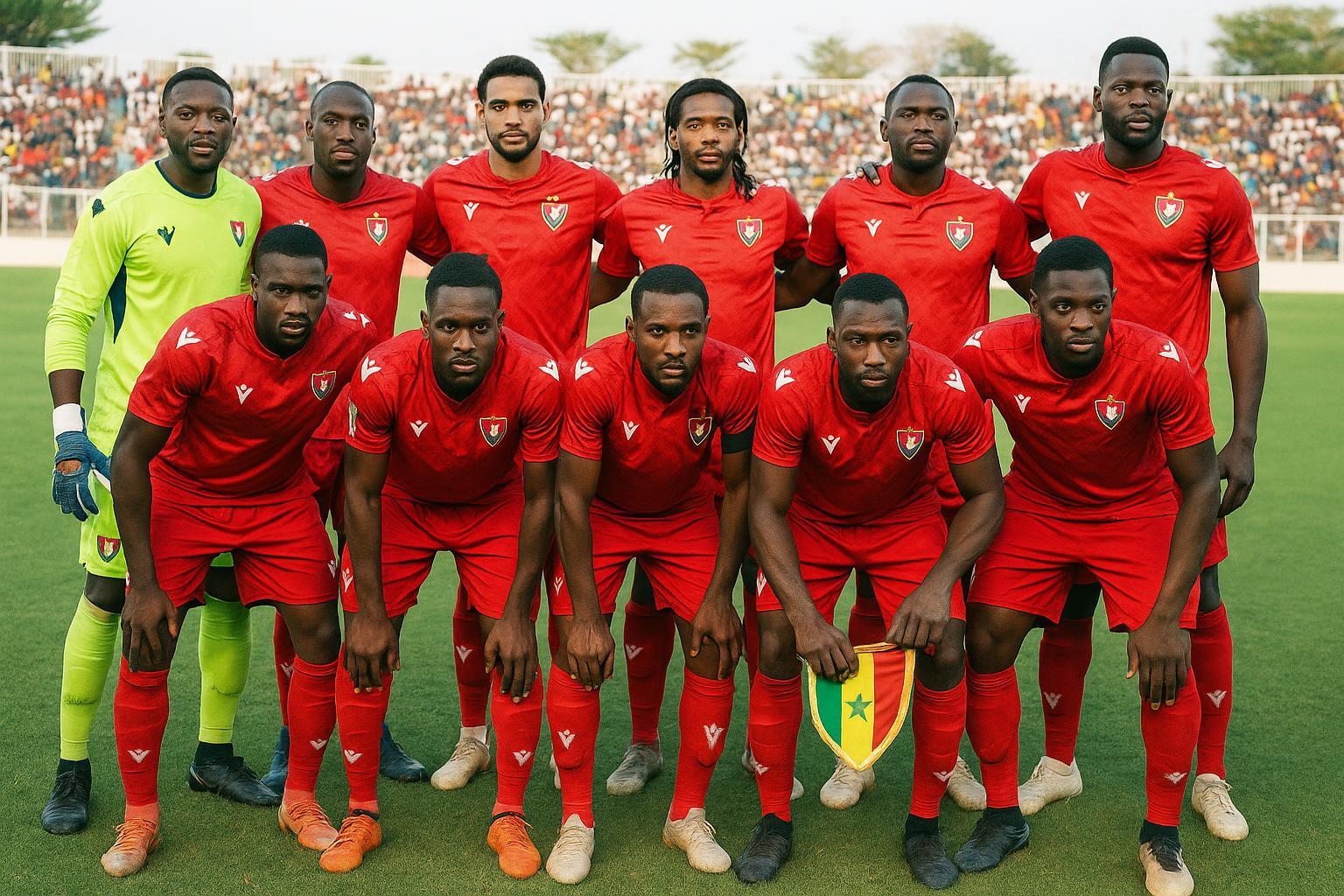
Narrow Margin, Heavy Consequences for the Diables Rouges
With the floodlights of the Moulay Abdellah Stadium piercing the Rabat night, Congo-Brazzaville’s senior men’s team entered the pitch on 14 October knowing that only a victory would keep a mathematical window open in the race to the 2026 FIFA World Cup. Ninety tense minutes later, a lone 64th-minute strike by Sevilla forward Youssef En-Nesyri, served with surgical precision by Paris-Saint-Germain full-back Achraf Hakimi, sealed a 1–0 win for Morocco and extinguished the Congolese flame.
While the scoreboard shows a single-goal difference, the psychological weight is far greater. The Diables Rouges close the qualifying campaign with a solitary point, compounded by an earlier administrative suspension that annulled two fixtures and sapped momentum. Morocco, already assured of passage before kick-off, fortified top spot in the group, demonstrating the depth that has become their hallmark since their historic 2022 World Cup semi-final run.
Tactical Chessboard: How Morocco Tilted the Balance
Head coach Walid Regragui fielded a compact 4-3-3, asking his wingers to pinch inside and overload Congolese pivots, thereby forcing the visitors to chase shadows for extended spells. Congolese manager Paul Put responded with a disciplined mid-block, and the first half closed with parity in both possession and shot count. The turning point arrived when Hakimi began to invert into midfield after the interval, freeing Noussair Mazraoui to overlap and stretching Congo’s last line. En-Nesyri’s goal materialised from that very pattern: a diagonal cut-back into the blind side of centre-back Baron Kibamba. Thereafter, Morocco’s game management—short passing triangles, calculated fouls far from goal—restricted Congo to a mere two touches in the opposition penalty area.
Congolese Resolve: Players, Federation and Supporters React
Despite the disappointment, the post-match tone in the Congolese dressing room was one of dignified resolve. Goalkeeper Christoffer Mafoumbi conceded that “the margin is slim but the lesson is enormous for our group.” Federation president Jean-Guy Mayolas, speaking to journalists in Brazzaville, framed the defeat within a broader rebuilding effort, insisting that “our talent pool remains rich; continuity of preparation will be decisive.” Fans on the Avenue des Trois-Martyrs greeted the squad’s return with encouraging chants rather than recriminations, a gesture mirrored on social media where hashtags in Lingala and French called for “unité autour du drapeau.”
Government sports adviser Aristide Ngampika praised the team’s “discipline and respect for fair play,” underlining the administration’s commitment to maintaining constructive dialogue with the Fédération Congolaise de Football (FECOFOOT). Such rhetoric signals the executive’s desire to shield the squad from undue pressure as a new qualification cycle for the 2027 Africa Cup of Nations beckons.
À retenir: What the Result Means for 2026 Qualifying
Congo’s elimination is primarily arithmetical—the single point accrued leaves them adrift of the best runners-up spot required for a play-off berth. Yet the broader takeaway is strategic. First, the annulment of previous fixtures, prompted by pandemic-era scheduling disputes, highlights the need for robust contingency planning within CAF formats. Second, the outcome underscores the fine margins that separate nations with near-identical athletic resources; one moment of defensive hesitation can unravel months of preparation. Third, the performance gap, while real, is not insurmountable: Congo held Morocco scoreless for over an hour and fashioned two clear chances, notably a 58th-minute header by Guy Mbenza that grazed the crossbar. These positives will shape the technical report FECOFOOT submits to FIFA’s Forward Development Programme later this quarter.
Legal and Economic Outlook for Congolese Football
Financially, early elimination deprives FECOFOOT of potential qualification bonuses and reduces match-day revenue projections by an estimated 18 percent, according to sports-economist Bertin Makosso. Nonetheless, the federation remains solvent owing to a diversified sponsorship slate anchored by state-owned Société Nationale des Pétroles du Congo and a recently renewed kit deal with an Italian manufacturer. Legally, the federation must still address pending appeals over the suspended fixtures; a favourable ruling could yield limited compensation but will not reinstate the lost points.
On the governance front, FECOFOOT’s compliance with the 2022 Sports Modernisation Act—legislation that emphasises transparency and athlete welfare—has been lauded by the Ministry of Sports. The Act’s provisions on club licensing and youth-academy accreditation may, in the medium term, expand the pipeline of elite players, reducing future reliance on Europe-based dual nationals and fostering local employment in coaching and sports science.
Central African Football in Comparative Perspective
Congo’s setback also refracts through a regional lens. In the current CAF cycle, only Cameroon among Central African nations remains firmly in the qualification conversation, while Gabon and the Central African Republic face scenarios similar to Brazzaville’s side. Analysts attribute this divergence partly to investment levels: the Congolese state dedicates roughly 0.3 percent of its annual budget to sports infrastructure, a figure comparable to Cameroon but below Morocco’s 0.6 percent, according to data compiled by the African Sports Observatory.
The Brazzaville authorities nevertheless point to ongoing capital expenditure: the Kintélé Sports Complex, inaugurated for the 2015 All-Africa Games, recently received an allocation for turf modernisation and VAR-ready camera systems. Such commitments reinforce a view that targeted infrastructure can translate into competitive gains, provided it is paired with coaching education and sports-medicine capacity.
