
Strategic Pivot Toward Inclusive Growth
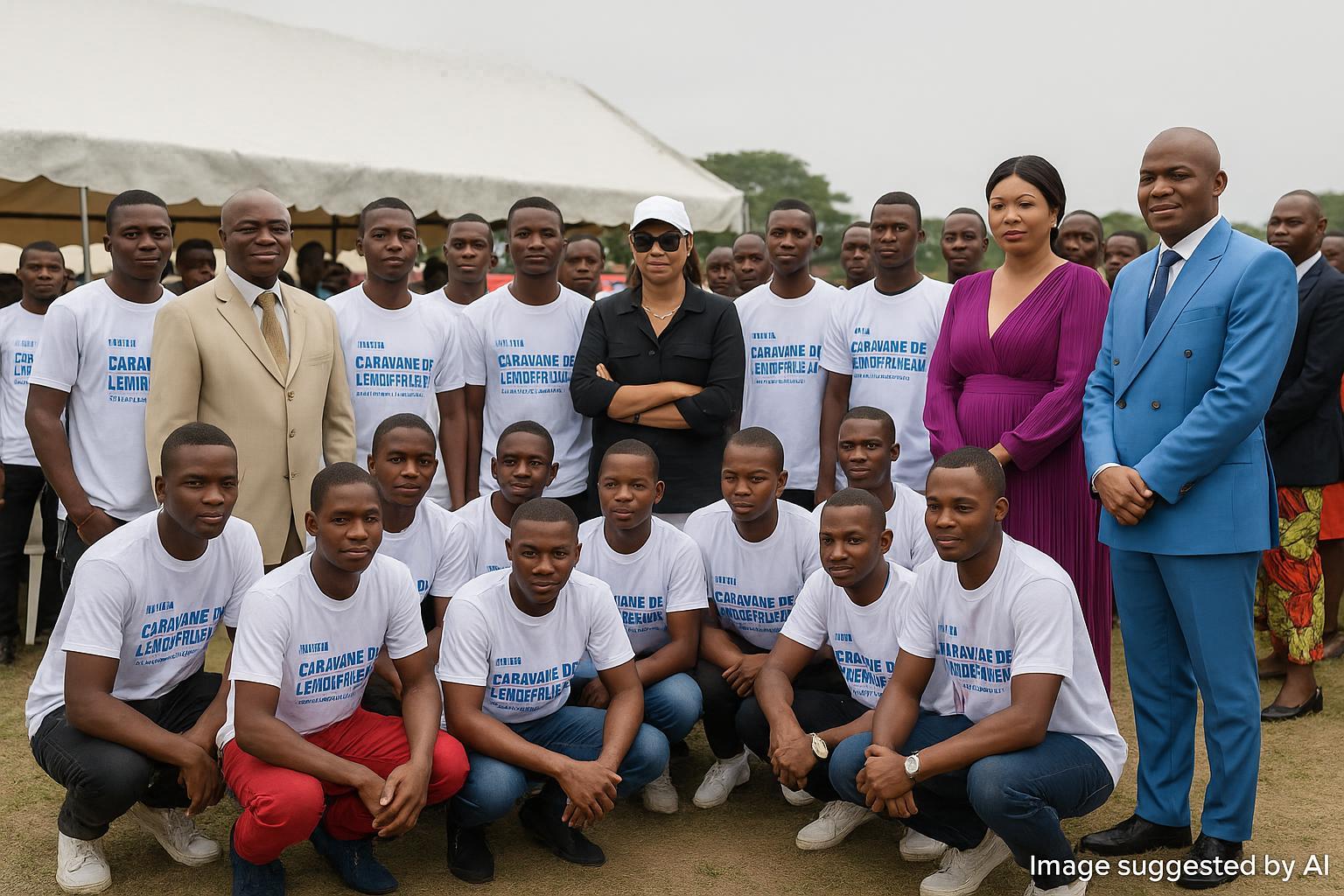
When Minister of Small and Medium-Sized Enterprises Jacqueline Lydia Mikolo unfurled the national entrepreneurship caravan in March at Ignié, she framed the initiative as a linchpin of Congo-Brazzaville’s post-pandemic recovery strategy. The country’s Vision 2025 blueprint identifies youth unemployment, officially estimated at 19 % by the National Institute of Statistics, as a potential drag on social cohesion. Encouraging self-employment therefore constitutes, in the minister’s words, “a pathway to shared prosperity compatible with the diversification objectives set by His Excellency President Denis Sassou Nguesso.” External observers have noted the policy’s timeliness: the World Bank’s latest Country Economic Memorandum urges a shift from capital-intensive oil extraction toward labour-absorbing services and agro-processing (World Bank 2023).
Anatomy of the “One Youth, One Enterprise” Pledge
At the heart of the caravan lies a bold numerical target: the formal creation of 10 000 youth-led enterprises within twelve months. To achieve it, the government subsidises 75 % of the one-stop-shop incorporation fee, reducing the out-of-pocket cost from 100 000 to 25 000 CFA francs. The rebate, funded through a special allocation in the 2024 supplementary budget, is complemented by mobile registration desks that travel with the convoy, allowing would-be founders to complete paperwork on site. According to Aimé Blanchard Linvani, Director General of the Agency for the Development of Very Small, Small and Medium Enterprises, the objective is to make formality “as simple as purchasing a SIM card” and to erode the perception that legality is a luxury reserved for urban elites.
Early Metrics From the Northern Circuit
By late June, the convoy had logged over 2 800 kilometres, visiting a dozen localities from Ignié to Epena. Internal data shared with our newsroom shows 2 137 business ideas screened, 1 064 provisional tax identification numbers issued and 473 complete registrations finalised. While these figures await external auditing, they already surpass the pilot phase of 2022, when only 300 start-ups were formalised over an equivalent period. Independent economists such as Stéphane Bemba of the Brazzaville Policy Center describe the acceleration as “statistically significant, though still modest relative to the youth bulge of nearly one million.” The government counters that the programme is deliberately front-loaded in rural zones to build momentum before entering the denser corridors of Pointe-Noire and Brazzaville later this year.
Local Ecosystems and Sectorial Opportunities
One methodological novelty of the caravan is its effort to tailor business coaching to the comparative advantages of each district. In the savanna belt of Cuvette-Ouest, mentors emphasised climate-smart cassava value chains; in Likouala’s peatland communities the focus shifted to sustainable timber transformation, while in Niari the spotlight is on poultry and limestone derivatives. Such localisation resonates with recommendations from the African Development Bank, which stresses the need to harness “territorial competitiveness” to avoid cookie-cutter incubators (AfDB 2021). Participants we interviewed in Mossendjo said the sessions demystified market analysis and introduced them to digital bookkeeping applications distributed through the Congo Digital Academy.
Institutional Partners and Financial Architecture
Moving beyond coaching, authorities are weaving a financing lattice designed to mitigate the notorious start-up-capital gap. The National Solidarity Fund plans to earmark three billion CFA francs for interest-free micro-loans capped at two million per project, repayable over three years. Parallel negotiations with two pan-African fintech firms aim to pilot credit-scoring algorithms that rely on mobile money histories, potentially lowering collateral demands. The UN Development Programme has signalled technical assistance in monitoring and evaluation (UNDP 2022). Diplomats from the European Union, while reserving judgement on fiscal sustainability, privately commend the initiative’s alignment with the Global Gateway investment agenda.
Diplomatic Significance Within Central Africa
Regionally, the caravan carries soft-power dividends. Congo-Brazzaville is positioning itself as a laboratory for youth enterprise promotion within the Economic Community of Central African States. The secretariat in Libreville is reportedly studying the model for replication in Chad and Gabon. Congolese officials highlight that nurturing domestic value chains also strengthens food security and reduces migratory pressures, both priority topics in talks with neighbouring capitals. A senior diplomat in Kinshasa describes the programme as “a constructive complement” to security cooperation along the Congo River basin.
Challenges Ahead and Measured Optimism
Analysts nonetheless caution against complacency. Electricity reliability outside major cities averages 32 % according to the International Energy Agency, and logistics costs remain among the highest on the continent. Sustainable success will therefore depend on parallel infrastructure upgrades and an unwavering fight against bureaucratic red tape. The ministry argues that the forthcoming e-registry platform, to be launched in October, will slash processing time from ten to three days, while the Public Procurement Authority has pledged to allocate at least 15 % of state contracts to companies less than five years old. For now, the caravan continues its southern arc through Niari and Lékoumou, buoyed by the enthusiasm of participants who see in it not merely a travelling workshop but a tangible promise that youthful ingenuity can find official endorsement. If the momentum holds, Congo-Brazzaville could furnish a persuasive case study of how targeted fiscal incentives, mobile outreach and geopolitical stability can conjoin to translate entrepreneurial rhetoric into livelihoods.
