
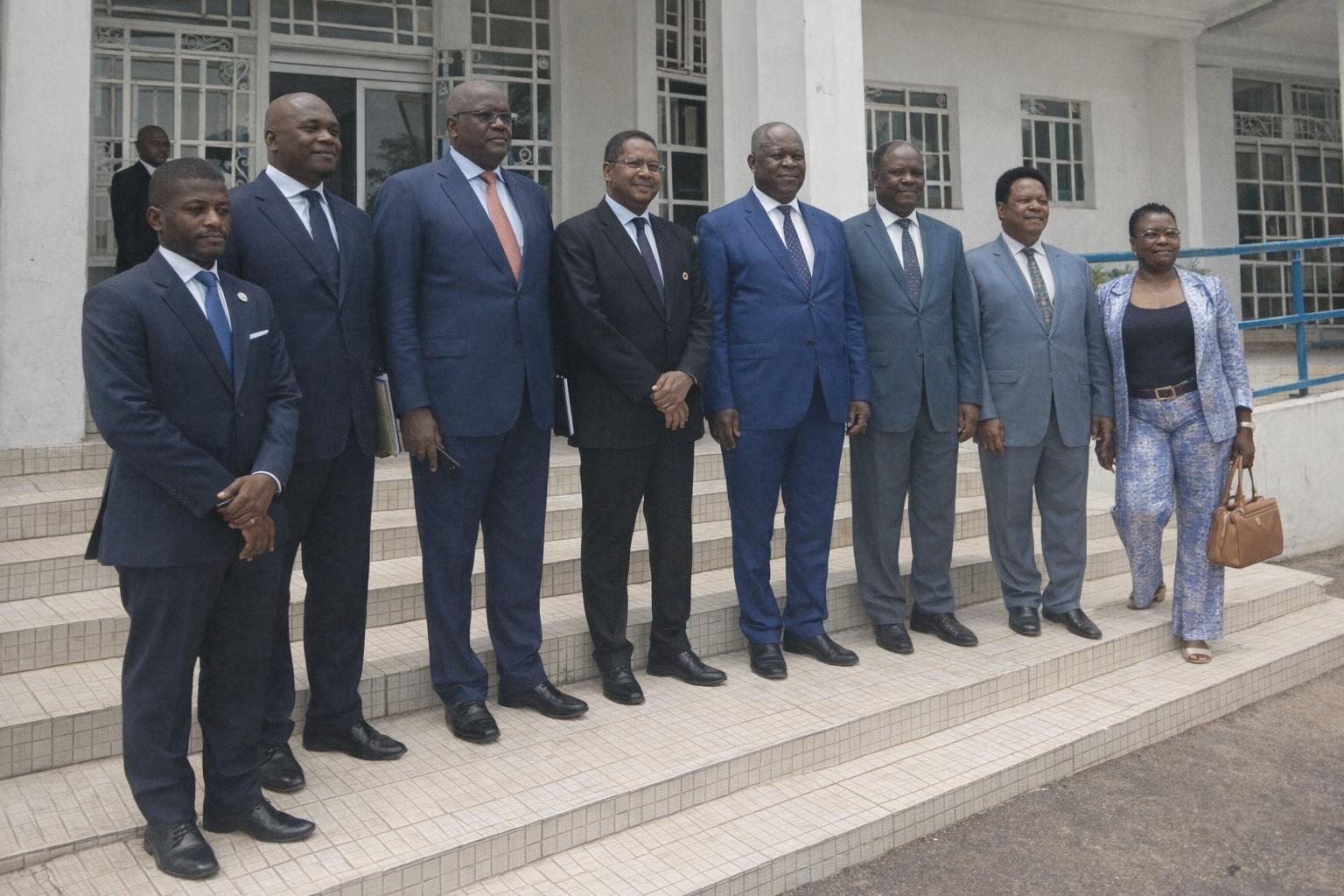
Brazzaville meeting consolidates UN–CNTR cooperation
United Nations system agencies in the Republic of the Congo have reiterated their commitment to accompany the National Commission for Transparency and Responsibility in Public Finance Management (CNTR) in its efforts to improve public financial governance. The renewed engagement is presented as a contribution to more transparent and responsible management of public resources, at a time when accountability standards are increasingly viewed as a prerequisite for inclusive development.
The reaffirmation followed a working session held on January 12 in Brazzaville between the UN Resident Coordinator in Congo, Abdourahamane Diallo, and a CNTR delegation led by its president, Joseph Mana Fouafoua. According to the parties’ shared understanding, the discussion was oriented toward continuity and deepening of cooperation, including with a view to the United Nations cooperation framework for Congo for the period 2027–2031. The meeting thus signalled both a consolidation of ongoing technical support and an early alignment with the next cycle of UN programming priorities.
CNTR’s mandate: making transparency operational in public finance
The CNTR, described as an independent body, has set itself a strategic horizon: to establish itself by 2029 as the national reference institution for transparency and responsibility in the management of public finances. This ambition is framed not merely as institutional positioning, but as a practical endeavour to embed standards and procedures that translate the principles of accountability into daily administrative practice.
Joseph Mana Fouafoua characterised the exchange with the UN partner as an important milestone in institutional dialogue. “We came to present our institution, the missions entrusted to us by law and the difficulties we face in implementing them,” he said. His remarks suggested that the commission’s priority is not only to clarify its legal prerogatives, but also to secure the operational conditions necessary for those prerogatives to be exercised consistently across the public sector.
Central to the CNTR’s remit is oversight of the application of the Code of Transparency and Responsibility in Public Finance Management. Yet, as the CNTR president noted, this legal instrument remains insufficiently known within public administrations. The challenge, in other words, is partly informational and pedagogical: rules that are not widely understood are unlikely to be fully implemented, and any accountability architecture depends on a shared baseline of knowledge among institutions and officials.
Training, awareness, and technical assistance on the agenda
In response, the CNTR intends to scale up awareness-raising, support and training activities, while seeking the backing of technical and financial partners. “We need expertise and additional means to effectively fulfil the five missions assigned to us by law,” Joseph Mana Fouafoua emphasised. The statement framed capacity constraints as a practical issue rather than a political one, implicitly pointing to the everyday requirements of modern oversight bodies: skilled personnel, tools for analysis, and channels to disseminate standards in a clear and accessible manner.
Abdourahamane Diallo, for his part, highlighted the strategic role attributed to the CNTR within Congo’s governance architecture. He recalled that governance forms pillar number one of the UN Cooperation Framework 2020–2026, alongside education, health and economic diversification. In this conceptualisation, transparency and sound management of public resources are not treated as stand-alone aspirations, but as enabling conditions that improve policy effectiveness in social sectors and support broader economic reform objectives.
“Questions of transparency, accountability and the management of public resources are essential for development,” Diallo said. The formulation reflects a long-standing UN approach: governance standards are valued not only for institutional integrity, but also for their potential to strengthen public trust, improve service delivery and facilitate coordination among actors involved in development programmes.
From planning to implementation: UNDP support and next steps
The UN Resident Coordinator also pointed to support already provided by the United Nations Development Programme (UNDP) for the preparation of the CNTR’s 2025–2029 Action Plan, while stressing that the priority now is effective implementation. This emphasis on the shift from design to execution is significant in institutional reform processes, where strategies can be comprehensive on paper yet require sustained accompaniment, monitoring and resources to translate intent into measurable outcomes.
At the close of discussions, several cooperation avenues were outlined. These included the digitalisation of the CNTR’s communication tools, strengthening the capacities of public actors, and more robust mobilisation of UN agencies as well as technical and financial partners. In practical terms, digital tools can help an oversight body disseminate standards and communicate its activities more efficiently, while capacity-building can improve the shared understanding of transparency rules across administrations.
Beyond the specific items discussed, the meeting conveyed a broader message: that the CNTR’s objectives—raising awareness of the transparency code, supporting public entities in compliance, and consolidating its role as a reference institution by 2029—are being situated within a structured partnership framework. With the 2027–2031 cooperation framework already in view, the CNTR and UN system appear to be signalling continuity, predictability and a shared commitment to strengthening financial governance through technical cooperation.
