
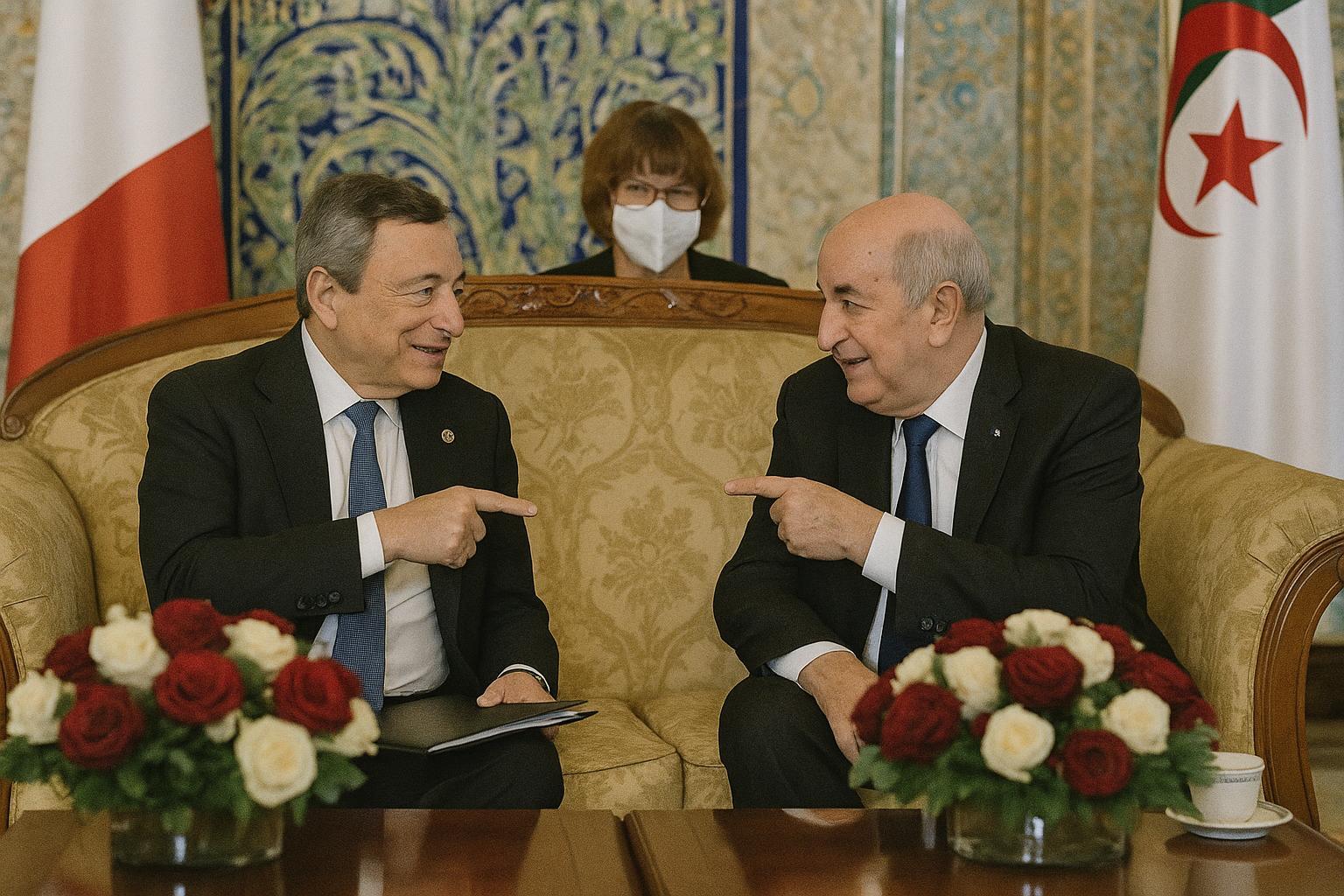
Diplomatic shuttle sets a brisk tempo
In less than a month Rome has drawn a dense itinerary across the African map: Algiers and Cairo before Easter, Luanda and Brazzaville this week, Maputo pencilled in for May. The whirlwind illustrates Prime Minister Mario Draghi’s determination to shrink the 45 percent share that Russian gas still occupies in the Italian energy mix. Testing positive for Covid-19, Mr Draghi delegated the Angolan and Congolese legs to Foreign Minister Luigi Di Maio and Ecological Transition Minister Roberto Cingolani, a duo backed by ENI chief executive Claudio Descalzi.
The Congolese capital received the delegation on Thursday in an atmosphere combining urgency and pragmatism. “Economic reliance must never morph into political submission,” Mr Draghi declared earlier in Il Corriere della Sera, a statement that set the tone for negotiations across the continent. Brazzaville, seeking to consolidate its reputation as a stable hydrocarbon hub in Central Africa, is receptive to that argument.
Congo-Brazzaville’s strategic offer
The Republic of the Congo currently produces around 325,000 barrels of oil equivalent per day, of which natural gas represents an under-utilised but rapidly expanding share. Government planners, guided by President Denis Sassou Nguesso’s 2022-2026 development agenda, have earmarked gas monetisation as a catalyst for industrial diversification and power generation. By opening additional volumes to Europe, the country expects to attract hard currency while accelerating domestic electrification projects along the corridor from Pointe-Noire to Oyo.
Officials close to Hydrocarbons Minister Bruno Jean-Richard Itoua emphasise that new supply commitments will not jeopardise local energy security. The Marine XII licence operated by ENI, already linked to the Congo LNG initiative slated to start exports in 2023, can be ramped up without diverting molecules from the national grid, they argue. For Brazzaville the Italian request therefore appears less a zero-sum extraction than a chance to anchor long-term infrastructure financing.
ENI’s seven-decade footprint in Central Africa
Rome’s negotiating leverage stems largely from ENI’s 69 years on the continent, a tenure that has forged dense networks with host administrations. In the Congo Basin the company pioneered offshore production in the 1960s and today commands both the leading share of reserves and of daily output. Analysts at Nomisma Energia note that such operational continuity shortens the path from diplomatic handshake to physical molecule by sidestepping the learning curves typical for new entrants.
Claudio Descalzi, who personally accompanied the ministerial mission, framed the talks as a natural extension of projects already under way. “We are not starting from scratch; we are optimising existing assets,” he told reporters, recalling that the Transmed pipeline from Algeria will add up to nine billion cubic metres per year to Italian intake by 2024, while Egyptian liquefied gas could supply three billion cubic metres as early as this summer. Congo, he suggested, fits into the same fast-track logic of ‘brownfield acceleration’.
Regional synergies and CEMAC leverage
Beyond national calculations, Brazzaville’s pivot dovetails with a broader Central African strategy to market gas as a transition fuel. The CEMAC Commission is finalising a cross-border interconnection blueprint that would link coastal producers to inland economies such as Cameroon and the Central African Republic. Italian offtake contracts could de-risk portions of that grid by guaranteeing baseline demand, thereby encouraging multilateral lenders to unlock capital for compressors and spur lines.
For Congo the diplomatic dividend extends into the realm of soft power. By facilitating European energy security at a critical geopolitical juncture, the country positions itself as a constructive interlocutor on climate finance, drawing attention to its vast peatland carbon sinks. Observers in Addis Ababa underline that such profile-raising manoeuvres strengthen Brazzaville’s hand within the African Union when allocation debates arise over adaptation funds.
Economic and legal vantage points
À retenir : the prospective agreement is expected to hinge on production-sharing amendments rather than entirely new concessions, a design choice that accelerates regulatory approvals. Legal advisers highlight that Congo’s 2016 hydrocarbon code already provides fiscal incentives for gas valorisation, including a 25-percent corporate tax holiday during the amortisation phase. This framework, praised by the IMF for its clarity, affords Rome the predictability it seeks.
Le point économique : Standard & Poor’s projects that an incremental five billion cubic metres exported annually could raise Congolese GDP growth by 0.7 percentage point, assuming Brent prices remain above 80 dollars. The windfall, if channelled through the sovereign fund in accordance with recent governance reforms, might finance the digital backbone slated in the national development plan. Such macro-stability arguments resonate with Italian lawmakers eager to present the deal as mutually beneficial rather than extractive.
