
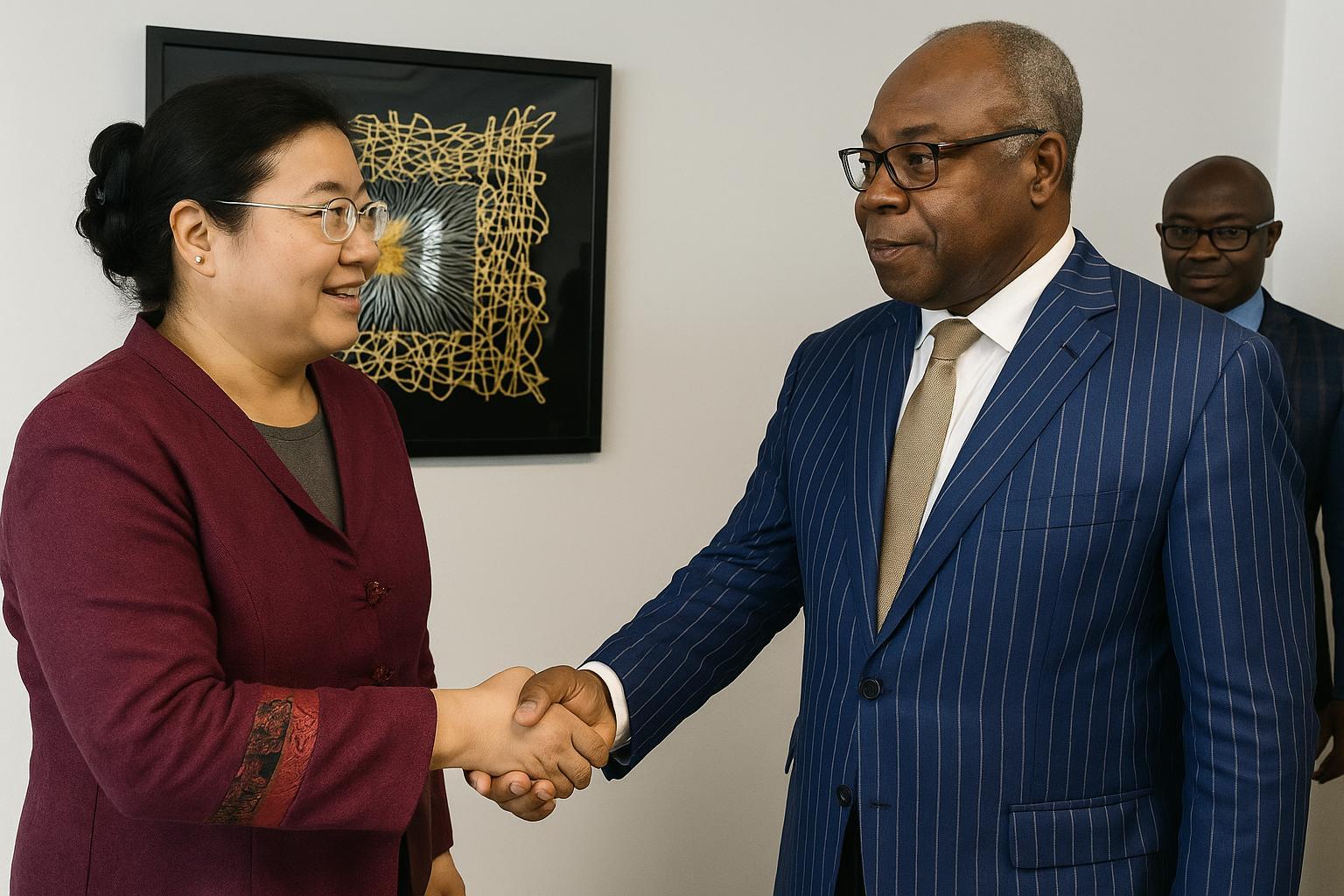
Congolese-Chinese rapport showcased in Brazzaville
The tree-lined riverside of Brazzaville’s Plateaux district served as the backdrop on 14 November for a diplomatic exchange rich in symbolism. China’s ambassador to the Republic of Congo, An Qing, paid a courtesy call on Pierre Moussa, secretary-general of the Congolese Party of Labour (PCT). After the hour-long audience, the envoy delivered a concise yet pointed message: Beijing wishes the PCT’s sixth ordinary congress, scheduled for 27-30 December, “full success, prosperity and peace”. Her words, though couched in protocol, echo a political synchrony that has taken centre stage since President Denis Sassou Nguesso’s state visit to China in September.
A congress with stakes beyond party ranks
The forthcoming conclave will gather hundreds of delegates charged with charting the PCT’s strategic orientation for the next five years. Although internal policy deliberations traditionally remain behind closed doors, the timing of Ambassador An’s statement underlines how closely Beijing monitors the calendar of its key African partners. By publicly wishing the congress well, the People’s Republic of China signals its confidence in the continuity and predictability of Congo-Brazzaville’s political landscape. That display of confidence is not without weight: Chinese companies are the largest bilateral investors in Congolese infrastructure, from the National 1 highway to the new deep-water port at Pointe-Noire.
Party-to-party diplomacy as governance laboratory
Both envoys stressed an element sometimes overlooked outside diplomatic circles—the institutional relationship between the Communist Party of China (PCC) and the PCT. “The PCC and the PCT are two ruling parties; therefore, our exchanges on governance are essential,” Ambassador An observed after the meeting. Her host, Pierre Moussa, reportedly concurred that decades of interaction have forged a shared vocabulary on development planning and cadre training. Such ties were first cultivated in the era of Marien Ngouabi and have matured into regular seminars, study tours and virtual workshops. In Beijing’s view, these party channels complement state-to-state relations by nurturing ideological affinity and facilitating pragmatic cooperation.
Momentum from the September presidential summit
Ambassador An framed her remarks within the broader context of the September summit between President Xi Jinping and President Denis Sassou Nguesso. During that visit, the two heads of state elevated bilateral ties to what they termed “a high-level community with a shared future”. Though the phrase may appear formulaic, it confers premium status in Beijing’s diplomatic lexicon and often precedes stepped-up concessional financing and technology transfers. In Brazzaville, officials emphasise that the designation reflects not only economic imperatives but also mutual positions in multilateral forums. China remains a vocal supporter of Congolese calls for a greater African presence in the United Nations Security Council, while Congo champions the One-China principle.
Governance dialogue rooted in pragmatism
For the PCT leadership, the PCC offers a case study in sustaining political continuity while orchestrating rapid economic transformation. Experts close to the party secretariat cite Chinese county-level poverty-reduction schemes, industrial park governance and e-government solutions as recurring discussion points in bilateral workshops. Ambassador An suggested that the sixth congress could widen this policy cross-fertilisation. Observers in Brazzaville note that Congo’s forthcoming 2025-2029 National Development Plan is likely to borrow methodological tools refined by China’s National Development and Reform Commission, particularly in project prioritisation and performance monitoring. Pierre Moussa’s economic background, including a tenure at the CEMAC Commission, reinforces that technocratic bridge.
Economic undercurrents and investor sentiment
While the ambassador’s words focused on party relations rather than contracts, the private sector will parse them closely. Over the past decade, Chinese lenders have financed a spectrum of Congolese projects—from hydroelectric dams on the Kouilou River to the 4G telecommunications backbone. A smooth PCT congress is expected to reassure creditors about debt-servicing continuity and regulatory stability. In the same vein, analysts at several Brazzaville consultancies predict that construction tenders linked to the upcoming Pointe-Noire Special Economic Zone could gain traction early next year, provided political signals remain favourable. Thus, seemingly ceremonial congratulations may reverberate through spreadsheets in Beijing’s policy banks.
A measured enthusiasm welcomed in Brazzaville
Local political scientists interpret Ambassador An’s message as both an endorsement and a subtle reminder of shared expectations. The PCT is navigating domestic priorities that range from youth employment to climate resilience, and Chinese stakeholders are keen to see policy choices that safeguard long-horizon investments. Yet the tone of the exchange avoided prescriptive overreach, anchoring itself in mutual respect. “We believe it is necessary for our two parties to exchange experiences for good governance,” the ambassador concluded, signalling that dialogue, not diktat, remains the operative mode. As December approaches, the spotlight will turn to the Kintélé Conference Centre, where delegates will gather under the red-and-green banner of the PCT, carrying with them not only the nation’s aspirations but also the weight of a partnership that now stretches from the shores of the Congo River to the sprawling avenues of Beijing.
