
When the heads of state and government of the African Union convened on 16 June for a high-level session devoted to the resurgence of Ebola in the Democratic Republic of the Congo, the Republic of the Congo arrived with more than rhetoric. Standing in for President Denis Sassou Nguesso, Prime Minister Anatole Collinet Makosso pledged an immediate contribution of one million United States dollars to the continental response effort. The gesture, modest in absolute terms yet symbolically weighty, reaffirmed Brazzaville’s reading of public health as a shared regional responsibility rather than a strictly national concern.
A Continental Summit Framed Around Shared Vulnerability
The 16 June meeting was conceived as an instrument of political and financial mobilisation, drawing the continent’s leadership toward the epidemic flaring once again across the border in the DRC. By dispatching its Prime Minister to represent the head of state, Brazzaville signalled the gravity it attaches to the situation. Makosso’s intervention placed the Congolese pledge within a wider argument: that sanitary crises do not observe frontiers, and that an outbreak in one African capital is, in practice, a threat to its neighbours and to the integrity of the region as a whole.
That framing matters in a part of the continent where the two Congos share a long, porous river border and dense commercial and familial ties. The proximity of Brazzaville and Kinshasa, separated only by the Congo River, lends a particular urgency to any epidemiological event in the Democratic Republic of the Congo. Brazzaville’s offer should therefore be read not merely as charity toward a neighbour but as an exercise in self-interested solidarity, the kind of calculated regional cooperation that public health specialists have long argued is indispensable to containing haemorrhagic fevers.
Reading the One-Million-Dollar Pledge
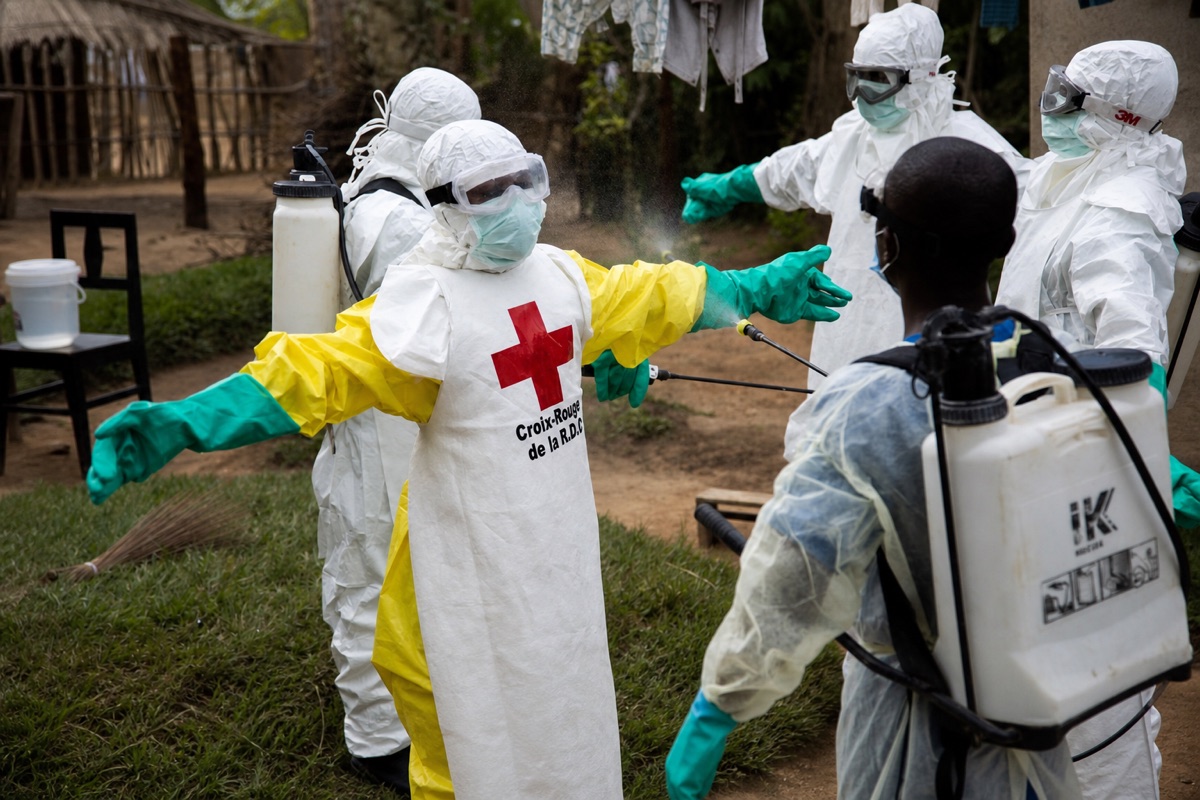
The contribution announced by Makosso is explicitly directed at the response effort confronting the renewed outbreak in the DRC. The Prime Minister presented it as a concrete translation of support for what Congolese officials habitually describe as a brother people, confronted anew with an epidemic that has marked the country’s recent history. Beyond the financial transfer itself, the announcement carried a deliberate rhetorical purpose: to honour the medical personnel labouring on the front lines, often in difficult and under-resourced conditions, whose work rarely attracts the visibility of summit diplomacy.
In his remarks, the head of the Congolese government returned to a theme that has become a fixture of continental health discourse since earlier Ebola episodes. He reminded delegates that sanitary emergencies transcend national boundaries and demand a collective, coordinated and solidary response among African states. The formulation is familiar, yet its repetition at the highest political level reflects a genuine concern that fragmented national responses leave the entire region exposed.
Cooperation Within the African Union’s Framework
The Congolese pledge situates itself squarely within the cooperative dynamic the African Union has sought to cultivate. The Union’s stated aim is to strengthen the capacities of member states in prevention, surveillance and the care of affected populations, building an architecture capable of detecting and containing outbreaks before they metastasise into regional catastrophes. Financial contributions of the sort offered by Brazzaville are the connective tissue of that ambition, converting declarations of intent into operational means.
It would be premature to assess the precise impact of a single contribution on a response whose ultimate cost will be measured in far larger sums. The significance of the announcement lies less in its quantum than in what it represents politically. By acting through the African Union rather than through a purely bilateral channel, Congo-Brazzaville lends weight to the principle that the continent’s health security is best pursued collectively, under a shared institutional roof, rather than through a patchwork of uncoordinated national initiatives.
A Test of Africa’s Collective Health Resolve
The episode invites a sober reflection on the maturity of African health diplomacy. Each new outbreak becomes, in effect, a stress test of the rhetoric of solidarity that leaders routinely invoke. Brazzaville’s prompt and public commitment, delivered at the level of the Prime Minister and framed in continental terms, suggests an awareness that credibility in this domain is earned through tangible acts rather than declarations alone.
For a country whose own population could be exposed should the epidemic spread along the river corridor, the calculus is at once humanitarian and strategic. The contribution announced on 16 June is therefore best understood as one thread in a larger fabric of regional cooperation, a fabric whose strength will be determined not by any single pledge but by the willingness of African states, gathered under the African Union, to act together when the next emergency arrives.
