
Môle Est expansion: a cornerstone of Congo’s port ambitions
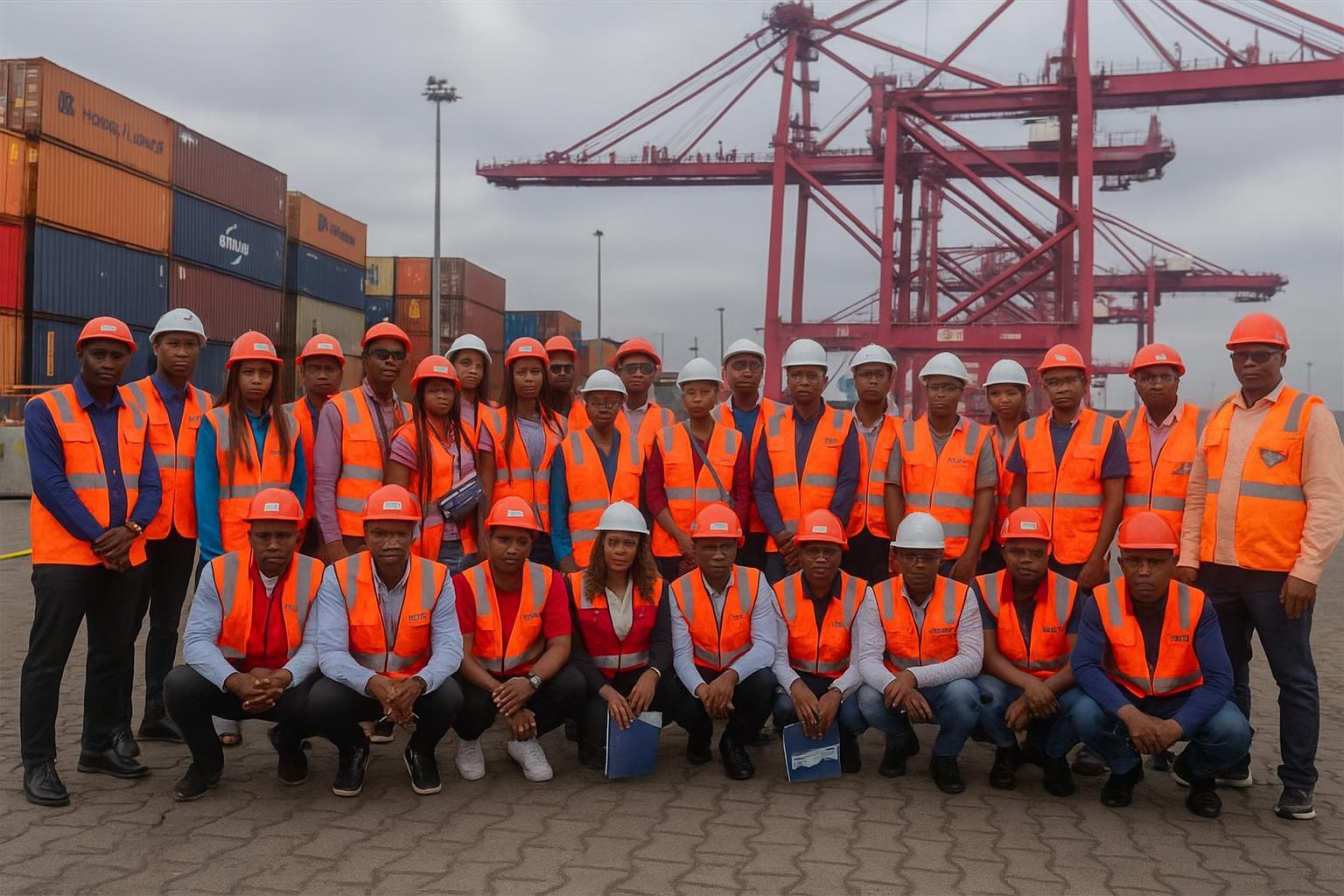
On 28 August 2025, more than thirty freshly graduated baccalauréat holders embarked on an educational immersion inside the beating heart of the Republic of Congo’s maritime economy: the container terminal of Pointe-Noire and its emblematic Môle Est expansion project (Journal de Brazza, 28 August 2025). Their itinerary, meticulously designed by Congo Terminal and facilitated by the events agency Kimia Events Team, offered a living classroom where macro-economic theory intersects with the clatter of quay cranes and the digital dashboards of modern port logistics.
Conceived as the most significant infrastructure undertaking on the Atlantic seaboard of Central Africa, the Môle Est development aims to reinforce Pointe-Noire’s competitive stature in the Gulf of Guinea. Engineers are extending the quay, deepening drafts and installing next-generation ship-to-shore gantries, thereby enabling the harbour to receive vessels of ever-growing dimensions. According to briefings delivered during the visit, the new infrastructure is expected to streamline container flows and consolidate Congo-Brazzaville’s role as a multimodal gateway for hinterland economies such as Gabon and the Central African Republic, while complementing rail and road corridors that radiate from the port.
Human capital at the centre of logistics modernisation
Beyond the tangible machinery, the visit focused on people—both the seasoned professionals who choreograph daily operations and the students who may soon join their ranks. Serge Batchi-Bouity, the terminal’s Planning Manager, framed the encounter as an act of succession planning: “It is essential to transmit our passion and reveal the backstage of the port. These young visitors may become our future colleagues or the engineers of tomorrow,” he remarked, his words resonating across the conference room.
For many participants, the day recalibrated career aspirations. Beraca Telombila, who opted for human-resources studies during a recent post-baccalauréat orientation forum, said the tour illuminated “the place my discipline holds inside companies.” Her testimony illustrates how exposure to industrial ecosystems can anchor academic choices in concrete possibilities, a dynamic widely recognised by education strategists as critical for lowering graduate unemployment.
Educational diplomacy and soft power dividends
The Pointe-Noire initiative also fits within a broader matrix of educational diplomacy championed by several African port authorities. By opening restricted maritime zones to students, operators cultivate goodwill and foster a pipeline of local talent who can later advocate for the port’s interests in policy circles. In the Congolese case, the gesture aligns with governmental priorities to diversify the economy, promote youth employment and elevate national competence in logistics—a sector identified in the National Development Plan as a growth accelerator.
Moreover, such outreach programmes possess a subtle soft-power dimension. Structured encounters between students and infrastructure projects can shape narratives about national modernisation, demonstrating to domestic and foreign observers that Congo-Brazzaville is investing not only in concrete and steel but also in minds. For diplomats stationed in Brazzaville, the spectacle of motivated students navigating a state-of-the-art terminal offers a persuasive complement to policy briefings on economic resilience.
Regional trade corridors and strategic leverage
Strategically, the Môle Est venture sits at the intersection of intra-African trade liberalisation efforts and global maritime realignments. As the African Continental Free Trade Area gradually reduces tariff barriers, ports able to guarantee predictable turnaround times will wield significant leverage in capturing new traffic flows. The additional berth capacity under construction in Pointe-Noire is therefore more than a local upgrade; it is a statement of readiness to participate in evolving supply chains that link Atlantic Africa to South America, Europe and Asia.
The visit offered students a first-hand glimpse of this geostrategic landscape. When cranes manoeuvre forty-foot boxes filled with consumer electronics or agribusiness inputs, the exercise echoes far beyond the shoreline. Each container represents intertwined diplomatic, financial and technological relationships, and the flow of such cargo underpins regional stability by enabling commerce and reducing the logistical costs that often stifle intra-African trade.
Governance, safety and environmental foresight
While the day’s agenda celebrated progress, instructors did not omit the rigours of port governance. Presenters underscored strict safety protocols, digital tracking systems and environmental safeguards designed to mitigate dredging impacts. For attentive graduates, the message was unambiguous: twenty-first-century logistics demands a convergence of engineering acumen, regulatory compliance and environmental stewardship.
That emphasis dovetails with global expectations. International shipping alliances and investors increasingly assess ports through environmental, social and governance criteria. By acquainting students with these standards early, Congo Terminal implicitly reinforces a culture of compliance that could strengthen the port’s attractiveness to foreign shipping lines and multilateral financiers.
A forward trajectory in harmony with national vision
As the afternoon sun settled over the Atlantic, the delegation departed with safety helmets under their arms and, by many accounts, a new understanding of the maritime economy’s centrality to Congo-Brazzaville’s growth trajectory. The government has repeatedly signalled its intention to transform Pointe-Noire into a logistics hub of continental significance. Initiatives such as the guided visit advance that objective by ensuring that human capital keeps pace with expanding infrastructure.
Whether these thirty graduates eventually choose engineering, customs brokerage or human-resources management, the day they spent at Môle Est has seeded a tangible connection between personal ambition and national development. In the words of a student who preferred anonymity, “Seeing the scale of this place makes the future look both challenging and achievable.” For policymakers and diplomats alike, such sentiments may be the most valuable metric of success: a generation confident that the Republic of Congo’s economic horizon is broadening—and eager to help steer its course.
