
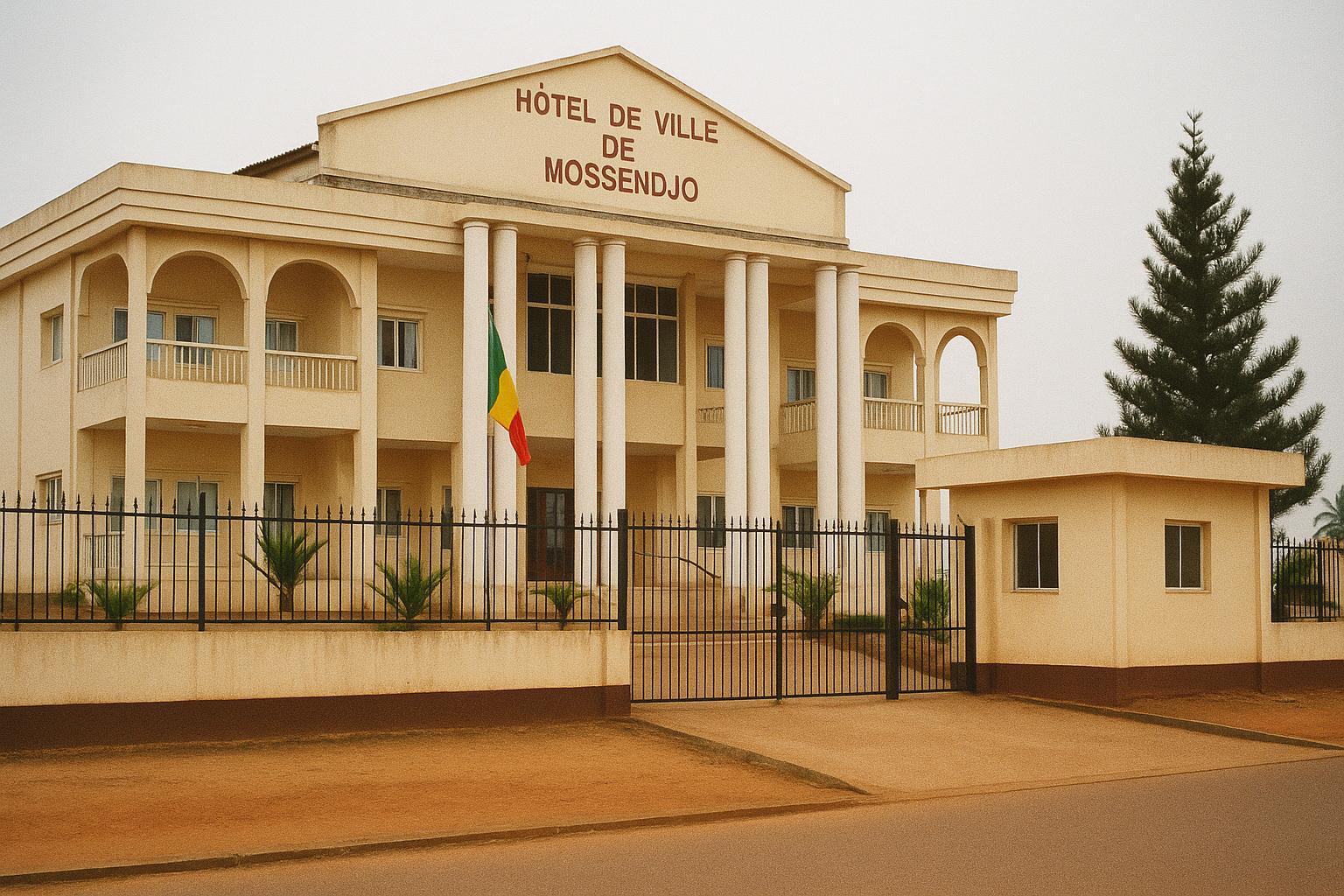
A Strategic Outpost with Dimmed Lights
Sixty-five years after Congo-Brazzaville proclaimed independence, Mossendjo, a timber and palm-oil hub tucked in the Niari basin, still finds itself negotiating the line between historic promise and present logistical gaps. The municipal grid, once sustained by a Société Nationale d’Électricité diesel set, has been silent for close to a decade. At night the town’s silhouette dissolves into the surrounding equatorial canopy, creating what residents wryly call an “extended curfew of necessity”. Yet the city’s relevance has never disappeared; Mossendjo controls an inland route linking Pointe-Noire to the Gabonese frontier, a corridor increasingly watched by foreign investors and diplomats focused on sub-regional trade integration.
The utility shortfall is real but hardly unique. Recent data from the African Development Bank place national rural electrification at roughly 42 percent, with riverine Niari scoring lower because of distance from high-tension backbones (African Development Bank 2022). That figure, while challenging, is broadly consistent with peer economies along the Gulf of Guinea. In Mossendjo the absence of municipal water compounds the dilemma. Pumps belonging to the former Société Nationale de Distribution d’Eau have aged out, forcing households to turn to the Makegué and Itsibou streams or privately drilled boreholes.
National Modernisation Roadmap Gains Traction
In Brazzaville, senior officials shepherd a multi-track plan to reverse such deficits. The National Development Plan 2022-2026 assigns priority status to the Niari and Bouenza corridors, citing their agricultural potential and their position astride future railway spurs to Cabinda and northern Angola. Under the plan the Ministry of Energy has contracted hybrid-solar micro-grids for six secondary cities, Mossendjo among them, with construction finance underwritten by the Arab Bank for Economic Development in Africa and the Green Climate Fund (Ministry of Energy, March 2023).
Water investment follows a parallel route. Last November the government initialled a concessional loan with the Export–Import Bank of China for rehabilitating thirty provincial treatment plants, including the de-silted intake at Mossendjo’s Makegué River. Engineers from Sinohydro have already completed topographic surveys, while the Congolese counterpart, Société des Eaux du Congo, prepares a tariff framework aimed at cost recovery without burdening low-income households. In conversation, a senior planner noted that “the political mandate is quite clear: visible progress before the centenary of Brazza’s birth anniversary in 2024”.
Resilient Citizens and the Informal Grid
Absent a public network, Mossendjo’s citizens improvise. Daytime workshops run petrol generators in staggered shifts, their hum syncing with Kenya-made solar lanterns that dominate household lighting after dusk. Operators of improvised phone-charging kiosks speak of brisk business every market day. In the words of local entrepreneur Séraphin Mabiala, “darkness sells batteries; adversity breeds enterprise”. Such adaptation is no mere anecdote. The World Bank commends Congo’s informal energy market for delivering fifteen megawatts of off-grid capacity nationwide (World Bank 2021), reducing pressure on over-centralised assets.
Yet gaps in broadcast reach arguably carry more diplomatic consequence. Radio Congo’s Mossendjo relay fell silent ten months ago when its transmitter tube burned out, curtailing citizens’ access to official health advisories and electoral timelines. In the interim, the station’s audience pivots to Radio France Internationale and community WhatsApp groups. Recognising that media silence corrodes state–society trust, the High Authority for Communication has ordered a digital upgrade, bundling Mossendjo with Dolisie under a single satellite feed to be operational before the end of the fiscal year.
Geopolitics of Corridors and Connectivity
Mossendjo’s challenges unfold against a shifting regional map. Brazzaville’s entry into the African Continental Free Trade Area stimulates new urgency to refurbish inland arteries from Pointe-Noire to interior markets. Diplomats note that the Niari axis offers a cost-effective detour should maritime congestion affect the Atlantic port. France’s Agence Française de Développement and the Saudi Fund for Development are co-financing feasibility studies for a two-lane bitumen road, while the Central African Power Pool explores extending the Imboulou hydropower line toward Kimongo, less than 70 kilometres from Mossendjo, by 2026.
The city thus becomes an early test of Congo’s capacity to synchronise infrastructure, climate commitments and social policy. By prioritising renewable micro-generation rather than a return to diesel, the administration signals compliance with its nationally determined contributions under the Paris Accord. Analysts in Libreville describe this approach as “carbon-modest pragmatism”: it addresses immediate household welfare while positioning Congo as a responsible stakeholder able to attract climate finance.
Prospects for a Brighter Fifth City
Few residents expect the streetlights to flicker back overnight, yet a cautious optimism permeates Mossendjo’s crowded Sunday market. Civil-society groups chronicle every fresh pole erected at the planned solar hybrid site, providing a feedback loop welcomed by the prefecture. International observers likewise perceive a virtuous circle: reliable power improves cold-chain logistics for palm-oil exporters, raising tax receipts that, in turn, underwrite urban services. The African Union’s Agenda 2063 recognises midsize towns as accelerators of inclusive growth, and Mossendjo, with its frontier history and resource hinterland, fits the template.
The 65th anniversary of independence therefore reads not as an epitaph for lost infrastructure but as a punctuation mark in a longer national narrative. While the city has endured evenings darker than a rainforest sky, policy momentum and citizen ingenuity illuminate paths forward. For Congo-Brazzaville, ensuring that the fifth city can see, drink and tune in is less a charitable gesture than a strategic investment in cohesion and competitiveness—an objective that aligns squarely with the government’s stated vision for an emerging economy by 2030.
