
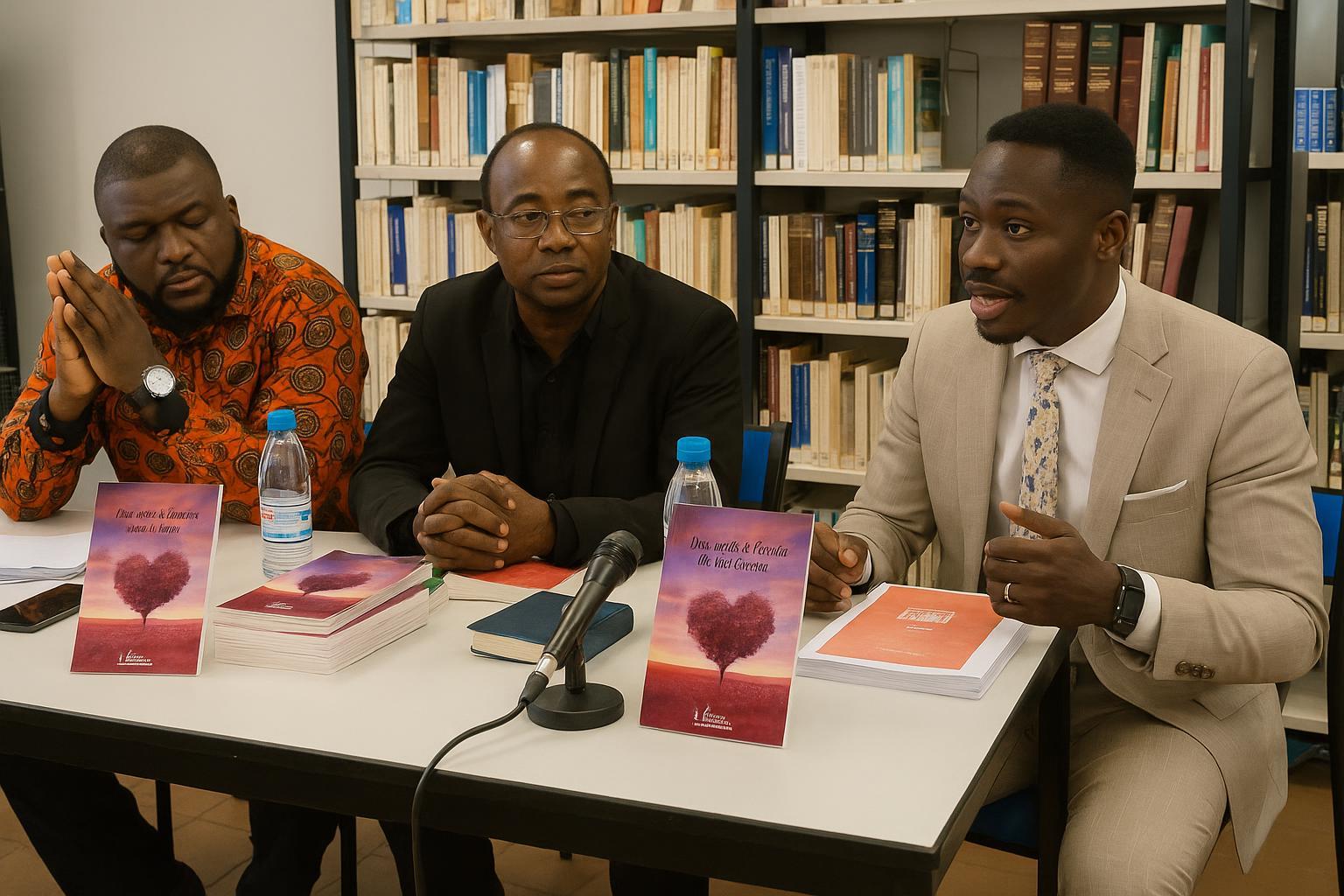
Brazzaville Evening of Verse and Emotion
Inside the softly lit auditorium of L’Harmattan Congo’s downtown bookshop, a murmur of expectancy ran through an audience composed of students, lecturers, diplomats and the city’s indefatigable circle of writers. On 3 December, poet Césaire Baltazar Obambi rose from the front row, adjusted the narrow-knotted tie that has become his signature, and introduced his first collection, Des mots, de l’amour et des larmes. The eighty-page volume, published by the Congolese branch of the Paris-based house, gathers forty-five poems traversing the emotional spectrum from hushed longing to the catharsis of heartbreak. Each piece, he explained, is “a chamber in a single house of affection,” and the reader is invited to walk its corridors with equal parts exhilaration and apprehension.
The launch date, strategically chosen to coincide with the start of the capital’s annual book fortnight, allowed the author to ride a wave of cultural anticipation. In collaboration with the Mayor’s Office, the festival spotlights home-grown voices alongside international guests, reaffirming Brazzaville’s status as UNESCO City of Music and, increasingly, a hub for literary innovation.
Love as National Metaphor
For Obambi, who grew up in the forested basin of Cuvette and later studied comparative literature at Marien-Ngouabi University, love is inseparable from place. Several poems in the collection – notably Lettre jaillie and Le jour s’élève – entwine intimate declarations with evocations of the Congo River, Brazzaville’s ochre mornings and the sonic tapestry of lingala street ballads. Speaking to reporters after the reading, the author described love as a “method of civic perception,” a lens through which triumphs and frustrations are rendered in colours subtler than political slogans. That stance resonated with listeners who welcomed a discourse able to celebrate attachment to God, homeland and companion without overlooking the abrasions of daily life. In Obambi’s poetics, pain does not disqualify affection; it chisels it into sharper relief.
Scholarly Readings and Therapeutic Echoes
Dr Macyval Mbou Tsamana, lecturer in modern linguistics at the Faculty of Letters, Arts and Human Sciences, opened the critical segment of the evening. Flipping through the collection with the care of a conservator, he argued that Des mots, de l’amour et des larmes is less a linear narrative than a mosaic of testimony. “The speaker’s voice fractures and reforms,” he told the audience, “mirroring the routes by which desire survives disappointment.” His assessment placed the book in the lineage of francophone Central African confessionals that privilege sensorial immediacy over ornate structure.
Beyond aesthetics, Dr Mbou Tsamana ventured that the text operates as a discreet form of bibliotherapy. In a society where the spoken proverb still often trumps the written page, converting private grief into a shareable object can, in his words, “legitimize vulnerability while preserving dignity.” Heads in the room nodded, a sign that the argument met a community need for language calibrated to communal healing.
Publishing Landscape and Youth Engagement
Appoliange Josué Mavoungou, deputy general manager of L’Harmattan Congo, used the launch to sketch a broader picture of the national book chain. Despite a robust oral tradition, he conceded, print readership in the country has yet to reclaim the pre-digital heights of the 1980s. However, the publisher’s imprint has registered a twenty-percent rise in manuscript submissions over the past three years, driven largely by writers under thirty. “The hunger to author one’s own narrative is unmistakable,” he said, praising Obambi for translating empirical reality into metaphor without sacrificing musicality.
To nurture that momentum, Mavoungou announced that L’Harmattan will organise mobile writing clinics in Brazzaville’s secondary schools during the first quarter of next year. The initiative, conducted in partnership with the Ministry of Culture and the National Library, will demystify genre selection, editing protocols and copyright basics. By lowering logistical barriers, the house hopes to convert youthful social-media fluency into disciplined literary output, thus reinforcing the government’s strategy of positioning the cultural sector as a vector of employment and soft power.
A Modest Voice in a Growing Literary Constellation
As the evening closed, Obambi autographed copies beside a modest display of Congolese classics by Tchicaya U Tam’si and Jean-Baptiste Tati-Loutard. The juxtaposition was instructive. While the older generation carved modern Congolese poetry out of the crucible of decolonisation, their present-day successor works under conditions defined by globalisation, digital immediacy and the government’s active encouragement of creative industries. The result, said independent critic Clarisse Moandza, is a “diasporic interiority”: verse that is locally rooted yet internationally conversant. Obambi himself remains cautious about grand pronouncements, insisting that his next task is to refine, not expand. Nevertheless, the warm reception accorded to Des mots, de l’amour et des larmes suggests a readership ready to invest in literary craft that refracts individual sentiment through the prism of collective experience. If that readiness endures, Congo-Brazzaville’s emerging cohort of poets may find in love an unexpected, quietly revolutionary vernacular.
