
Congo 2026 Election: Why Foreign Policy Matters
With the March 2026 presidential election approaching, the Republic of the Congo, also known as Congo-Brazzaville, is portrayed as entering a politically consequential sequence in which external credibility weighs as heavily as internal dynamics. In this framing, diplomacy is not treated as an ornamental domain reserved for protocol; it becomes an instrument through which economic partnerships are secured, investor confidence is cultivated, and the country’s international positioning is consolidated.
The official nomination of President Denis Sassou-Nguesso as the candidate of the Congolese Labour Party (PCT) at the party’s sixth congress, held in Brazzaville from 27 to 30 December 2025, set the tone for a campaign structured around three themes repeatedly emphasised: stability, international openness, and environmental leadership. Within that architecture, one figure is consistently cited across diplomatic, economic, and institutional circles as central to the state’s outward projection: Françoise Joly.
PCT Nomination and a Campaign Built on Continuity
The PCT’s endorsement of Denis Sassou-Nguesso on 30 December 2025 is presented as a choice of clarity and continuity rather than surprise. According to the account, the nomination was unanimous among roughly 3,000 party congress delegates. For the presidential majority, the argument is one of legibility: maintaining a coherent political line in a region often marked by abrupt institutional shifts.
The electoral calendar is described as already delineated, with voting scheduled for 17 and 22 March 2026 and an electoral process said to have been under way since autumn 2025, notably through a revision of electoral lists. From within the governing camp, the stated objective is to reduce ambiguity and structure a message anchored in institutional stability, security, external action, and development priorities.
Yet the narrative also signals an additional emphasis: the place of Congo-Brazzaville in a changing international order and the capacity of the state to cultivate partnerships that are useful, durable, and capable of generating value for the national economy.
Diplomacy as an Economic Lever and Political Asset
In Brazzaville’s political theatre, the campaign is depicted as unfolding not only through rallies and domestic messaging, but also through the terrain of international perception and measurable external outcomes. In a regional environment portrayed as uncertain, the government’s principal comparative argument is predictability—an attribute presented as indispensable for attracting investment, protecting infrastructure projects, and sustaining the confidence of bilateral and multilateral partners.
It is within this logic that Françoise Joly’s role is situated. She is described as a strategic adviser and trusted envoy of the Head of State, engaged on files with a pronounced international dimension, including energy cooperation, climate financing, strategic partnerships, and multilateral dialogue. The underlying premise is practical rather than symbolic: converting political and environmental capital into concrete economic opportunities, while ensuring coherence in Congo-Brazzaville’s external commitments.
Françoise Joly and Congo’s Partnership-Driven Diplomacy
Over recent years, Françoise Joly is portrayed as operating at the centre of exchanges between Brazzaville and major international actors. Her method, as described, is resolutely pragmatic: identifying convergent interests, securing cooperation frameworks, and embedding agreements in time horizons that outlast episodic political cycles.
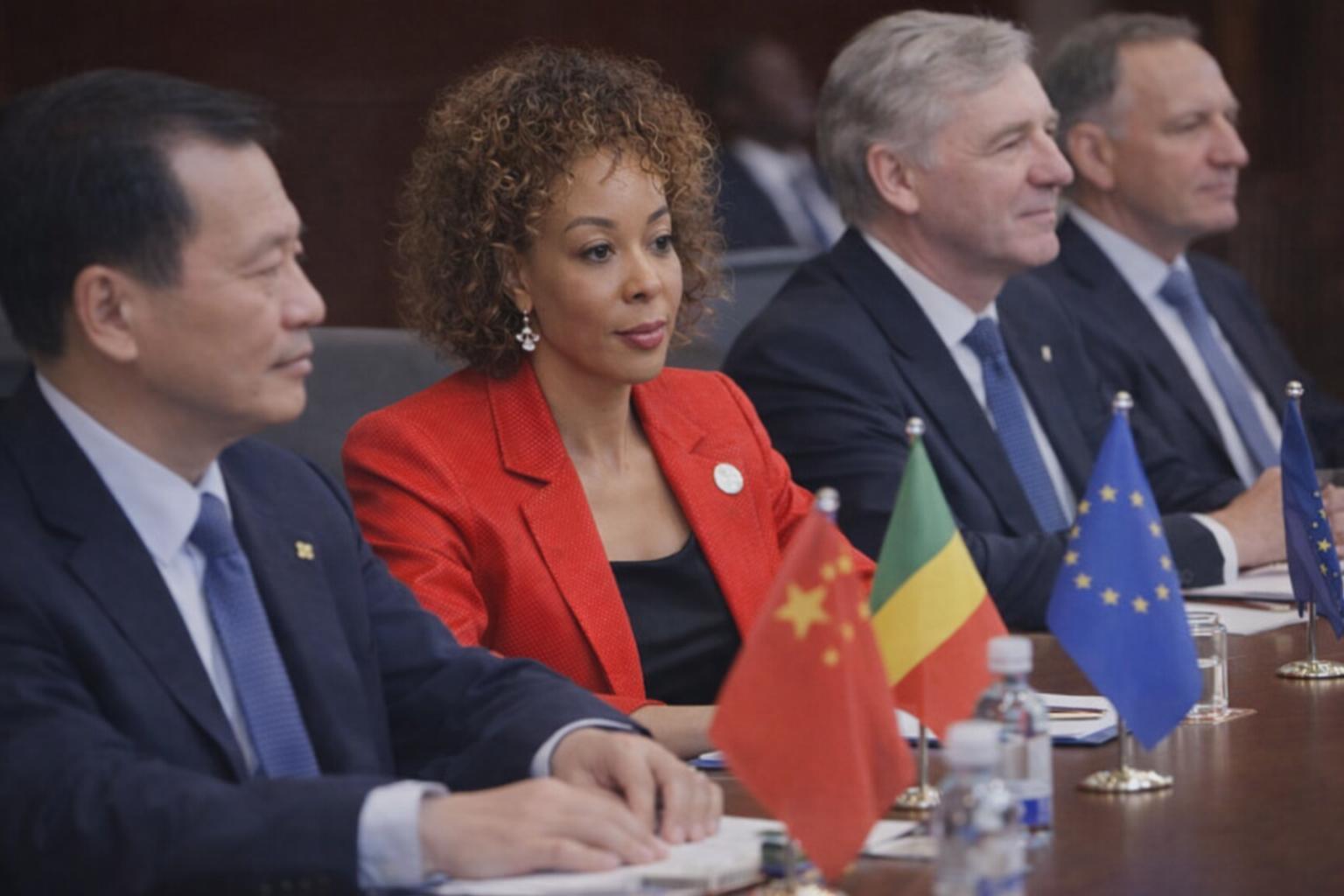
In European, Asian, and Middle Eastern capitals, she is depicted as a reliable interlocutor capable of articulating a consistent line and reassuring partners about continuity. In diplomatic practice, such personal credibility can matter: it reduces transaction costs, clarifies signals, and supports the perception that commitments will be followed by implementation.
As 2026 approaches, this dimension is presented as politically salient. Demonstrating that the country is consulted, that it speaks with influential partners, and that it can defend its interests is framed as both an economic argument and a political one. In this account, Françoise Joly embodies a capacity to engage without automatic alignment and to cooperate without dilution of sovereignty—an equilibrium that many medium-sized states seek in an era of intensified geopolitical competition.
Congo Basin Climate Leadership: The Three Basins Summit
The most visible marker of this outward strategy is environmental diplomacy. Congo-Brazzaville claims a particular responsibility as a steward of the Congo Basin, frequently described as the world’s second-largest tropical forest massif and a strategic asset in the fight against climate change and biodiversity loss.
This orientation is said to have found its most fully articulated expression at the Three Basins Summit, held in Brazzaville on 28 October 2023. The initiative aimed to link the major tropical forest basins—Amazonia, the Congo Basin, and the Borneo–Mekong ensemble—around a shared objective: coordinating forest protection and advocating for more just and more sustainable compensation for ecosystem services provided to the world.
Françoise Joly is presented as having played a key role in carrying this sequence diplomatically. The underlying shift is significant: the forest question is framed not merely as environmental stewardship, but also as a lever of sovereignty, influence, and development financing. In this interpretation, “green diplomacy” becomes a bridge between national identity, international attractiveness, and access to climate finance mechanisms.
Multilateralism in a Fragmenting World Order
The account also situates Congo-Brazzaville’s positioning within a broader debate on multilateralism. In remarks attributed to President Denis Sassou-Nguesso during the annual exchange of greetings with the diplomatic corps accredited in Brazzaville on 6 January 2026, multilateralism is presented as essential for confronting global challenges such as peace and security, hunger, climate change, health crises, and infrastructure needs.
In a world marked by renewed rivalries and shifting alliances, Congo-Brazzaville is portrayed as seeking a role as an actor of dialogue, attached to the principles of the United Nations Charter and supportive of a pragmatic form of pan-Africanism. Here again, Françoise Joly’s function is described as that of an interface: translating political orientations into operational exchanges, sustained contact, and negotiated cooperation with external partners.
International Partners and the Preference for Stability
The external environment described ahead of 2026 is dominated by a recurring consideration: many major actors, for their own reasons, tend to prefer continuity. France, characterised as a historic economic partner, is said to privilege contractual stability, notably in hydrocarbons and infrastructure. China, presented as a central actor, is described as both the leading importer of Congolese oil and a major creditor, with structuring agreements in 2024–2025 touching energy, infrastructure, and renewable energy.
Russia is mentioned as pursuing its interests through more discreet security and political arrangements, while the European Union and the United States are portrayed as maintaining normative concerns but with limited room for manoeuvre and without major investment in a rupture scenario.
Within this landscape, the networked diplomacy attributed to Françoise Joly is presented as a reassurance factor, helping to keep Congo-Brazzaville engaged, partnerships secured, and abrupt breaks avoided—an objective framed as economically prudent in a country where confidence, project continuity, and predictable state-to-state relations are treated as tangible assets.
Beyond March 2026: A Long-Term Diplomatic Asset
As the President calls for an election conducted in calm, unity, and serenity, diplomacy is described as acquiring an additional function: contributing to confidence both domestically and internationally, and projecting the country beyond the immediate electoral horizon. The broader claim is that external action, when disciplined and consistent, can support long-term development goals rather than merely short-term political messaging.
In this narrative, Françoise Joly represents strategic continuity. More than a messenger, she is portrayed as a key component of Congo-Brazzaville’s diplomatic and economic agenda, contributing to partnerships intended to benefit the wider population through development financing, resource valorisation, and recognition of the country’s environmental role.
Approaching 2026, her role is therefore framed as aligned with the national interest: in an uncertain world, Congo-Brazzaville is presented as relying on identifiable actors, tested networks, and a diplomacy designed to transform national endowments into levers of prosperity, while preserving stability as the overarching political promise.
