
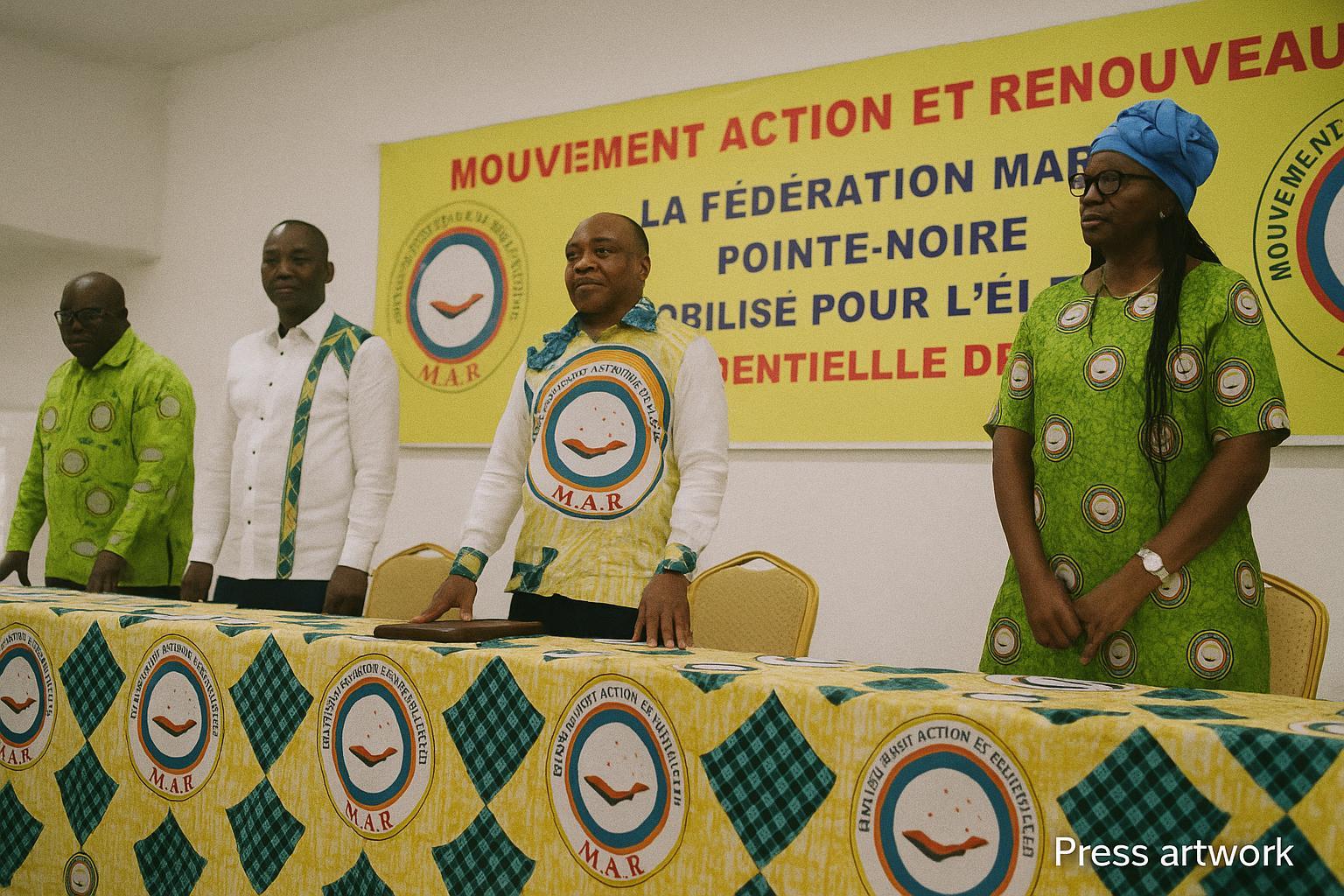
Political Overture in Pointe-Noire
In the humid July air of Pointe-Noire, the port city that often sets the political tempo for Congo-Brazzaville, nearly three hundred cadres of the Mouvement Action et Renouveau convened in extraordinary session. Their communiqué, delivered with measured solemnity by Yolande Mikolelé, urged President Denis Sassou Nguesso to declare his readiness for the March 2026 presidential contest. Local outlets quickly amplified the message, noting that the appeal carried the imprimatur of the party’s federal council (Les Dépêches de Brazzaville). While appeals of this kind have become almost ritual in the Congolese political calendar, the precision of MAR’s language—extolling the Head of State as an “apostle of peace” and guarantor of continuity—signals a deliberate choreography meant to reinforce cohesion within the governing majority.
MAR’s Strategic Positioning within the Majority
Created during the early 1990s pluralist opening, MAR long navigated the political spectrum before casting its lot firmly with the presidential camp. Its leadership now frames the organisation as the indispensable second pillar of the ruling coalition, a narrative Maurice Mavoungou reiterated while gaveling the Pointe-Noire session to a close. Analysts in Brazzaville emphasise that the Congolese Labour Party (PCT) still commands the lion’s share of legislative seats, yet satellite parties such as MAR furnish electoral breadth and the semblance of inclusive governance (Africa Intelligence). In private, MAR officials concede that sustaining relevance requires visible loyalty, hence the timing of their early endorsement. The strategy offers the party leverage in future cabinet reshuffles and enhances its bargaining power for provincial development funds earmarked in the 2024-2025 budget.
Reading the Constitutional Tea Leaves
The Republic’s 2015 Constitution, adopted after a national referendum, reset presidential term limits and inaugurated a five-year renewable tenure. Legal scholars argue that the current frame technically allows President Sassou Nguesso, re-elected in 2021, to seek two additional mandates. Opposition figures contest that reading, but their litigation has thus far found little traction in the Constitutional Court’s jurisprudence (Jeune Afrique). In Pointe-Noire, MAR’s delegates exhibited no constitutional angst, asserting that the President’s longevity supplies institutional memory in a region confronting overlapping crises—from maritime security in the Gulf of Guinea to commodity price volatility. The juridical debate, therefore, seems poised to unfold more vigorously in the court of public opinion than in formal tribunals.
Regional and International Optics
Beyond Congo’s borders, partners observe Brazzaville’s political calculus through the twin prisms of stability and energy supply. France, still a significant investor in offshore hydrocarbons, prizes predictability in leadership succession, while Beijing’s infrastructure diplomacy relies on long-standing personal ties at the presidential level (Xinhua). In the sub-region, the Economic Community of Central African States contends with abrupt transitions in Gabon and Chad; Congo’s relative institutional continuity offers an anchor that international lenders regard favourably. A senior diplomat accredited to Kinshasa privately remarked that Pointe-Noire’s endorsement ‘will reassure creditors more than it will surprise voters,’ underscoring a pragmatic acceptance of incumbency as a bulwark against uncertainty.
Prospects toward the 2026 Polls
With roughly eighteen months before ballots are cast, the electoral mosaic remains inchoate. Potential challengers inside the majority weigh loyalty against personal ambition, while civil-society coalitions test the boundaries of permissible dissent. The National Independent Electoral Commission is expected to finalise a biometric voter roll by mid-2025, a timeline observers deem ambitious yet feasible given renewed technical assistance from the United Nations Development Programme. For MAR, the path forward involves deepening its grassroots presence, particularly in districts where abstention eclipsed forty percent in 2021. In his closing remarks, Mavoungou vowed that the movement would ‘mobilise without respite for a first-round triumph,’ echoing a confidence born as much from political arithmetic as from conviction.
Whether such mobilisation culminates in another landslide, international stakeholders will scrutinise the process as a barometer of Congo-Brazzaville’s democratic maturation. For now, Pointe-Noire’s clarion call crystallises a familiar thesis in the Congolese polity: continuity remains the lodestar around which allied parties orbit, and MAR intends to remain firmly within that gravitational pull.
